News

  • When light makes quantum jumps: tracing coherence between macroscopic states

    Light trapped inside an optical cavity can switch abruptly between two very different states – one bright, the other almost dark. In a new theoretical study, Th. K. Mavrogordatos at the Department of Physics, Stockholm University, proposes a method for probing the quantum coherence behind these remarkable jumps.

    Department of Physics
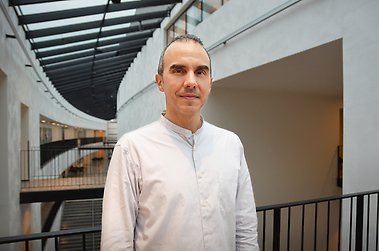
  • Foivos Perakis receives SEK 28 million in research funding

    The Knut and Alice Wallenberg Foundation has granted professor Foivos Perakis SEK 28 million for the project “HYDRA: HYdration-Driven Regulation of Condensate Assembly”. Over five years, the research will explore the role of water in the hidden organisation of the cell.

  • Nobel Prize for IceCube research with strong ties to Stockholm University

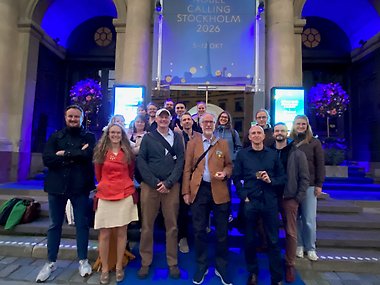
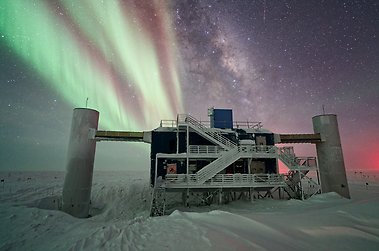
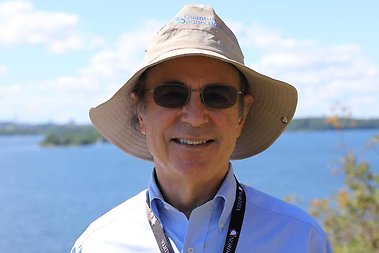
    This year’s Nobel Prize in Physics has been awarded to Francis Halzen for his decisive contributions to the IceCube Neutrino Observatory and the discovery of high-energy neutrinos from space. Stockholm University has been part of this research for several decades, from IceCube’s predecessor AMANDA to today’s observatory at the South Pole.

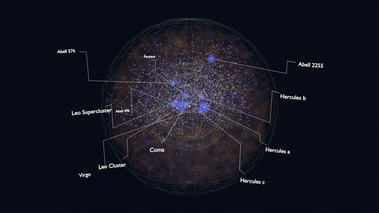
  • A cloud of white-blue dots shows supernovas in the universe, overlayed by a dark red layer showing cosmic dense regions of space. Large blue spheres indicate superclusters in the universe with higher than average supernova rates.

    Supernova hotspots could skew how we measure the expansion of the universe

    New findings from PhD student Antoine at Oskar Klein Centre, Fysikum/SU, puts calculations of the Hubble constant into question. Supernovas were assumed to either be evenly distributed, or scale with a structure's mass. But new simulations based on ZTF observations show them distributed in dense superclusters at rates far exceeding what mass alone can account for. This could affect how cosmologists calculate the Hubble constant in the future.

    Oskar Klein Centre
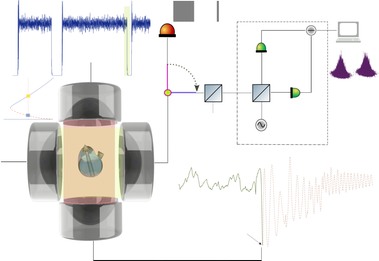
  • Exploring the Contextual Stern–Gerlach Experiment

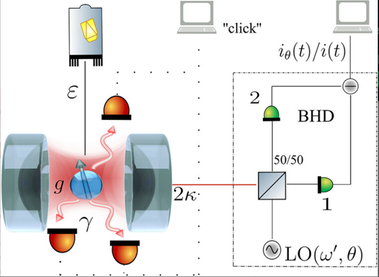
    We have developed a new quantum version of the famous Stern–Gerlach experiment, using an artificial atom inside a cavity or superconducting circuit. Instead of a particle’s spin, the system has two possible quantum states. A resonant electromagnetic field takes the role of the magnetic field in the original experiment, explains Themistoklis Mavrogordatos, guest researcher at Fysikum, Stockholm University.

    Department of Physics
  • Meet Lovisa Jansson, our new digital ambassador

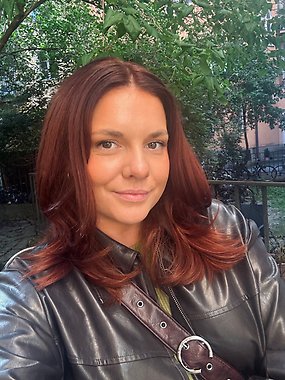
    Fysikum now has three digital ambassadors. Ignacio Verdugo is a doctoral student in the Medical Radiation Physics department. Medeea Husaru, is a bachelor's student in the Physics program and Lovisa Jansson is a doctoral student. Lovisa is 27 years old and comes from Degerfors in Värmland. She has studied in the bachelor's program in physics and the master's program in general physics. She is now a doctoral student in the Chemical Physics department at Fysikum. – The more I studied physics, the more it felt like the only right thing to do, says Lovisa.

    Department of Physics
  • Rotation could make superconductivity easier to achieve

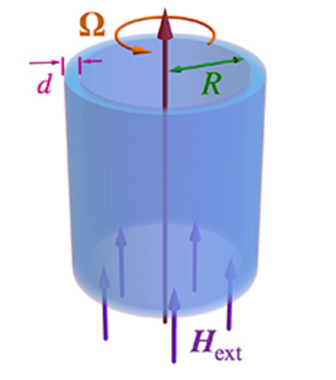
    Superconductors are materials that can carry electric current without electrical resistance. But this remarkable state usually exists only below a certain temperature, known as the critical temperature. In a new theoretical study, Maxim Chernodub, senior scientist in the University of Tours, France, and Nobel Laureate Frank Wilczek, professor at the Department of Physics, Stockholm University, propose that this temperature could be increased simply by rotating a thin superconducting cylinder.

    Department of Physics
  • Vacuum fluctuations can enhance superconductivity

    Researchers have experimentally demonstrated for the first time that vacuum fluctuations can enhance superconductivity. Nobel Prize laureate Frank Wilczek, professor at Stockholm University, helped develop the theoretical model behind the findings. This work opens up for new ways to influence quantum states.

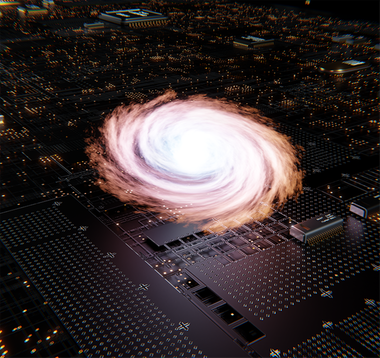
  • Galaxy against a motherboard backdrop. Made in Blender.

    How the EDUCATE centre is learning to work with agentic AI

    During the spring of 2026, researchers at the EDUCATE centre — the Oskar Klein Centre's new centre of excellence for the dark universe, run jointly by Stockholm University and KTH Royal Institute of Technology — began testing what a new generation of AI tools can and cannot do in everyday research. The work is part of the centre's agentic-AI initiative, and it drew in people from across the group: among them Renske Wierda, a PhD student in particle physics at KTH; Christian Ohm, an experimental particle physicist at KTH; Prerna Baranwal, a research engineer at KTH; and Arthur Loureiro, a researcher at the Oskar Klein Centre, Stockholm University amongst others.

    Oskar Klein Centre
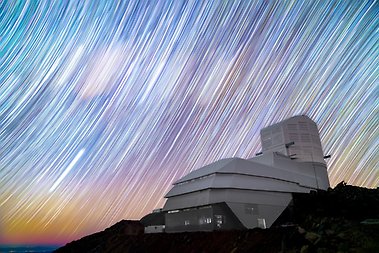
  • Image: Countless star trails appear as colorful brushstrokes spread across the night sky above NSF–DOE Vera C. Rubin Observatory.

    OKC revs up to do science as the Rubin Observatory begins its ten-year survey

    After more than two decades of construction and testing, the NSF–DOE Vera C. Rubin Observatory in Chile has formally begun the Legacy Survey of Space and Time (LSST), a ten-year record of the southern sky. At the Oskar Klein Centre (OKC) — which brings together researchers from the departments of physics and astronomy at Stockholm University and the department of physics at KTH Royal Institute of Technology — the milestone marks the point where a decade of preparation turns into data. We asked centre director Ariel Goobar, professor of physics, and several of his colleagues what they are now setting out to do.

    Oskar Klein Centre
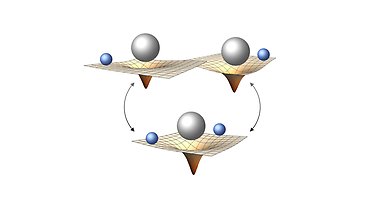
  • Illustration of two different interpretations of the same physical scenario, viewed from different perspectives.

    A new theoretical framework to identify what quantum gravity would look like

    Quantum mechanics and gravity are two fundamental theories in physics that govern the natural world. However, uniting these two principles into the single theory of “quantum gravity” has yet to be done. Researchers at Stockholm University, Kyushu University and the University of Waterloo have now developed a theoretical framework that outlines what observations can distinguish between classical and quantum descriptions of gravity. This framework provides a roadmap for designing experiments to find answers to one of the most sought-after theories in modern science.