
Supernova hotspots could skew how we measure the expansion of the universe
New findings from PhD student Antoine at Oskar Klein Centre, Fysikum/SU, puts calculations of the Hubble constant into question. Supernovas were assumed to either be evenly distributed, or scale with a structure's mass. But new simulations based on ZTF observations show them distributed in dense superclusters at rates far exceeding what mass alone can account for. This could affect how cosmologists calculate the Hubble constant in the future.
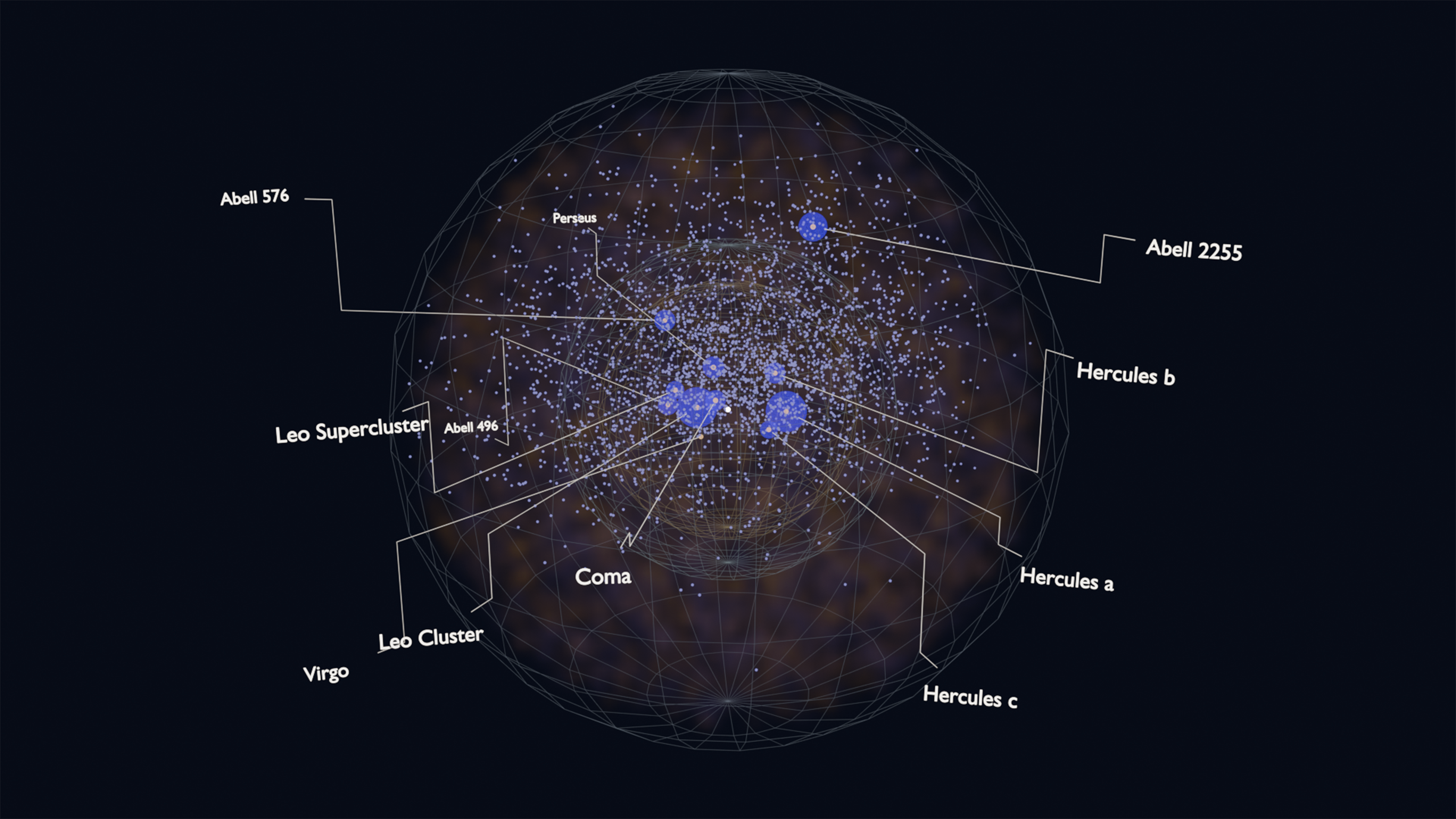
Image: White-blue dots: Type Ia Supernovae. The blue ball shows how many times more often supernovae explode here than in an average part of the universe — the bigger the ball, the more of them. Red areas: overdense regions as modelled by Manticore. Our viewpoint (earth) lies in the middle.
For decades Type Ia Supernovae (SNe Ia) observations in the universe have been used as one way to calculate the Hubble constant (the expansion rate of the universe) by creating a so-called “distance ladder”. What makes these explosions of stars such good tools is that they are one kind of “standard candles”. Their maximum luminosity is extremely consistent between events, allowing us to measure precise distances: if a SN Ia looks fainter than another, it has to be further away from us.
SNe Ia are tightly tied to the cosmic web, in a way that we currently don’t understand. Until now, cosmologists have expected the number of supernovas to be roughly constant at all locations in the universe, or increase with the mass of a cosmological structure.
“The problem is that the number of SNe Ia observed is increasing more than the matter content of some structures,” says lead author Antoine Gilles Lordet.
By analyzing the 3D dark matter density field reconstructed by the Manticore project across the local volume, Antoine calculated that matter overdensities in spherical shells typically reach 10 to 20 percent above the cosmic mean. His analysis of the Zwicky Transient Facility Data Release 2 (ZTF DR2) supernova sample and the Manticore large-scale structure reconstructions, further revealed that the amount of SNe Ia supernovas in those same areas can increase with 50 to 100 percent. Sometimes even 300 to 800 percent more within specific individual superclusters.
A non-linear relationship
Since the difference is so large from earlier expectations of supernova distribution, this shows that SNe Ia are not in a linear relationship with the underlying matter density. In other words, a small increase in mass may cause a disproportionately large increase in supernova production.
According to Antoine the number of stars present within a structure, turns out less important than the entire environment of galaxy clusters and superclusters, to how many type Ia supernovas we can observe.
“These kinds of environmental effects are currently not included within cosmological analysis so it is hard to quantify the impact it could have on them. However the simple possibility of an impact means it needs to be investigated,” he says.
Since this has never been attempted before Antoine had to build a new pipeline for his investigation.
“I had to build specific simulation pipelines as inhomogeneities (deviations from an even distribution) in the SNe Ia spatial distribution have been discovered only recently and never studied before, to my knowledge.”
“Cosmology usually assumes that, on large enough scales, the Universe looks the same everywhere and in every direction, so local details can be averaged away. But our own cosmic neighbourhood is significantly different from that average, and ignoring this can bias our results.”
Discovering and studying this effect was made possible thanks to the exceptional Zwicky Transient Facility (ZTF) telescope. With an imaging capacity the size of 100 full moons while observing every location in the northern sky at least once every three nights, it produced a larger dataset than the previous 30 years of observations in two and a half years.
This is key to studying how different environments shape the formation, evolution and death of stars. The beginning of a similar program in the southern hemisphere with the Legacy Survey of Space and Time (LSST) presents a perfect opportunity to confirm these findings and understand the reason why some clusters have more stars exploding than others.
Antoine's research has opened up new directions for future studies.
“There are two ways to continue this work: first study if other types of supernovae (core-collapse) also follow this trend, and secondly, to dig deeper into the root cause of the differences in SNe Ia rates,” Antoine concludes.
Infobox:
Read the full paper here: https://academic.oup.com/mnras/advance-article/doi/10.1093/mnras/stag1843/8845833?login=true
Infrastructure:
A computer with reasonable memory, the SUNRISE cluster and 2.5 years of sky observation by a telescope specifically designed for transient events observation.
Team and affiliations:
PhD student @ Stockholm University
Zwicky Transient Facility: https://www.ztf.caltech.edu/
Aquila Consortium: https://www.aquila-consortium.org/
Last updated: 2026-10-01
Source: OKC