


Researchers at the Department of Physics are contributing to the Nobel Prize-winning IceCube research
Francis Halzen’s Nobel Prize in Physics is a testament to Fysikum’s strategic initiatives and to the expertise and resources the department has contributed over several decades. Fysikum’s IceCube group will soon apply for funding from the Swedish Research Council’s Infrastructure Committee to continue its participation, operation, and development.
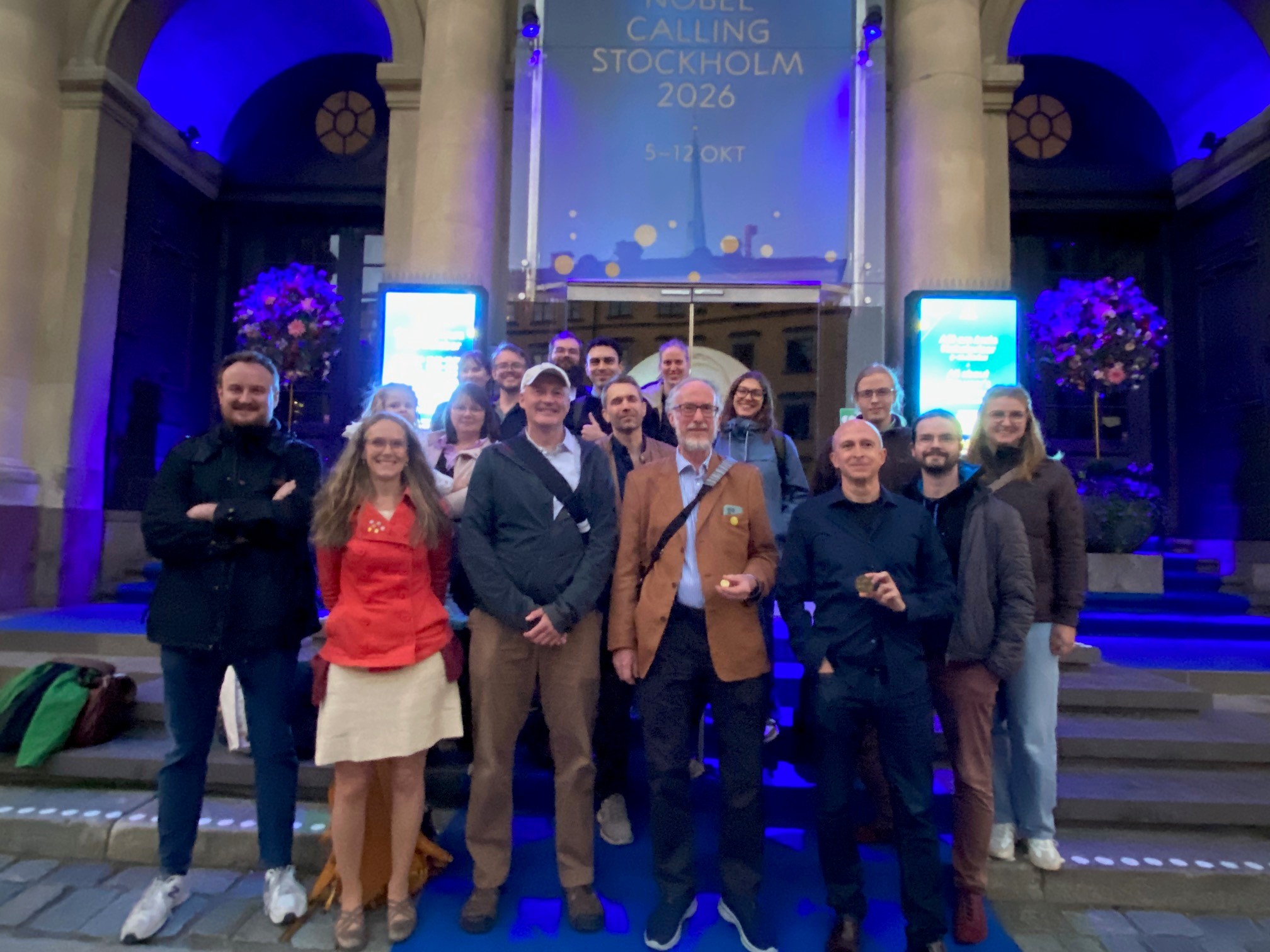
Particle physicists and drillers from IceCube outside the Nobel Prize Museum before they went out to celebrate the Nobel Prize. Photo: Per Larsson
“We are overjoyed! The prize is a recognition of the tremendous commitment and support that the Department of Physics has provided over several decades,” says Chad Finley, Professor of Astroparticle Physics at the Department of Physics and a member of the international IceCube collaboration, where approximately 450 researchers conduct research.
In 1988, Francis Halzen presented his vision of detecting neutrinos at the South Pole within the Antarctic glacier. The IceCube group at Fysikum has always played an important role in this collaboration, with Professor Per Olof Hulth (1943–2015) serving as IceCube’s spokesperson between 2001 and 2005.

The Department’s IceCube group is at the very forefront of research
“It is incredibly exciting and well-deserved that this year’s Nobel Prize in Physics has been awarded to Francis Halzen and the research at the IceCube Observatory. IceCube has opened a new and unique window onto the universe through a creative and groundbreaking research method. Fysikum has been involved from AMANDA to IceCube since the very beginning, and several staff members have held leading roles in the project. Per Olof Hulth was IceCube’s first spokesperson, and Chad Finley has led the work on identifying neutrino sources for many years. This year’s Nobel Prize highlights the importance of basic research and shows that Fysikum’s IceCube group is at the very forefront of research”, says Professor Sara Strandberg at Fysikum.
Sweden Camera Enhances IceCube’s Capabilities
Recently, the Department of Physics contributed the “Sweden Camera” under the leadership of Professor Chad Finley and Associate Professor Anna Obertacke, with support from Attila Hidvegi, Alex Kastanas, and others from the Department of Physics’ technical division. The Sweden Camera is a new tool that went into operation this year and improves IceCube’s ability to detect astrophysical neutrino sources.
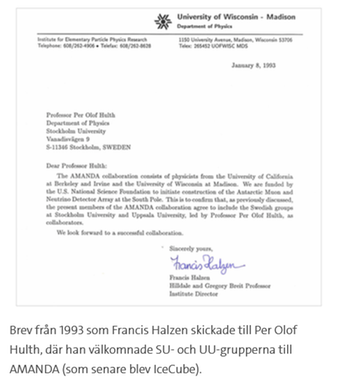
A letter from 1993 that Francis Halzen sent to Per Olof Hulth, in which he welcomed the SU and UU groups to AMANDA (which later became IceCube).
Chad Finley gave a lecture on IceCube at the Nobel Prize Museum
On October 6, the same day the Nobel Prize in Physics was announced, Chad Finley gave a lecture on IceCube at the Nobel Prize Museum. He was also interviewed by Sveriges Television about the Nobel Prize and IceCube’s significance for research. Finley has been working with IceCube since 2006 and has been based at Fysikum since 2009. He spent two months at the South Pole during the last season of construction of IceCube in 2010–2011. A few researchers and technicians also stay through the long Antarctic winter to keep the observatory running. During the pandemic, Martin Wolf, a former doctoral student at Fysikum, spent both summer and winter at the South Pole when travel restrictions and quarantine rules made staffing particularly challenging.
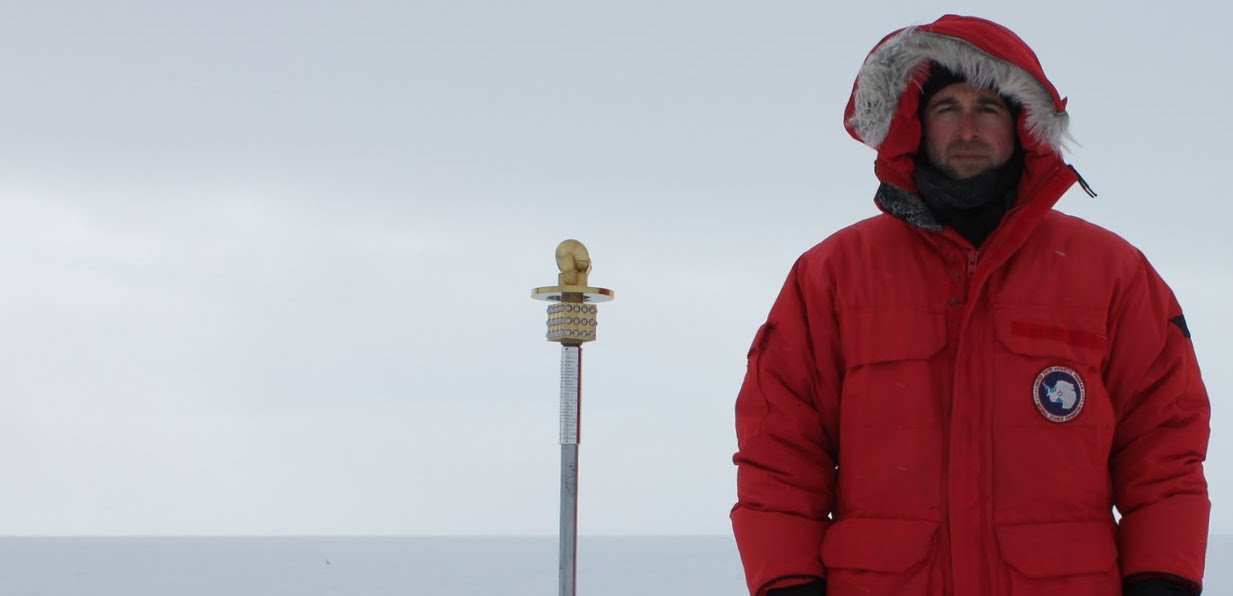
Professor Chad Finley at the South Pole.
Second generation of IceCube
The next goal is to build the second generation of IceCube, or “Gen2,” which will lead to the discovery of many more neutrino sources and more accurate measurements.
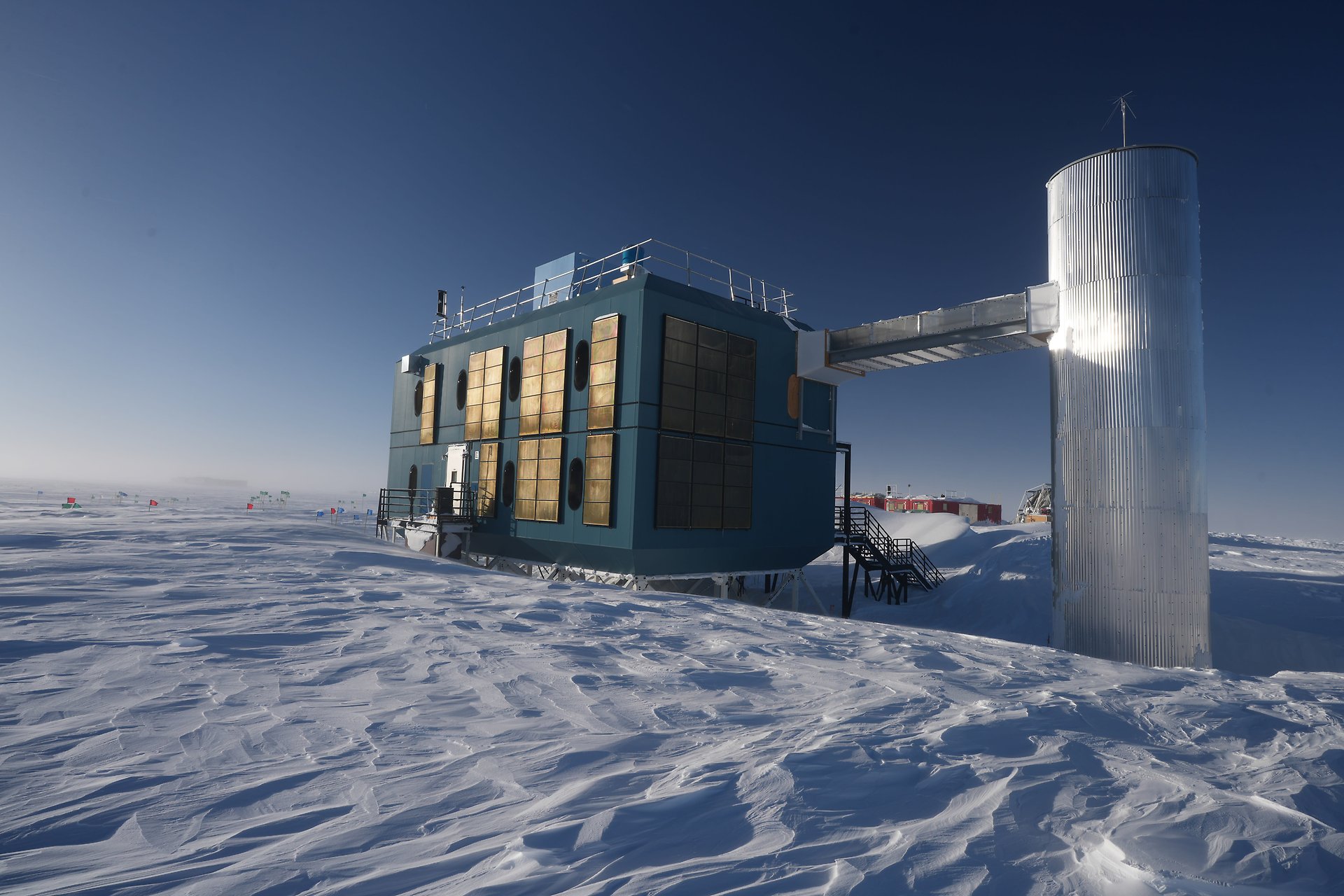
More information
News report on the 2026 Nobel Prize in Physics, featuring an interview with Chad Finley (in Swedish)
Courses and programmes (study physics at Fysikum, Stockholm University)
Neutrino Research Below Zero Degrees (Interview from 2022)
IceCube Neutrinos Provide New View of a Nearby Galaxy
Evidence for Neutrino Emission from the Nearby Active Galaxy NGC 1068Article in *Science*. The IceCube Collaboration: R. Abbasi et al. DOI:10.1126/science.abg3395
Last updated: 2026-10-20
Source: Department of Physics