
How the EDUCATE centre is learning to work with agentic AI
During the spring of 2026, researchers at the EDUCATE centre — the Oskar Klein Centre's new centre of excellence for the dark universe, run jointly by Stockholm University and KTH Royal Institute of Technology — began testing what a new generation of AI tools can and cannot do in everyday research. The work is part of the centre's agentic-AI initiative, and it drew in people from across the group: among them Renske Wierda, a PhD student in particle physics at KTH; Christian Ohm, an experimental particle physicist at KTH; Prerna Baranwal, a research engineer at KTH; and Arthur Loureiro, a researcher at the Oskar Klein Centre, Stockholm University amongst others.

Galaxy against a motherboard backdrop. Made in Blender.
A familiar chatbot answers a question and then stops. An agentic tool is closer to working with an assistant, taking several steps on their own: writing a piece of code, running it, reading the error, and trying again before it reports back. That extra autonomy is what makes these tools useful. It is also what makes people at EDUCATE want to look closely before leaning on them.
Room for the hard questions
Not every question about AI is a technical one. As the pressure to adopt these tools has grown, Renske Wierda found that she had reservations, and that she was not the only one. "Different people have different questions and different reservations," she says, "and so I felt the need for a space where all of these could be discussed." That became the AI discussion forum, which she volunteered to coordinate as the reflective counterpart to the initiative's more hands-on activities.
The forum has met several times over the spring, on themes including bias, trust and creativity. Wierda is candid that it is early days. "While we've had a good start, I also think that we're only just starting to scratch the surface," she says, adding that she sees these discussions as "crucial to the integrity of the scientific process." Next semester the group hopes to widen its activities to include seminars from invited speakers. The longer aim is to arrive, by consensus, at a set of guidelines on how scientists can reasonably work with generative AI.
That caution matters for reasons beyond the lab as well. These tools are not free in any sense: training and running large AI models consumes a considerable amount of energy and water, and being honest about that cost is part of using them responsibly.
Tools at the workbench
Elsewhere in the centre, the initiative has been more hands-on.
OKC researcher Christian Ohm, who directs the five-year Engineering Physics programme at KTH, had noticed that the programme's study counsellors were spending a large share of their time on general questions about rules, prerequisites and study plans, rather than on the students who needed individual help.
In May he built a chatbot to take the routine enquiries off their hands. It uses a method called retrieval-augmented generation, which in plain terms means it answers only from a fixed set of trusted documents — the programme's own rules and FAQs — rather than from whatever a model happens to absorb during training. It runs on a modest open model on local hardware, so no student's question is sent to an outside service, and it replies inside Mattermost, the chat tool the physics students already use.
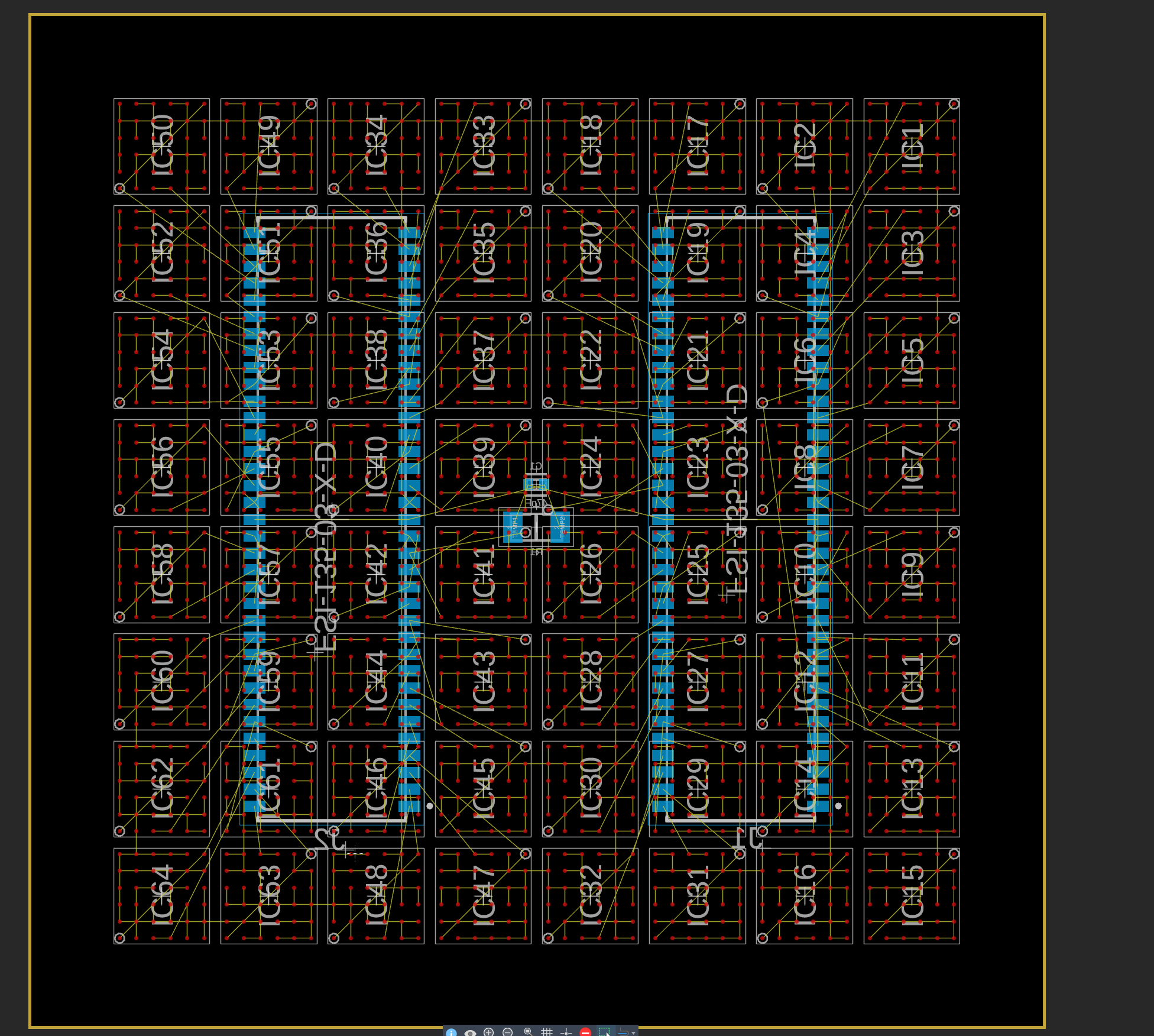
Prerna's SiPM board layout.
What makes it more than a convenience is that it was built to teach as much as to answer. Every reply links back to its sources, with the occasional reminder that a confident tone is not the same as being right and that the references are worth checking. Students can also open up the bot's workings and see which documents it drew on and whether it judged that it could answer the question at all, rather like being handed an assistant's rough notes alongside the tidy reply.
Christian admits this is as handy for debugging as it is for teaching. The tool is open-source and still being developed; a short set of slides describes how it works. The same idea has gone into a second tool for the centre's heavy meeting schedule: by giving an AI agent a way to reach into Indico, the web-based agenda system the collaborations use, a researcher can ask for something like "the slides from that meeting last spring where the new results were shown" and let the agent do the clicking.
- Chatbot: https://github.com/cohm/student-admin-bot
- Indico MCP: https://github.com/cohm/
Prerna Baranwal, a research engineer in the Particle Physics, Astrophysics & Medical Imaging division (PAM) at KTH, has been putting an AI assistant to work on detector electronics. Her task was to lay out a printed circuit board, or PCB, carrying 64 silicon photomultipliers — compact, highly sensitive light sensors known as SiPMs — and to wire them all together in the design software Fusion 360. Rather than draw every connection by hand, she wired up four of the sensors and asked the assistant, Claude, to follow the same pattern for the rest. It managed it: it read the layout of the first four and extended it to all 64, in both the schematic and the board design, with no corrections needed.
This is rather like showing someone how to wire the first few sockets on a wall and asking them to finish the rest to match. The limits showed up on a fiddlier request — flipping a pair of connectors so that a second board could sit on top of the first — where the results were not yet right. "A bit more fine tuning on the instruction set to Claude would be required," she notes. It is a fair snapshot of where these tools stand: quick and dependable on repetitive, patterned work, and still in need of a careful human hand for anything more complex.
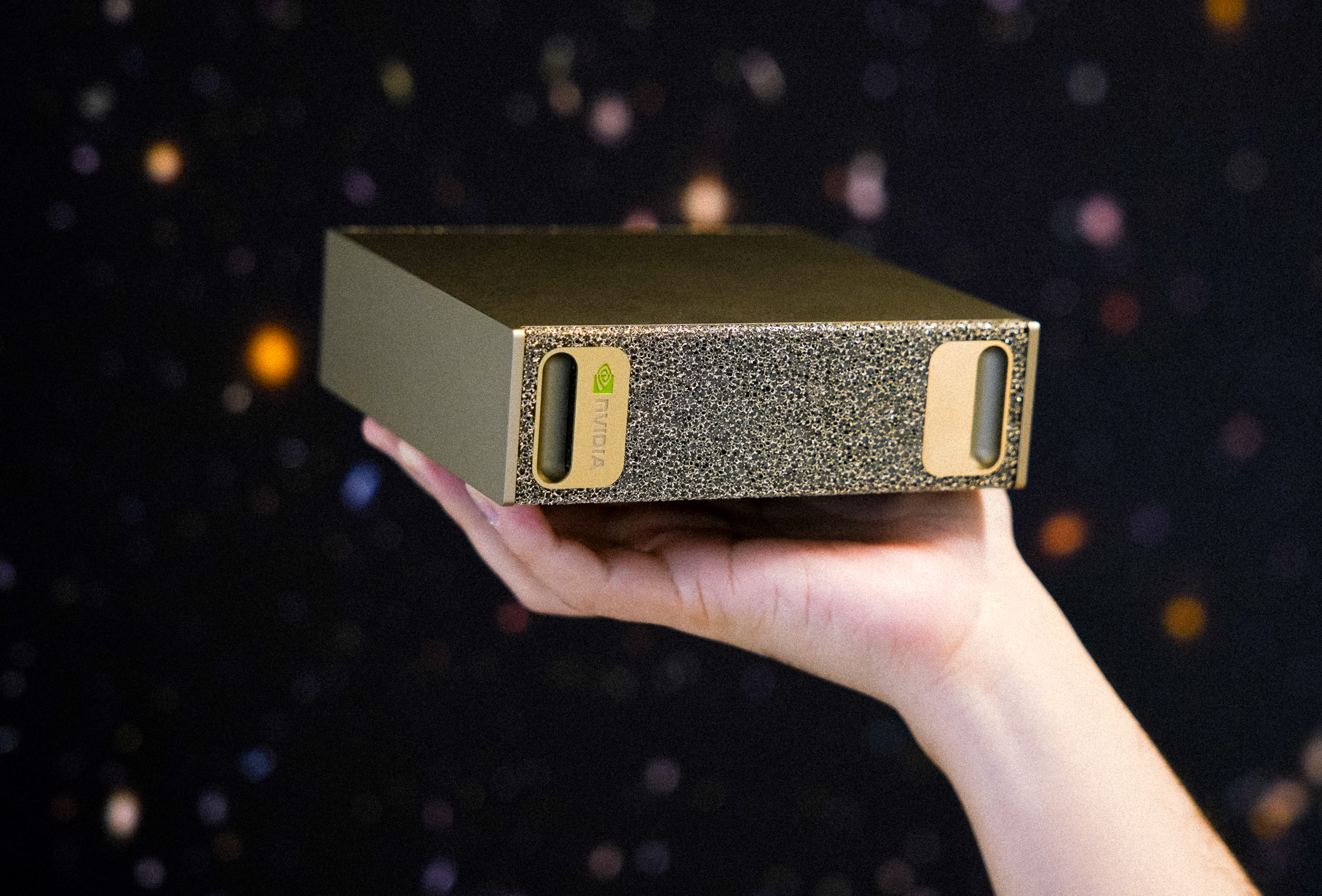
Image: The NVIDIA DGX Spark that started the project — a machine small enough to hold in one hand.
The most developed of these efforts has grown into a project of its own. Arthur Loureiro, a researcher at the Oskar Klein Centre, has been assembling a system of specialised AI agents, named cosmoTRON, to take on some of the repetitive work of cosmological data analysis, with the coming flood of data from the LSST and Euclid surveys in mind.
It began on an NVIDIA DGX Spark, a desktop machine small enough to hold in one hand that can run large language models on its own rather than through an outside service. Every script the agents write is saved, so that a person can check it, adjust it and run it again. "The aim is not to remove people from the work but to keep the results open to checking and correction," says Loureiro. The project grew out of the EDUCATE AI Agents working group, and we covered it in full in a separate article earlier this summer:
Building a team of AI agents for the next wave of cosmology data.
What the EDUCATE centre is
EDUCATE stands for the Excellence Dark Universe Centre And Technology Enabler. It is a centre of excellence funded by the Swedish Research Council (Vetenskapsrådet) with a grant of nearly 30 million kronor, and it is organised within the Oskar Klein Centre, the shared cosmology and particle-physics environment of Stockholm University and KTH. The centre is led by Professor Ariel Goobar, with co-applicants Jon Gudmundsson, Timothy Linden and Hiranya Peiris at Stockholm University and Christian Ohm at KTH.
Its subject is the dark side of the universe. As Ariel Goobar has put it, dark matter and dark energy make up some 95 per cent of the cosmos and yet their nature remains almost entirely unknown. EDUCATE's premise is that the next answers will come as much from method as from new instruments. The volume of data arriving from facilities such as the Vera Rubin Observatory, the Euclid space telescope and the ATLAS experiment at CERN is far too large to work through by hand, and machine learning has already become part of the standard toolkit. Alongside its research, the centre runs advanced courses in machine learning and astroparticle physics for master's and doctoral students, and is building connections with industry.
The agentic-AI initiative sits inside this. Its aim is a practical one: to work out, together, how tools such as large language models — software trained on large amounts of text to generate text and code — can help with real tasks, and where they should not be trusted. Access to the tools is supported through the initiative's EDUCATE AI grant.
About the EDUCATE centre
- Full name: Excellence Dark Universe Centre And Technology Enabler (EDUCATE)
- Host: organised within the Oskar Klein Centre (OKC), a collaboration between Stockholm University and KTH Royal Institute of Technology
- Funding: Swedish Research Council (Vetenskapsrådet), nearly 30 million kronor
- Lead: Professor Ariel Goobar; co-applicants Jon Gudmundsson, Timothy Linden and Hiranya Peiris (Stockholm University) and Christian Ohm (KTH)
- Focus: developing machine-learning and AI methods to study dark matter and dark energy, using data from facilities including the Vera Rubin Observatory (LSST), the Euclid space telescope and the ATLAS experiment at CERN
- Teaching: advanced courses in machine learning and astroparticle physics for master's and doctoral students
A note on the terms
- Large language model (LLM): software trained on large amounts of text to predict and generate text and code. It has no understanding of what it produces; it works by statistical prediction.
- Agentic AI: an AI tool given enough autonomy to carry out a multi-step task on its own — planning, acting, checking and revising — rather than answering a single prompt.
- SiPM (silicon photomultiplier): a small, very sensitive sensor that registers tiny amounts of light. SiPMs are used both in particle detectors and in medical imaging.
Last updated: 2026-07-07
Source: OKC