


Nobel Prize for IceCube research with strong ties to Stockholm University
This year’s Nobel Prize in Physics has been awarded to Francis Halzen for his decisive contributions to the IceCube Neutrino Observatory and the discovery of high-energy neutrinos from space. Stockholm University has been part of this research for several decades, from IceCube’s predecessor AMANDA to today’s observatory at the South Pole.
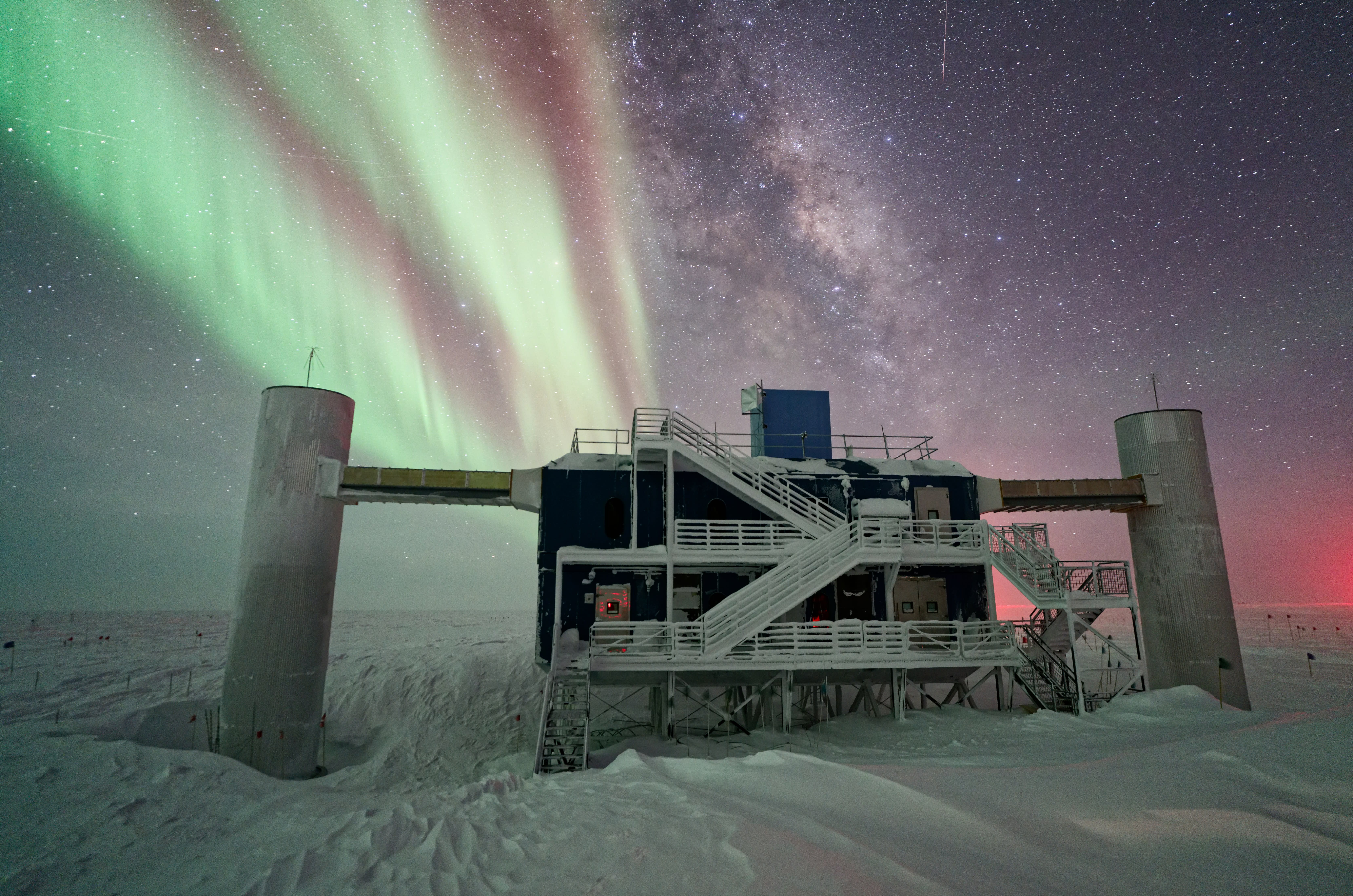
IceCube. Photo: Ilya Bod_IceCubeNSF
“We are beside ourselves with joy. We have always known that, in theory, it could be possible for IceCube to receive a Nobel Prize. But there is a world of difference between that possibility and it actually happening. There is so much great science out there,” says Chad Finley, Professor of Physics at Stockholm University.
Deep in the ice at the South Pole lies an unusual telescope. IceCube consists of thousands of light sensors embedded in the Antarctic ice and is used to detect traces of neutrinos, elusive particles that can provide researchers with new knowledge about some of the most extreme environments in the Universe.
The pristine Antarctic ice is particularly well suited to detecting the faint light emitted by secondary charged particles produced when neutrinos interact in the ice. The more than 450 researchers in the IceCube Collaboration use these light patterns to reconstruct the neutrinos’ energy and direction and determine where they came from.
The 2026 Nobel Prize in Physics has been awarded to Francis Halzen of the University of Wisconsin–Madison, USA, “for decisive contributions to the IceCube Neutrino Observatory and the discovery of high-energy neutrinos of astrophysical origin”.
“We always knew that if IceCube were to receive the Nobel Prize, it would be Francis Halzen receiving it. He is the singular visionary behind this, going all the way back to 1988, when he had the idea of using the ice at the South Pole to make such a detection possible. This is what made it possible,” says Chad Finley.
Involved from the beginning
For researchers at Stockholm University, the prize also has a special connection to the University’s own research history.
Stockholm University and Uppsala University were among the founding partners of AMANDA, IceCube’s predecessor. The experiment demonstrated that the deep ice at the South Pole could be used to study neutrinos. Swedish researchers went on to play a significant role in the construction of IceCube.
“Going from a small group working with this idea on a small scale, called AMANDA (Antarctic Muon And Neutrino Detector Array), to the huge IceCube collaboration that exists today has been a long journey. It took decades before we saw exciting results,” says Chad Finley.
Stockholm University remains actively involved in IceCube. Researchers at the Department of Physics contribute both to the development of the observatory and to research using IceCube data to study neutrinos from the Universe.
As part of the major IceCube Upgrade completed in 2026, researchers in Stockholm and Uppsala developed steerable cameras that have been installed deep in the ice. The cameras will help researchers better understand the properties of the ice and thereby improve the precision with which the direction of neutrinos can be reconstructed.
“We started receiving the first images from the cameras while the installation of the strings was still ongoing. It was an amazing feeling to see that they worked as intended, two kilometres down in the glacier and under very high pressure as the water in the borehole freezes again,” says Chad Finley.
Ice telescope in Antarctica explores the mysteries of the universe
Meet Chad Finley, a researcher at Stockholm University who has been involved in the international research project since its early days. He talks about the challenges along the way and what researchers hope to discover in the future.
Last updated: 2026-10-13
Source: Communications Office