


Rotation could make superconductivity easier to achieve
Superconductors are materials that can carry electric current without electrical resistance. But this remarkable state usually exists only below a certain temperature, known as the critical temperature. In a new theoretical study, Maxim Chernodub, senior scientist in the University of Tours, France, and Nobel Laureate Frank Wilczek, professor at the Department of Physics, Stockholm University, propose that this temperature could be increased simply by rotating a thin superconducting cylinder.
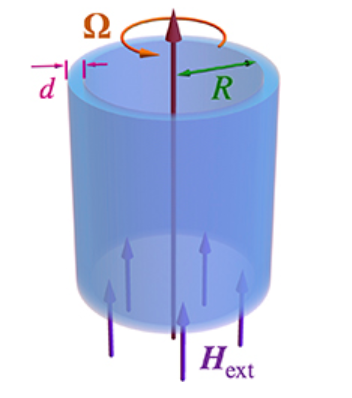
Figure 1. A thin superconducting film rotating in the presence of an external magnetic field.
The key lies in the unusual way electrons behave when a material becomes superconducting. In a conventional metal, electrons contribute to the mechanical rotation of the material. When superconductivity sets in, some electrons pair up to form so-called Cooper pairs and enter the superconducting state. These pairs can effectively decouple from the ordinary rotational motion.
Read more in the published paper "Enhanced condensation through rotation", IOP Science, below.
More information
Enhanced condensation through rotation - IOP Science
Last updated: 2026-09-02
Source: Department of Physics