
OKC revs up to do science as the Rubin Observatory begins its ten-year survey
After more than two decades of construction and testing, the NSF–DOE Vera C. Rubin Observatory in Chile has formally begun the Legacy Survey of Space and Time (LSST), a ten-year record of the southern sky. At the Oskar Klein Centre (OKC) — which brings together researchers from the departments of physics and astronomy at Stockholm University and the department of physics at KTH Royal Institute of Technology — the milestone marks the point where a decade of preparation turns into data. We asked centre director Ariel Goobar, professor of physics, and several of his colleagues what they are now setting out to do.
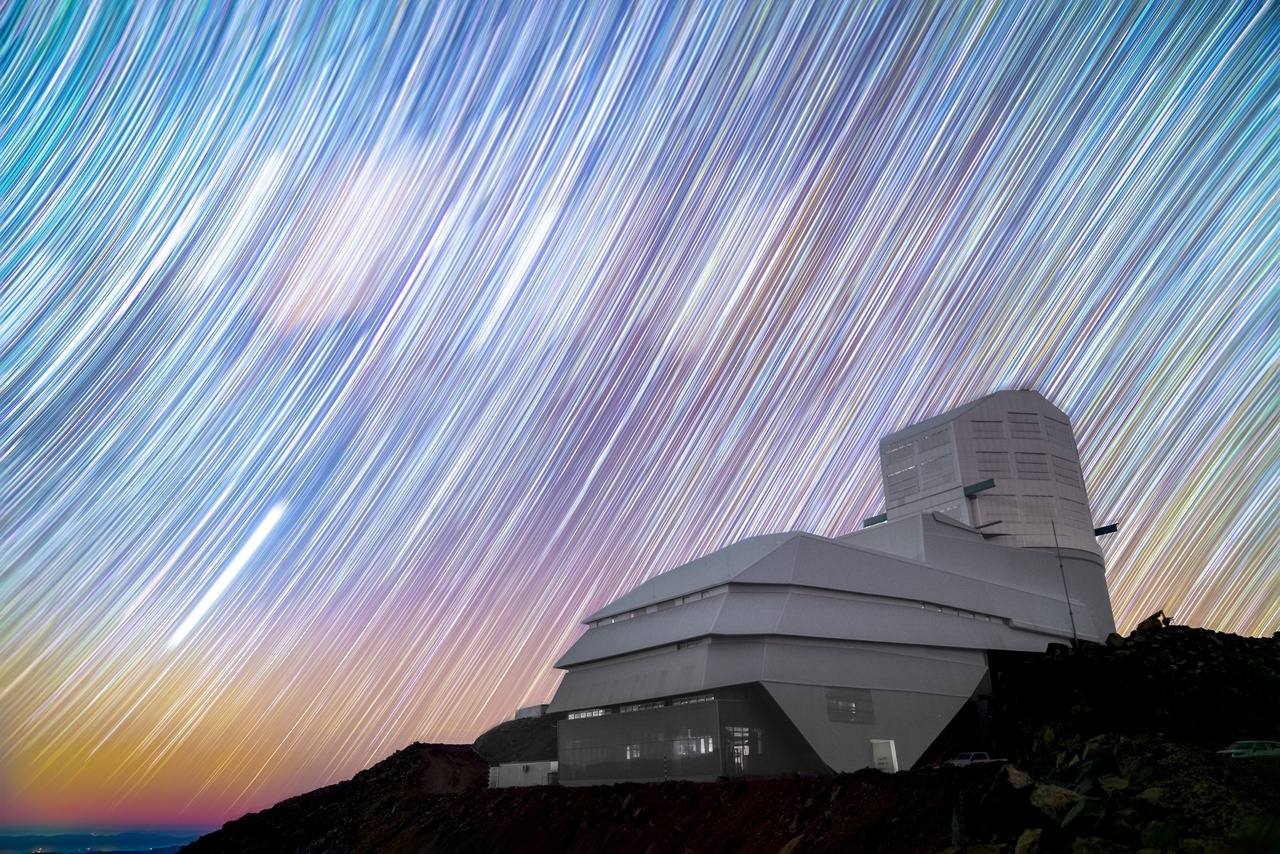
Image: Countless star trails appear as colorful brushstrokes spread across the night sky above NSF–DOE Vera C. Rubin Observatory.
The survey, in brief
From Cerro Pachón in northern Chile, Rubin has started what its team describes as the largest astronomical film ever attempted. Rather than taking a single portrait of the sky, the observatory scans the entire southern sky every few nights and will keep doing so for ten years, returning to each patch around 800 times. Stack those visits together and the result is a time-lapse of the changing Universe rather than a still photograph.
The scale is unusual. Rubin's camera holds 3,200 megapixels, the largest digital camera yet built, and records a fresh image roughly every 40 seconds. Each night it gathers on the order of ten terabytes of data and issues up to seven million automated alerts whenever something in the sky moves, brightens, or fades. Those alerts are sorted by software "brokers" so that researchers can react quickly. Over the full survey the dataset is expected to hold billions of objects and trillions of measurements, released openly for anyone to use. Even during early testing, before the survey formally started, Rubin picked out more than 11,000 previously unknown asteroids in about six weeks.
The observatory is named after Vera Rubin, whose observations provided some of the first firm evidence that most of the matter in galaxies is unseen.
A new era at the Oskar Klein Centre
A year ago, as the first images arrived, the OKC marked the moment as the start of a new phase of work. An application carried jointly by the physics and astronomy departments at Stockholm University, and new recruitment to strengthen the group. That earlier piece set out the groundwork: Its LSST work was seeded with funding previously granted by the Knut and Alice Wallenberg Foundation totaling SEK 30 million, and is in part carried out within the LSST Dark Energy Science Collaboration. The survey is now delivering, and the preparation is being put to use.
LSST telescope launched – New era of research at the Oskar Klein Centre
For Ariel Goobar, the immediate prize is strongly lensed supernovae — exploding stars whose light passes massive foreground galaxies on its way to us. The galaxy's gravity bends and magnifies that light, much as a glass lens would, and can split a single explosion into several images that arrive at slightly different times. Those delays can be used to measure how fast the Universe is expanding. Goobar has spent years forecasting how many such events LSST should find, and the work points to an order of magnitude more than have ever been seen (see links below).
"Before LSST, we found four of these over seven years," Goobar says. "Now we expect to find closer to one a week - of varying quality - and we can select the best ones to make precise measurements" He expects the sample to bear directly on the so-called Hubble tension, the awkward fact that two well-established ways of measuring the expansion rate give answers that do not agree — a little like two carefully made rulers disagreeing on the length of the same table. "With the precision these telescopes give us, our understanding of stellar explosions is going to have a renaissance."
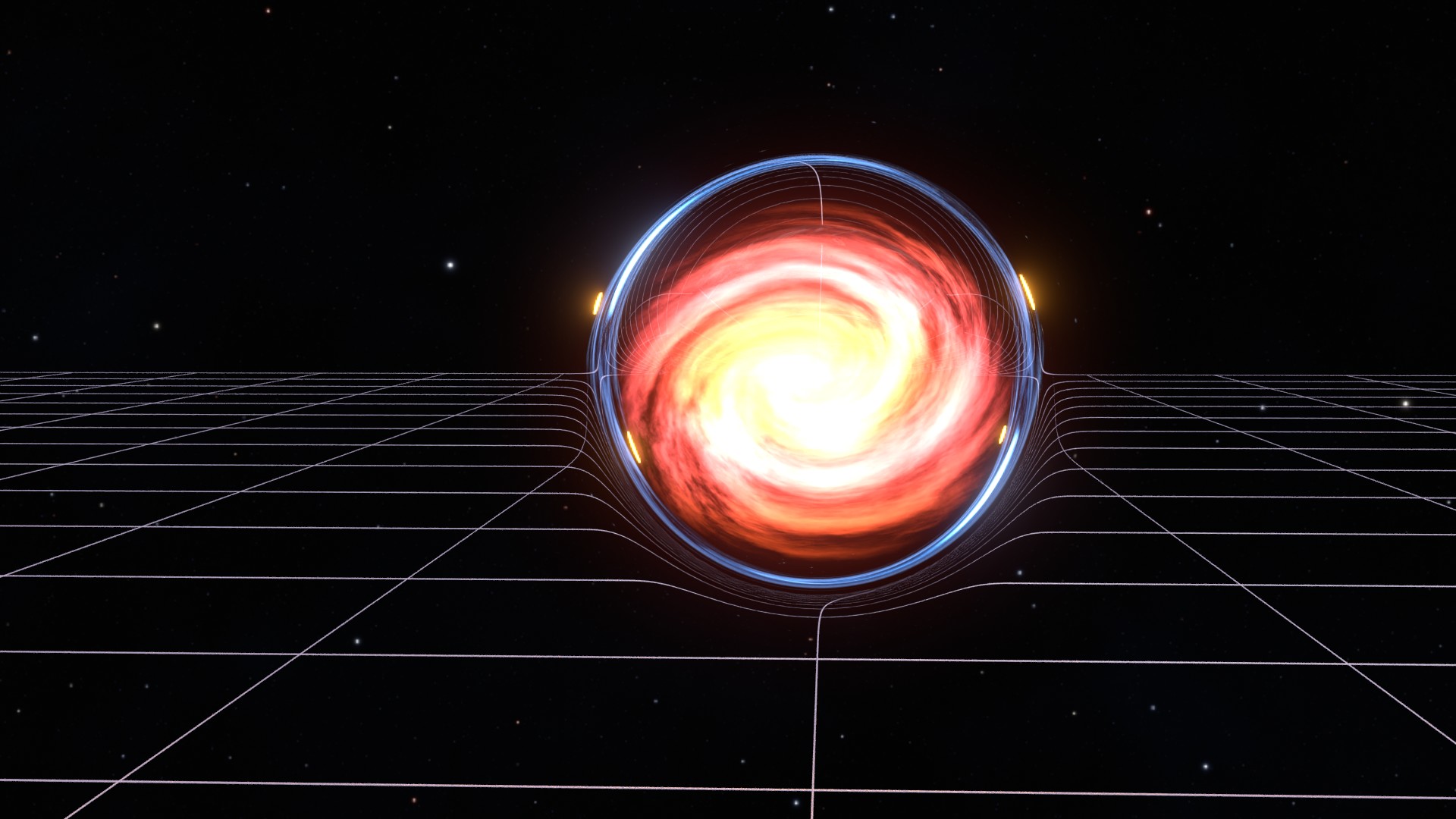
An artist’s interpretation of light from a supernova passing through a gravitational lens, reaching Earth at different times.
His colleague Jens Jasche, associate professor of observational cosmology at the Department of Physics and the OKC, will work on transients alongside Goobar and, separately, on reconstructing the motions of galaxies in the nearby Universe. The aim there is to test whether cosmic structures are growing at the rate Einstein's gravity predicts. His group has also built a digital twin of the Local Group — a detailed model of the Milky Way and its neighbours — to ask why the small satellite galaxies around us appear to line up in flat planes rather than scattering at random. LSST should reveal more of these faint companions, and with them a sharper picture of our own corner of the Universe.
Jasche is quick to point out that the survey reaches well beyond his own desk.
Azadeh Fattahi, associate professor at the Department of Physics and a Wallenberg Academy Fellow, studies faint dwarf galaxies — the smallest, dimmest galaxies, which are dominated by dark matter and, in the standard picture, are the building blocks from which larger galaxies assemble from the bottom up. They are sensitive probes of what dark matter actually is, and LSST is well suited to finding these low-surface-brightness objects that are otherwise easy to miss. The survey is expected to find hundreds, if not thousands, of dwarf galaxies in the nearby universe, resulting in strong tests of the standard cold dark matter model.
Matthew Hayes, professor of astrophysics at the Department of Astronomy, works on how galaxies form and grow and will also be involved in the upcoming research.
Arthur Loureiro, a Researcher at the Oskar Klein Centre, worked as a pipeline scientist within the LSST Dark Energy Science Collaboration for two years. His research explores how LSST's enormous galaxy surveys can help pin down the mass of neutrinos — some of the lightest and most elusive particles in the universe — by combining the survey's data with measurements of the cosmic microwave background, the faint afterglow of the Big Bang.
He has also developed Smokescreen, an open-source tool that helps keep LSST's cosmological analyses free from unconscious bias, by hiding key cosmological results from researchers until the analysis is complete and ready to be revealed.
"LSST is going to be a discovery machine," Jasche says. "Whenever we point a big telescope at the sky, we find things we were not looking for. It is an extremely rich dataset, and a creative collaboration — thousands of people internationally, working on different parts of the science. This will fill books of knowledge." He adds that handling data on this scale will lean heavily on new methods, including machine learning built for the purpose.
The work starts now
The past year at the OKC was spent getting ready; the coming years will be spent on the data itself. Rubin is one instrument shared by thousands of researchers, and the centre's contribution is a set of specific threads within that larger effort — supernovae and the expansion rate, the motions and shapes of galaxies, the faint dwarfs that trace dark matter, and the formation of galaxies over cosmic time. None of it arrives finished. The survey supplies the raw material; the interpretation is the job ahead.
Professor Jesper Sollerman at the Department for Astronomy at Stockholm University and member of the Oskar Klein Centre have high hopes for the new survey.
“Looking forward to finally get a tsunami of new supernovae from this machine!”
We will return to this in six months to look at what the first real data has made possible.
Contact:
- Ariel goobar: ariel.goobar@fysik.su.se
- Jesper Sollerman: jesper@astro.su.se
In brief: Rubin, LSST, and the OKC
- The observatory. The NSF–DOE Vera C. Rubin Observatory sits on Cerro Pachón in Chile and is operated jointly by NSF NOIRLab and the U.S. Department of Energy's SLAC National Accelerator Laboratory. It is named after astronomer Vera Rubin.
- The survey. The Legacy Survey of Space and Time (LSST) runs for ten years, imaging the whole southern sky every few nights and revisiting each point around 800 times.
The camera. At 3,200 megapixels it is the largest digital camera ever built, taking a new image roughly every 40 seconds. - The data. Around ten terabytes per night and up to seven million change alerts nightly, building towards a final catalogue of billions of objects and trillions of measurements, released openly.
- Gravitational lensing. When light from a distant object passes a massive foreground galaxy, the galaxy's gravity bends and magnifies it. For a supernova, this can produce several images separated by measurable time delays — a route to the cosmic expansion rate.
- The OKC's role. The Oskar Klein Centre spans the departments of physics and astronomy at Stockholm University and the department of physics at KTH. Its LSST work was seeded by a SEK 30 million grant from the Knut and Alice Wallenberg Foundation and is carried out within the LSST Dark Energy Science Collaboration.
Links
Last updated: 2026-07-03
Source: OKC