News

  • From Stockholm to Stanford: OKC researcher awarded Wallenberg fellowship

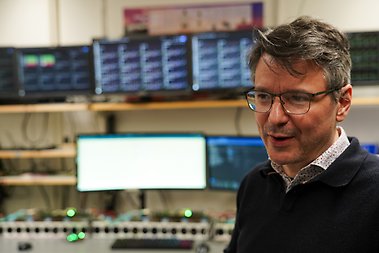
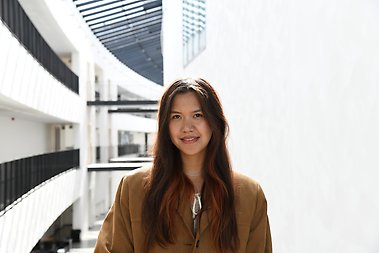
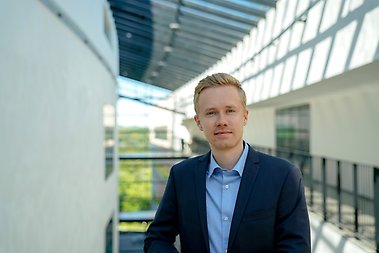
    Ludvig Doeser, who is completing his PhD at Stockholm University and the Oskar Klein Centre later this year, has been awarded a Wallenberg–Bienenstock fellowship at Stanford University. The goal is to take on one of cosmology's central tasks: reconstructing how our Universe evolved into the cosmic web of galaxies we see today by developing an AI-driven digital twin of the local Universe.

    Oskar Klein Centre
  • Wilczek's Successful Summer Schools

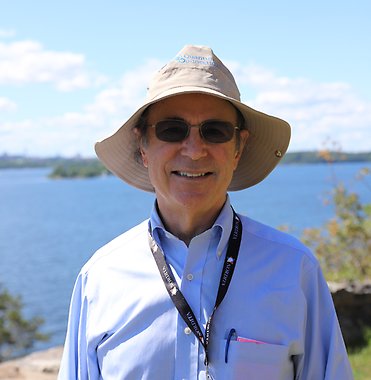
    Dr Frank Wilczek initiated Quantum Connections, which has now been held 16 times. The event takes place in Stockholm each June and brings together graduate students and postdocs from both theoretical and experimental backgrounds, spanning the broad landscape of quantum frontiers. Since 2025, it has expanded to include both a Summer School in Sweden in June and a Winter School in China in January.

    Department of Physics
  • 1,000-board contribution to CERN upgrade by SU clears pre-production

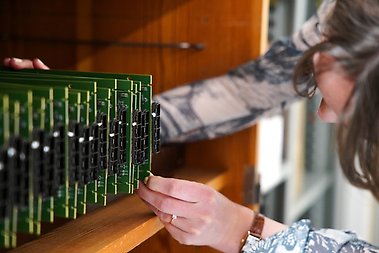
    A pre-production run of radiation-hard readout boards for the ATLAS experiment at CERN has been completed at the Department of Physics, Stockholm University. The work, carried out across the department's ELPA and Instrumentation divisions, includes Oskar Klein Cectre researchers Christophe Clément (Professor, ELPA) and PhD student Julia Salwén (ELPA), with PhD student Federico Bonaldo recently joining the team. The yield from the pre-production batch came in well above CERN's threshold, and the results were presented to an international expert panel at CERN on 12 May.

    Oskar Klein Centre
  • New centre to strengthen Sweden in the quantum race

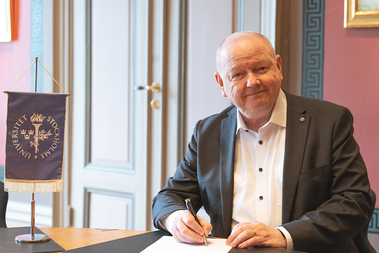
    Six Swedish universities are joining forces to establish the Swedish Center for Quantum Technology, a national hub for research, innovation, education, and capacity building in quantum technology. The initiative aims to strengthen Sweden’s international competitiveness and serve as a driving force for the development and application of quantum technologies.

    Department of Physics
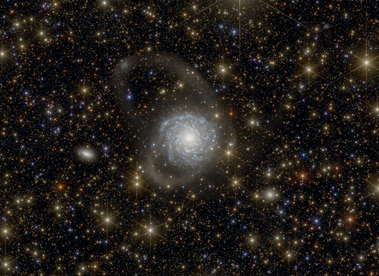
  • ARRAKIHS simulation of the low surface brightness features in the halo of a spiral galaxy like the Milky Way.

    Stockholm researchers help launch space telescope hunting the hidden halos of galaxies

    With ESA's adoption, ARRAKIHS now enters its final design phase ahead of a 2030 launch. Stockholm University, a core partner in the mission and headed by OKC Associate Professor Azadeh Fattahi, will contribute to the cosmological simulations that turn ARRAKIHS's observations into insights about how galaxies form and what dark matter is made of.

    Oskar Klein Centre
  • The hidden world of amorphous ice

    "I moved from Kazakhstan to Sweden to pursue my PhD and am now a postdoctoral researcher in the Structural Dynamics of Aqueous Solutions (SDAQS) group. I completed and defended my PhD thesis at Fysikum while caring for my infant daughter", says Aigerim Karina. Her research focuses on amorphous ice and protein diffusion in cryogenic solutions. Amorphous ice is often described as a solid form of water that retains the disordered structure of a liquid. Unlike ordinary ice, it lacks a crystalline arrangement. This is desirable for storing proteins and other biological materials because crystalline ice can damage delicate structures during freezing.

    Department of Physics
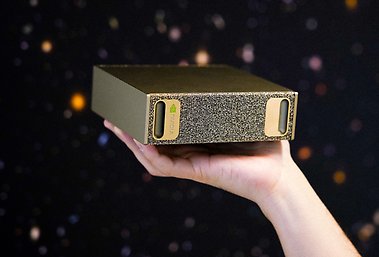
  • The NVIDIA DGX Spark that started the project — a machine small enough to hold in one hand.

    Building a team of AI agents for the next wave of cosmology data

    Arthur Loureiro, researcher at the Oskar Klein Centre, Department of Physics, Stockholm University, is developing a multi-agent system that takes on some of the more repetitive work of cosmological data analysis. The project grew out of discussions in the EDUCATE AI Agents working group and is being built with the data from the LSST and Euclid surveys in mind.

    Oskar Klein Centre
  • Shape before material: a new design rule for microwave absorbers in cosmic telescopes

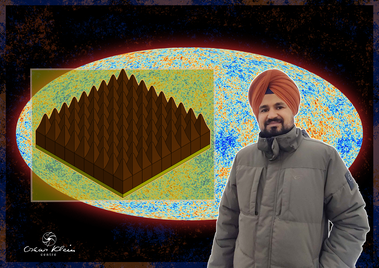
    A recent study led by postdoctoral researcher Gaganpreet Singh at the Oskar Klein Centre brings together numerical simulations, in-house material fabrication and laboratory measurements at a level of detail not previously reported for this class of microwave absorber. The work shows that the geometry of a millimetre-scale absorber, and not the material it is made of, governs how well it traps incoming microwaves. The study, selected as an Editors' Pick in Applied Optics, could simplify the design of future telescopes observing the afterglow of the Big Bang.

    Oskar Klein Centre
  • Guest article on radiological emergency preparedness

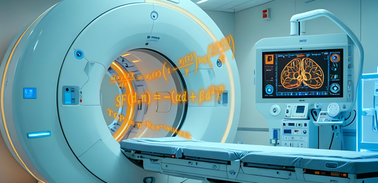
    The Department of Medical Radiation Physics is conducting a project on optimising radiological emergency preparedness. The aim is to contribute knowledge that can facilitate and streamline the response measures that may be required in the event of ionising radiation. The work is led by Professors Iuliana Toma-Dasu and Andrzej Wojcik. PhD student Tomas Palmqvist has summarised the two studies presented during a licentiate seminar. This has been published as a guest post on the website of the Knowledge Centre for Radiation Medicine in Disasters (KcRN).

    Department of Physics
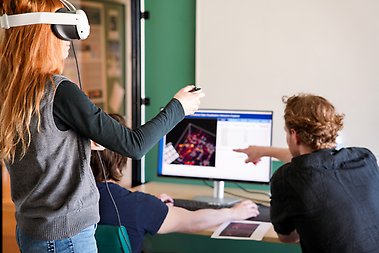
  • Stepping inside the cosmic web: a pilot in virtual reality cosmology

    A master's thesis project hosted at the Oskar Klein Centre asked twelve Stockholm cosmologists to label structures in a simulated patch of the universe — once on a flat screen, once inside a VR headset. The pilot suggests the headset is the better instrument for the job, and maps out what would have to change before it could become a normal part of a researcher's workflow.

    Department of Physics
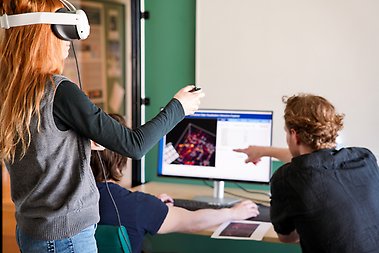
  • Visiting researcher Olivia Mostow tries IDaVIE during a session at the Oskar Klein Centre, with master's student Florian Unger pointing out a structure on the desktop monitor. The screen shows the Manticore reconstruction of a patch of the local universe; the controller is painting directly into that volume inside the headset.

    Stepping inside the cosmic web: a pilot in virtual reality cosmology

    A master's thesis project hosted at the Oskar Klein Centre asked twelve researchers to label structures in a simulated patch of the universe — once on a flat screen, once inside a VR headset. The pilot suggests the headset is the better instrument for the job, and maps out what would have to change before it could become a normal part of a researcher's workflow.

    Oskar Klein Centre