


Exploring the Contextual Stern–Gerlach Experiment
We have developed a new quantum version of the famous Stern–Gerlach experiment, using an artificial atom inside a cavity or superconducting circuit. Instead of a particle’s spin, the system has two possible quantum states. A resonant electromagnetic field takes the role of the magnetic field in the original experiment, explains Themistoklis Mavrogordatos, guest researcher at Fysikum, Stockholm University.
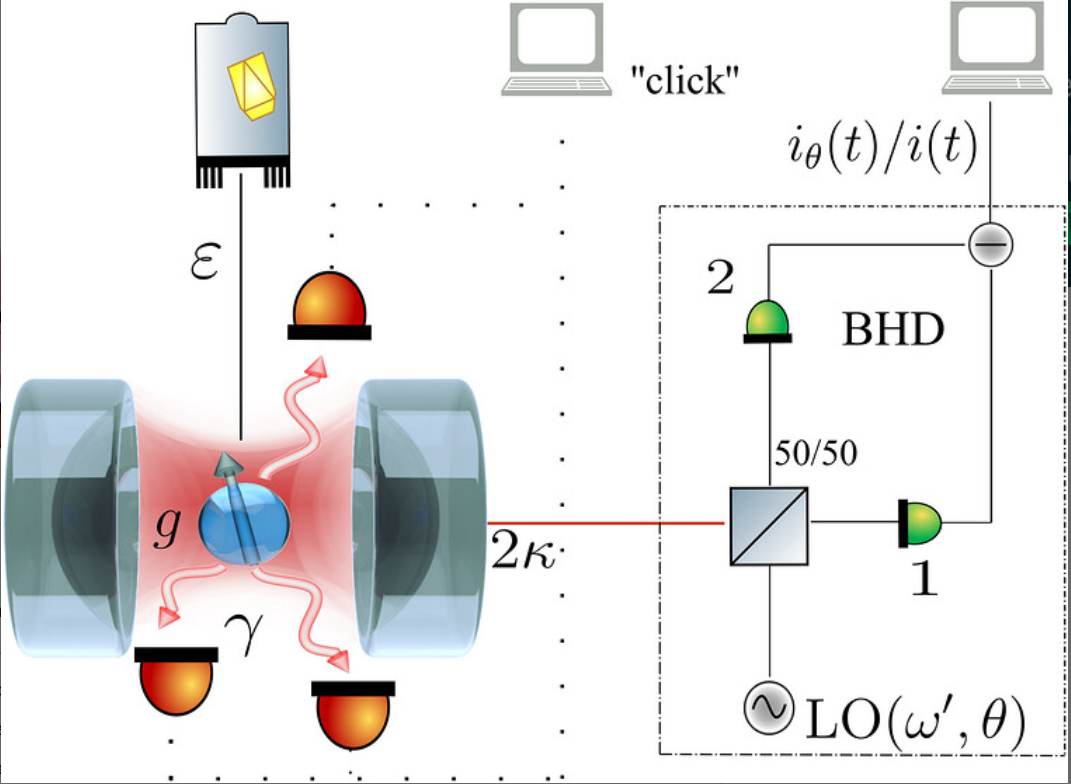
Schematic illustration of the contextual Stern–Gerlach apparatus in cavity QED.
By continuously monitoring the electromagnetic field, we can influence which of the two possible outcomes the system settles into. As the strength of the driving field is reduced, the system undergoes a remarkable change: the usual quantum states give way to a new form of spontaneous polarization.
The experiment also highlights a fascinating feature of quantum mechanics: what we observe depends on how we choose to measure the system. Under certain measurement conditions, the system repeatedly produces quantum superpositions—states in which two different possibilities coexist.
Even when the two stable outcomes disappear, the light emitted by the artificial atom can reveal fluctuations in the cavity field, giving us another way to explore the underlying quantum behaviour.
Read more
More information
Themistoklis Mavrogordatos, guest researcher at Fysikum, Stockholm University
Operating a Contextual Stern–Gerlach Apparatus, Wiley Online Library
Last updated: 2026-09-15
Source: Department of Physics