News

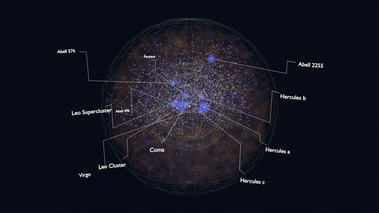
  • A cloud of white-blue dots shows supernovas in the universe, overlayed by a dark red layer showing cosmic dense regions of space. Large blue spheres indicate superclusters in the universe with higher than average supernova rates.

    Supernova hotspots could skew how we measure the expansion of the universe

    New findings from PhD student Antoine at Oskar Klein Centre, Fysikum/SU, puts calculations of the Hubble constant into question. Supernovas were assumed to either be evenly distributed, or scale with a structure's mass. But new simulations based on ZTF observations show them distributed in dense superclusters at rates far exceeding what mass alone can account for. This could affect how cosmologists calculate the Hubble constant in the future.

    Oskar Klein Centre
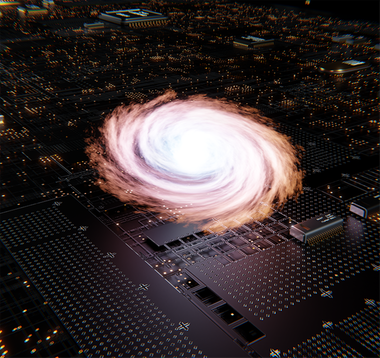
  • Galaxy against a motherboard backdrop. Made in Blender.

    How the EDUCATE centre is learning to work with agentic AI

    During the spring of 2026, researchers at the EDUCATE centre — the Oskar Klein Centre's new centre of excellence for the dark universe, run jointly by Stockholm University and KTH Royal Institute of Technology — began testing what a new generation of AI tools can and cannot do in everyday research. The work is part of the centre's agentic-AI initiative, and it drew in people from across the group: among them Renske Wierda, a PhD student in particle physics at KTH; Christian Ohm, an experimental particle physicist at KTH; Prerna Baranwal, a research engineer at KTH; and Arthur Loureiro, a researcher at the Oskar Klein Centre, Stockholm University amongst others.

    Oskar Klein Centre
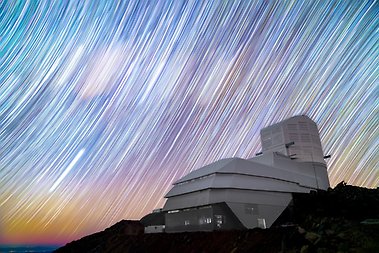
  • Image: Countless star trails appear as colorful brushstrokes spread across the night sky above NSF–DOE Vera C. Rubin Observatory.

    OKC revs up to do science as the Rubin Observatory begins its ten-year survey

    After more than two decades of construction and testing, the NSF–DOE Vera C. Rubin Observatory in Chile has formally begun the Legacy Survey of Space and Time (LSST), a ten-year record of the southern sky. At the Oskar Klein Centre (OKC) — which brings together researchers from the departments of physics and astronomy at Stockholm University and the department of physics at KTH Royal Institute of Technology — the milestone marks the point where a decade of preparation turns into data. We asked centre director Ariel Goobar, professor of physics, and several of his colleagues what they are now setting out to do.

    Oskar Klein Centre
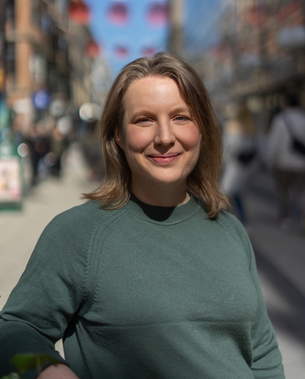
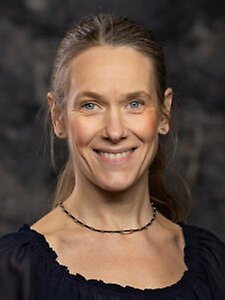
  • Profile picture of Ragnhild Lunnan

    Ragnhild Lunnan awarded the Nagler price in physics

    The Royal Academy of Sciences has awarded the Nagel price in physics to Ragnhild Lunnan, assistant professor at the Department of Astronomy. She is one of two scientists sharing the price for 2026.

    Department of Astronomy
  • From Stockholm to Stanford: OKC researcher awarded Wallenberg fellowship

    Ludvig Doeser, who is completing his PhD at Stockholm University and the Oskar Klein Centre later this year, has been awarded a Wallenberg–Bienenstock fellowship at Stanford University. The goal is to take on one of cosmology's central tasks: reconstructing how our Universe evolved into the cosmic web of galaxies we see today by developing an AI-driven digital twin of the local Universe.

    Oskar Klein Centre
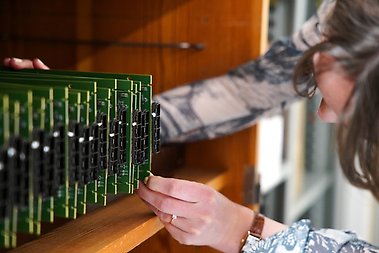
  • 1,000-board contribution to CERN upgrade by SU clears pre-production

    A pre-production run of radiation-hard readout boards for the ATLAS experiment at CERN has been completed at the Department of Physics, Stockholm University. The work, carried out across the department's ELPA and Instrumentation divisions, includes Oskar Klein Cectre researchers Christophe Clément (Professor, ELPA) and PhD student Julia Salwén (ELPA), with PhD student Federico Bonaldo recently joining the team. The yield from the pre-production batch came in well above CERN's threshold, and the results were presented to an international expert panel at CERN on 12 May.

    Oskar Klein Centre
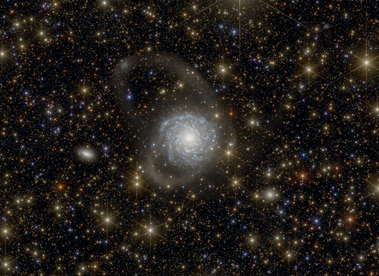
  • ARRAKIHS simulation of the low surface brightness features in the halo of a spiral galaxy like the Milky Way.

    Stockholm researchers help launch space telescope hunting the hidden halos of galaxies

    With ESA's adoption, ARRAKIHS now enters its final design phase ahead of a 2030 launch. Stockholm University, a core partner in the mission and headed by OKC Associate Professor Azadeh Fattahi, will contribute to the cosmological simulations that turn ARRAKIHS's observations into insights about how galaxies form and what dark matter is made of.

    Oskar Klein Centre
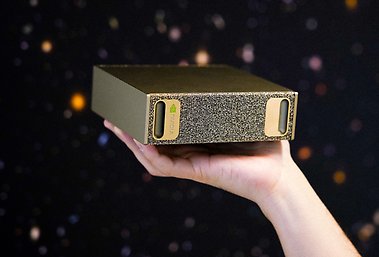
  • The NVIDIA DGX Spark that started the project — a machine small enough to hold in one hand.

    Building a team of AI agents for the next wave of cosmology data

    Arthur Loureiro, researcher at the Oskar Klein Centre, Department of Physics, Stockholm University, is developing a multi-agent system that takes on some of the more repetitive work of cosmological data analysis. The project grew out of discussions in the EDUCATE AI Agents working group and is being built with the data from the LSST and Euclid surveys in mind.

    Oskar Klein Centre
  • Shape before material: a new design rule for microwave absorbers in cosmic telescopes

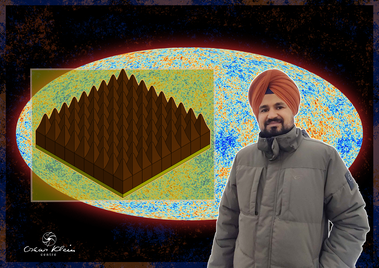
    A recent study led by postdoctoral researcher Gaganpreet Singh at the Oskar Klein Centre brings together numerical simulations, in-house material fabrication and laboratory measurements at a level of detail not previously reported for this class of microwave absorber. The work shows that the geometry of a millimetre-scale absorber, and not the material it is made of, governs how well it traps incoming microwaves. The study, selected as an Editors' Pick in Applied Optics, could simplify the design of future telescopes observing the afterglow of the Big Bang.

    Oskar Klein Centre
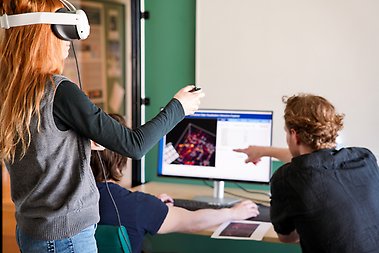
  • Visiting researcher Olivia Mostow tries IDaVIE during a session at the Oskar Klein Centre, with master's student Florian Unger pointing out a structure on the desktop monitor. The screen shows the Manticore reconstruction of a patch of the local universe; the controller is painting directly into that volume inside the headset.

    Stepping inside the cosmic web: a pilot in virtual reality cosmology

    A master's thesis project hosted at the Oskar Klein Centre asked twelve researchers to label structures in a simulated patch of the universe — once on a flat screen, once inside a VR headset. The pilot suggests the headset is the better instrument for the job, and maps out what would have to change before it could become a normal part of a researcher's workflow.

    Oskar Klein Centre
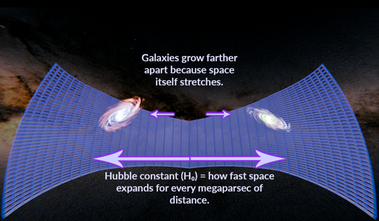
  • A statistical assumption may have inflated the Hubble Tension

    A new study suggests that a subtle statistical choice — long treated as an innocuous default — may be responsible for a significant part of one of astrophysics’ most persistent mysteries: the Hubble tension. Researchers at the Oskar Klein Centre, Marcus Högås and Edvard Mörtsell, show that replacing a conventional but potentially misleading assumption in the local distance-ladder method shifts the inferred expansion rate of the Universe downward. As a result, the discrepancy with early-Universe measurements is reduced from 5σ to 2σ.

    Oskar Klein Centre