
A statistical assumption may have inflated the Hubble Tension
A new study suggests that a subtle statistical choice — long treated as an innocuous default — may be responsible for a significant part of one of astrophysics’ most persistent mysteries: the Hubble tension. Researchers at the Oskar Klein Centre, Marcus Högås and Edvard Mörtsell, show that replacing a conventional but potentially misleading assumption in the local distance-ladder method shifts the inferred expansion rate of the Universe downward. As a result, the discrepancy with early-Universe measurements is reduced from 5σ to 2σ.
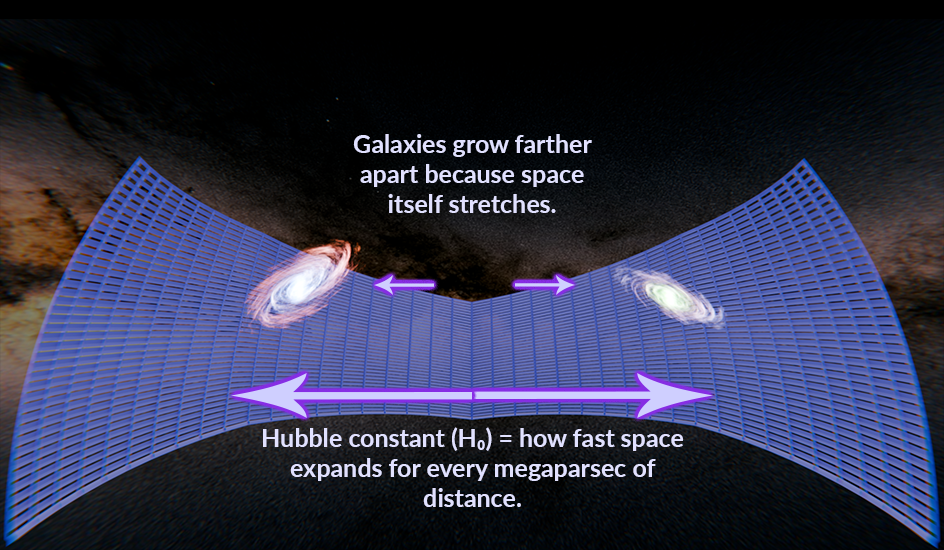
Illustration of space expansion increasing distance between galaxies.
When cosmologists say the Universe is expanding, they mean that space itself is stretching. A common analogy is raisin dough rising in the oven: as the dough expands, all the raisins move farther apart — not because they are racing through the dough, but because the dough itself is growing. In the same way, galaxies drift apart as space expands. The Hubble constant (H₀) tells us how fast the expansion is happening today. In simple terms, it says: the farther away a galaxy is, the faster it moves away from us. For every extra megaparsec of distance (about 3.26 million light-years), a galaxy’s recession speed increases by a fixed number of kilometers per second.
Edvard: Determining H₀ can be done in two ways: a late‑universe route that measures distances to nearby and progressively farther galaxies, and an early‑universe route that infers today’s expansion from the cosmic microwave background (CMB) under the well‑tested ΛCDM model of cosmic evolution. The friction between these two approaches is what the field calls the Hubble tension.
The distance ladder
Because galaxies are far beyond the reach of any direct measurement, astronomers determine distances step by step — building what is known as a cosmic distance ladder. The first rung is anchored by Cepheid variable stars in our own Milky Way, a special class of stars that brighten and dim at regular intervals. The key is that this rhythm is not random. Brighter, more luminous Cepheids vary more slowly, while fainter ones vary more quickly. By measuring how fast a Cepheid pulses, astronomers can determine its true, or intrinsic brightness, brightness. Comparing that intrinsic brightness to how bright the star appears in a telescope tells us how far away they are.
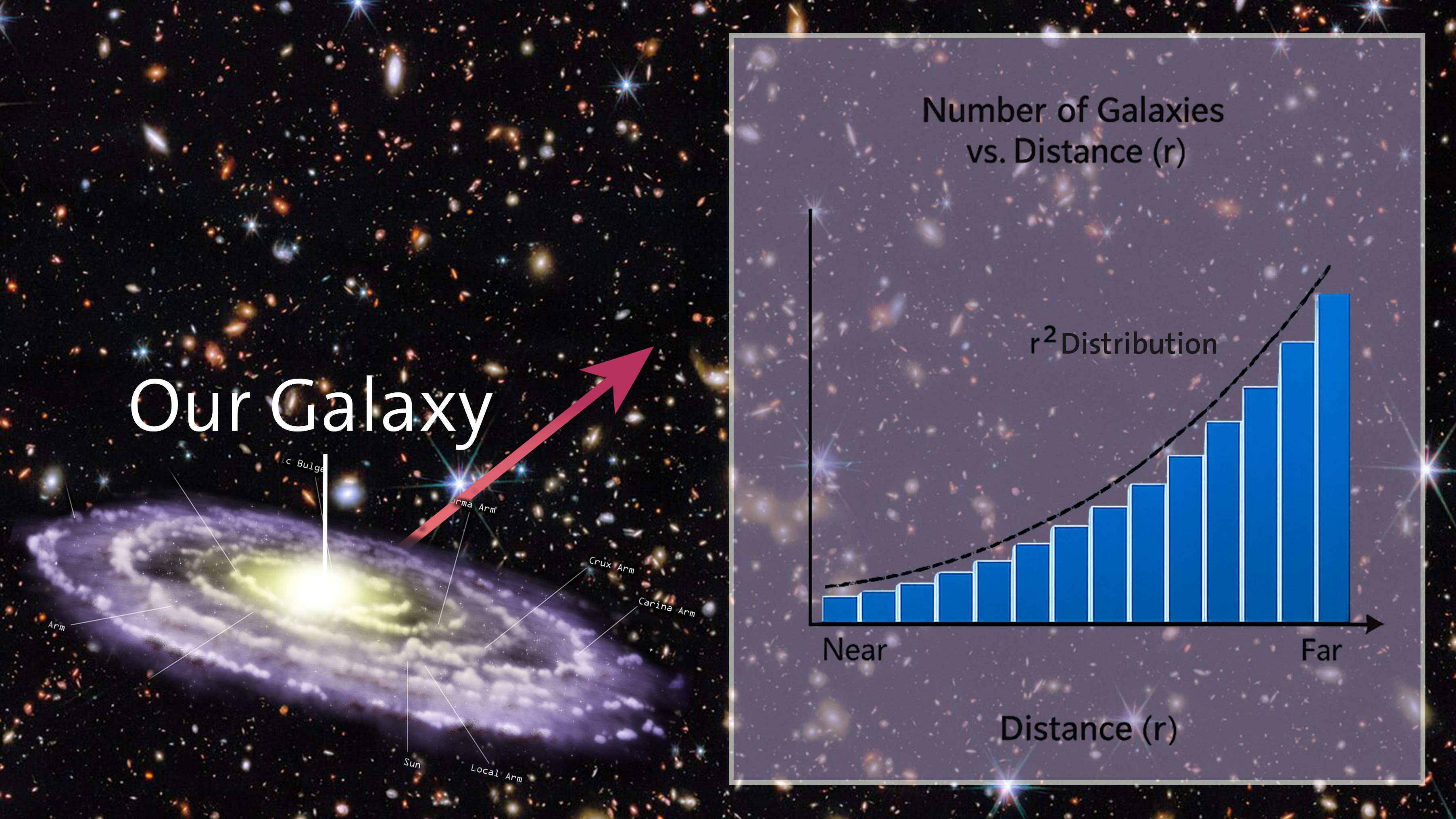
If galaxies are, broadly speaking, evenly distributed throughout the universe, the probability of a random galaxy being at a great distance from us is greater than that of it being close to us.
Those Milky Way Cepheids form the first rung of the distance ladder. Their distances are measured using exquisitely precise parallax observations from the European Space Agency’s Gaia satellite, which provides the fundamental yardstick for the entire method.
Their calibrated brightness is then used to determine distances to Cepheids in other galaxies — the second rung. In galaxies that host both Cepheids and Type Ia supernovae, brilliant stellar explosions visible across vast reaches of space. These distances allow astronomers to calibrate the true brightness of the supernovae themselves. The supernovae then become the third rung. Because they are extraordinarily bright, they can be observed in very distant galaxies. At those vast distances, their motion away from us — measured through redshift — directly reveals how fast the Universe is expanding today.
Högås and Mörtsell show that a widely used statistical “default” in this chain is not neutral. In the standard analysis, distances are handled through a logarithmic quantity known as the distance modulus, and all values of this logarithmic measure are assumed to be equally likely before considering the data.
"This assumption quietly upweights smaller inferred distances, making standard candles look too bright and thus biasing H₀ high. Instead, we expect large distances to objects to have higher probability than small distances, since large distances occupy larger volumes of space. In our study we have employed this physical distance prior into a single joint fit with all other data", Högås explains.
Gaia is a space telescope that measures the positions and distances of over a billion stars with extreme precision. The tiny apparent shifts in a star’s position as Earth orbits the Sun reveals its distance.
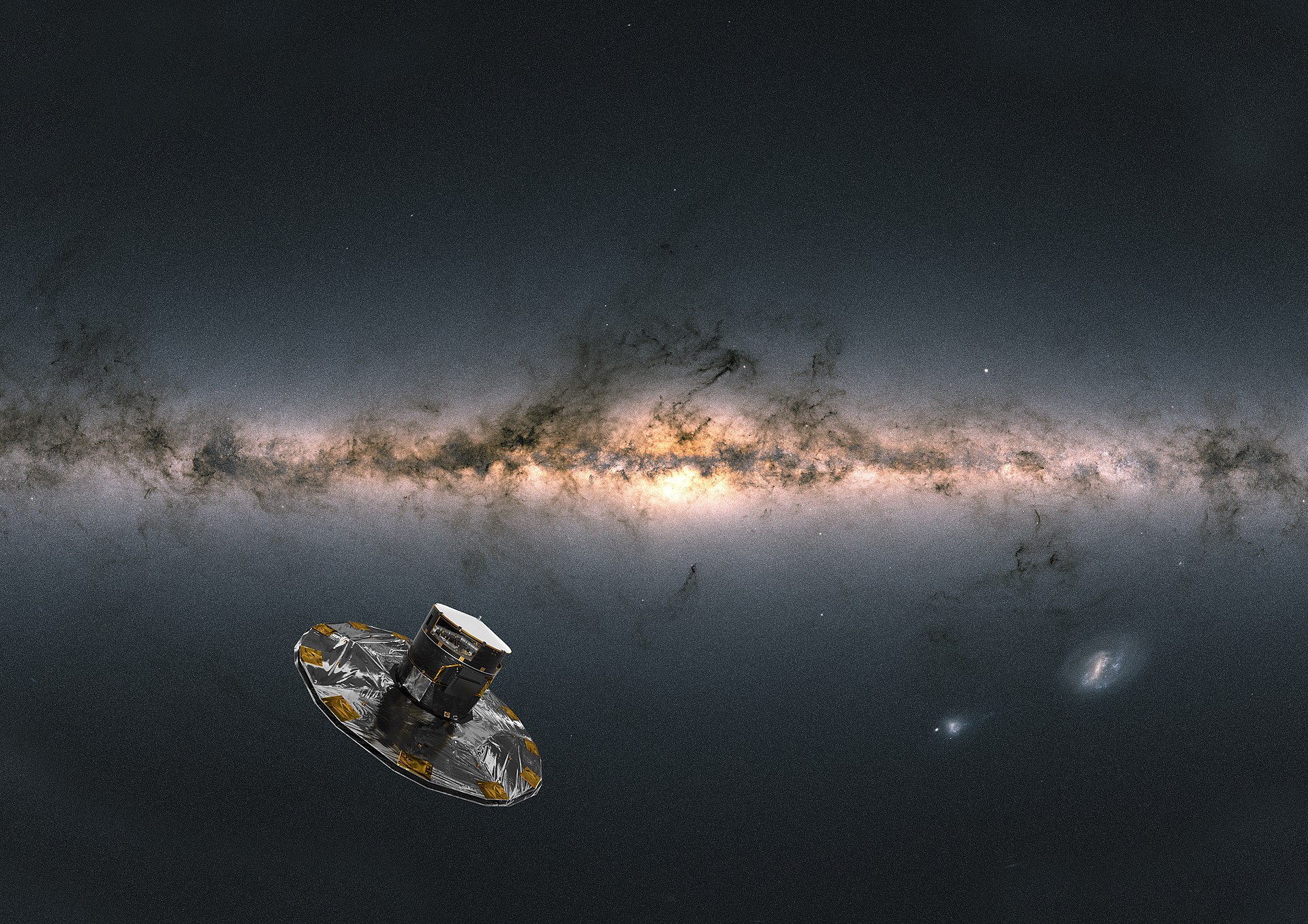
Artist impression of ESA's Gaia satellite observing the Milky Way. The background image of the sky is compiled from data from more than 1.8 billion stars. It shows the total brightness and colour of stars observed by Gaia released as part of Gaia’s Early Data Release 3 (Gaia EDR3) in December 2020.
But even Gaia’s extremely precise measurements contain a small systematic uncertainty known as the residual parallax offset. If this offset is slightly misestimated, stars can appear a bit closer or farther away than they truly are, and that shift propagates through the distance ladder. Astronomers must correct for this small offset to get accurate distances.
By rebuilding the ladder with physically motivated priors applied consistently to all distances, and by treating the Gaia residual parallax offset conservatively, the late‑universe value of H₀ shifts from 73.0 ± 1.0 to 70.6 ± 1.0 km/s/Mpc.
The practical upshot is that the headline‑grabbing gulf between late‑ and early‑universe measurements drops from 5σ to 2σ—a problem diminished from “crisis” to “calibration.”
"Our study shows that priors—often treated as harmless defaults—can materially steer cosmological inference. And because every local distance‑ladder technique relies on calibrated distances, similar prior‑driven effects may arise elsewhere, warranting a broader re‑examination before invoking exotic explanations", says Marcus Högås.
FACTBOX: The Högås–Mörtsell result at a glance
- Read the full article published in the Monthly Notices of the Royal Astronomical Society here: https://academic.oup.com/mnras/advance-article/doi/10.1093/mnras/stag724/8656780
- What changed? A shift from a common flat prior on distance modulus to physically motivated priors in a full Bayesian recalibration of the local distance ladder, plus a conservative treatment of Gaia EDR3 parallax offset.
- New H₀ (late‑universe): 70.6 ± 1.0 km/s/Mpc (down from 73.0 ± 1.0).
- Impact on the “Hubble tension”: 5σ → 2σ, substantially weakening the case that new physics is required to explain the discrepancy.
- Why it matters: Shows that statistical assumptions (priors) can play an outsized role in precision cosmology; invites similar checks across other distance‑ladder analyses.
- Paper: Physically‑motivated priors in the local distance ladder significantly reduce the Hubble tension (arXiv:2601.22215), submitted January 29, 2026.
- Funding: supported by the Swedish Research Council.
- Stockholm University is ranked 91th in the QS World University Rankings by Subject Natural Sciences 2026. And KTH Royal Institute of Technology is ranked 72nd in the world for Physics & Astronomy. Visit our OKC web site for more information on postgraduate programmes and other opportunities.
Last updated: 2026-10-01
Source: Department of Meteorology,Department of Physics