
Building a team of AI agents for the next wave of cosmology data
Arthur Loureiro, researcher at the Oskar Klein Centre, Department of Physics, Stockholm University, is developing a multi-agent system that takes on some of the more repetitive work of cosmological data analysis. The project grew out of discussions in the EDUCATE AI Agents working group and is being built with the data from the LSST and Euclid surveys in mind.
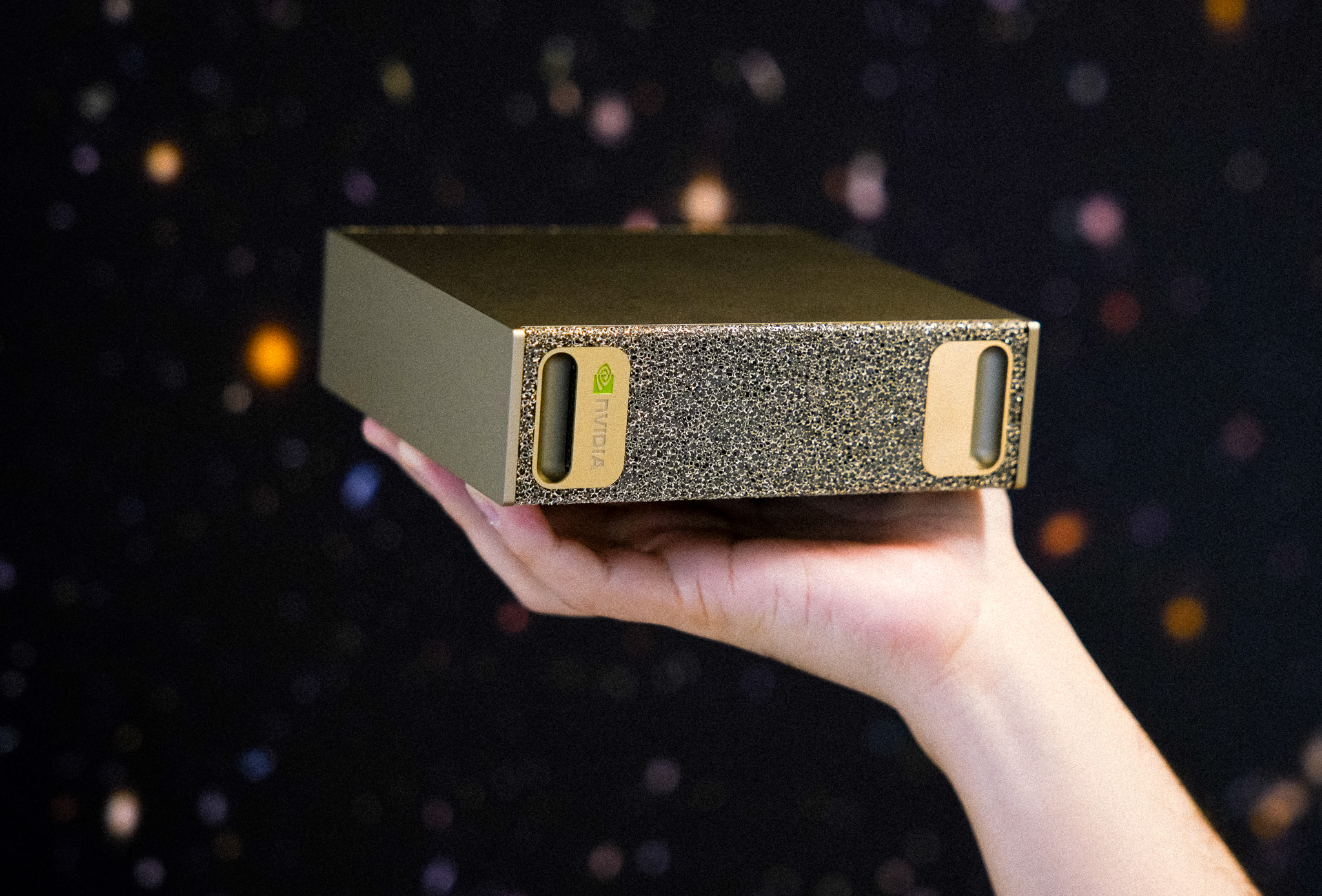
Image: The NVIDIA DGX Spark that started the project — a machine small enough to hold in one hand.
It began with a box small enough to hold in one hand. A few months ago, Arthur acquired an NVIDIA DGX Spark through his Swedish National Space Agency Career Grant — a desktop machine that can run large language models locally — and started testing what such models could do for science rather than for chat. The experiments raised more questions than they answered, and the newly started EDUCATE AI Agents working group provided an informal setting for discovery and exploration.
With data from the Vera C. Rubin Observatory's LSST survey and ESA's Euclid mission arriving over the coming months, the routine work of processing data, rewriting code, and rerunning analysis pipelines at scale becomes a genuine bottleneck. The group members designed a system of specialised AI agents with the capacity to work through tasks on cosmological datasets.
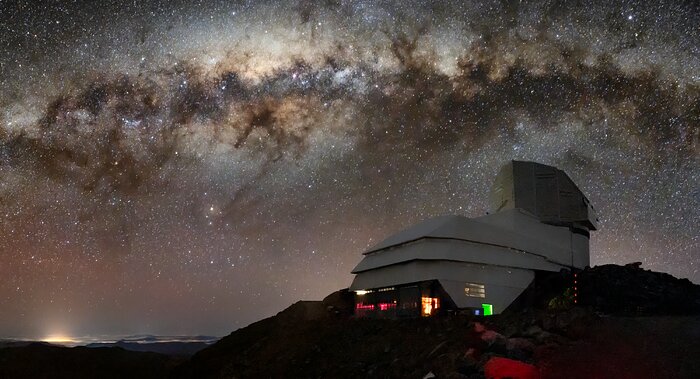
This image captures the Vera C. Rubin Observatory, with the milky way above.
The engine is not the car
In the novel system, a roster of agents each handle part of a user-defined task. Crucially, every script the agents produce is stored, so that a human can inspect it, change it, and rerun the analysis.
“The aim is not to remove people from the work but to keep the results open to checking and correction.”, says Arthur Loureiro.
As an early test, the team compared the system — named cosmoTRON — against the standard approach. Working on a simulated galaxy catalogue, the agents autonomously reproduced the angular power spectrum that a researcher would normally compute by hand using the established NaMaster tool. The two results both agreed with the theoretical input used to generate the simulation. For now, this system is a proof of concept rather than a finished result, but it suggests the approach is sound.
“In a multi-agent system, the language model is only the engine — and, as any engineer knows, the engine alone does not win the race. Getting the full system to work and learn reliably, task after task, means building everything around it with care.”, says Loureiro and describes it as a different way of thinking about how analysis tools are developed.”
Given the volume of data on the way from LSST and Euclid, exploring new technological pathways for analysis and evaluation is an ongoing effort.
LSST and Euclid generates huge data sets:
LSST / Vera C. Rubin Observatory: generates roughly 20 terabytes of raw data per night, with the camera capturing a new 3200-megapixel image every 40 seconds, each one 8 gigabytes. Over the ten-year survey this adds up to about 60 petabytes of raw data, and around 500 petabytes once processed. By the end of the mission, LSST's catalogue is expected to contain about 20 billion galaxies, nearly a million Type Ia Supernovae, and tens of thousands of strong gravitational lens systems.
Euclid: about 100 gigabytes of compressed data per day throughout its six-year mission, downlinked during a limited four-hour window each day. Over a year that comes to more than 1 petabit. Its photometric survey is expected to image around 2 billion galaxies, while the onboard slitless spectrograph will deliver redshifts for approximately 35 million of them.
Information box — the technical picture
- Hardware: an NVIDIA DGX Spark, a compact desktop system capable of running large language models locally rather than relying on external services.
- Architecture: a multi-agent system in which several specialised agents collaborate on a user-defined task applied to a given cosmological dataset.
- Reproducibility: every script generated by the agents is saved, allowing a human to inspect, modify, and rerun the analysis — the language model acts as the "engine", with the surrounding system doing the rest.
- Proof of concept: on a simulated galaxy catalogue, the system (cosmoTRON) reproduced the angular power spectrum obtained with NaMaster, a widely used tool for power-spectrum estimation, and matched the input theory.
- Context: the work anticipates the large data volumes expected from the LSST survey (Vera C. Rubin Observatory) and the Euclid mission (ESA), where repetitive pipeline work becomes a practical bottleneck.
- Origin: the idea developed from discussions in the EDUCATE AI Agents working group.
Last updated: 2026-06-08
Source: OKC