
1,000-board contribution to CERN upgrade by SU clears pre-production
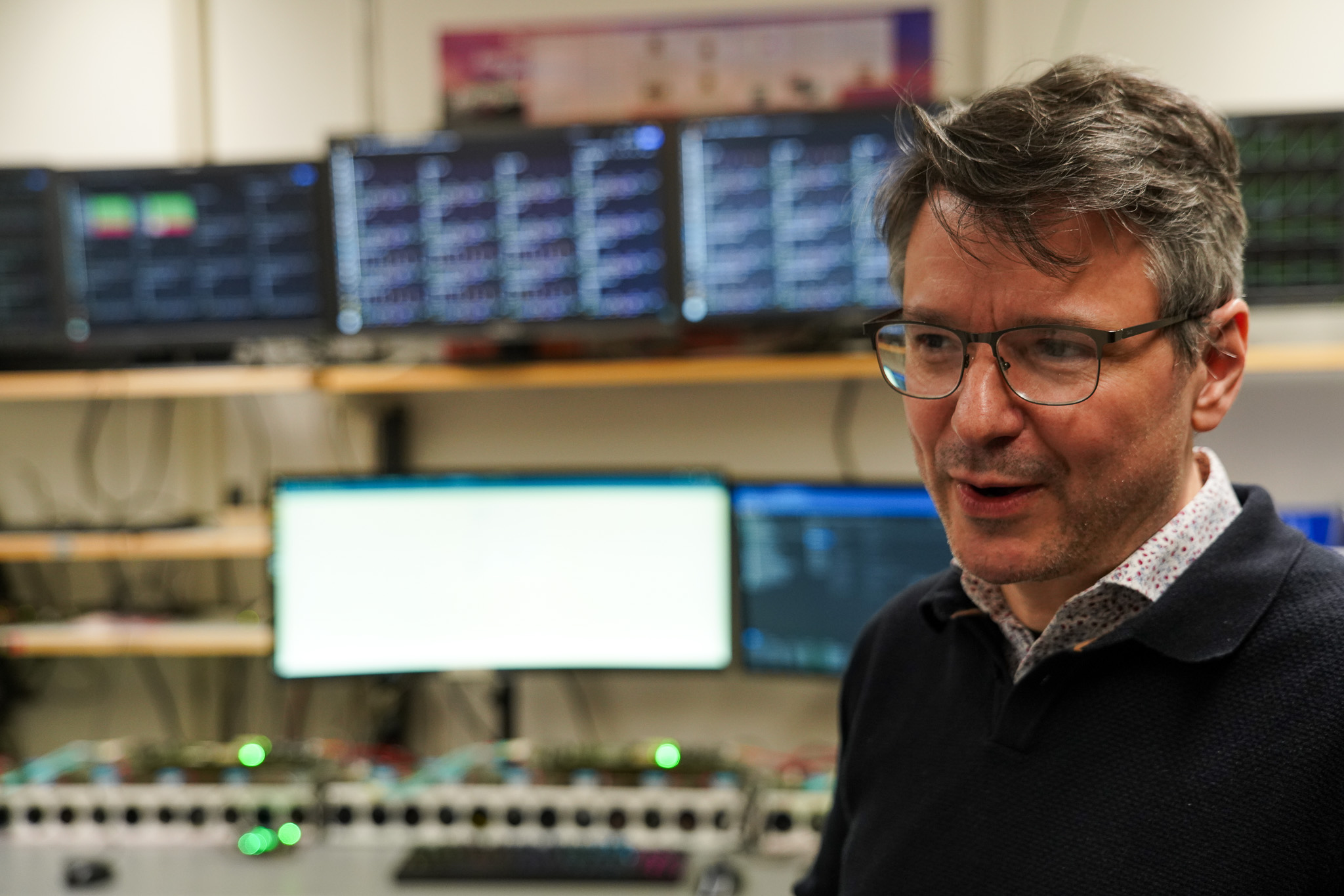
OKC researcher and board member Christophe Clément, Professor at the Department of Physics, Stockholm University, and senior member of the Stockholm ATLAS group working on the radiation-hard DaughterBoard for the ATLAS Tile Calorimeter upgrade at CERN.
A pre-production run of radiation-hard readout boards for the ATLAS experiment at CERN has been completed at the Department of Physics, Stockholm University. The work, carried out across the department's ELPA and Instrumentation divisions, includes Oskar Klein Cectre researchers Christophe Clément (Professor, ELPA) and PhD student Julia Salwén (ELPA), with PhD student Federico Bonaldo recently joining the team. The yield from the pre-production batch came in well above CERN's threshold, and the results were presented to an international expert panel at CERN on 12 May.
ATLAS is one of the four large experiments at CERN's Large Hadron Collider. It records the debris from high-energy proton-proton collisions and uses it to study the structure of matter, the properties of the Higgs boson, and possible signs of new physics such as dark matter particles. The detector is built in layers, and each layer measures something different. The Tile Calorimeter, or TileCal, is the central layer that measures the energy of hadrons — the spray of quarks and gluons that comes out of most collisions.
Simple in principle
Alternating slabs of steel and plastic scintillator tiles, where the tiles emit a small flash of light when a particle passes through. The light is led out through optical fibres, converted to an electrical signal by photomultiplier tubes, and then has to be digitised, time-stamped, and shipped out of the detector to the computers that decide which collisions are worth keeping. Around 10,000 channels are read out this way.
Turning analogue signals into digital data and getting them off the detector is what the new electronics do.
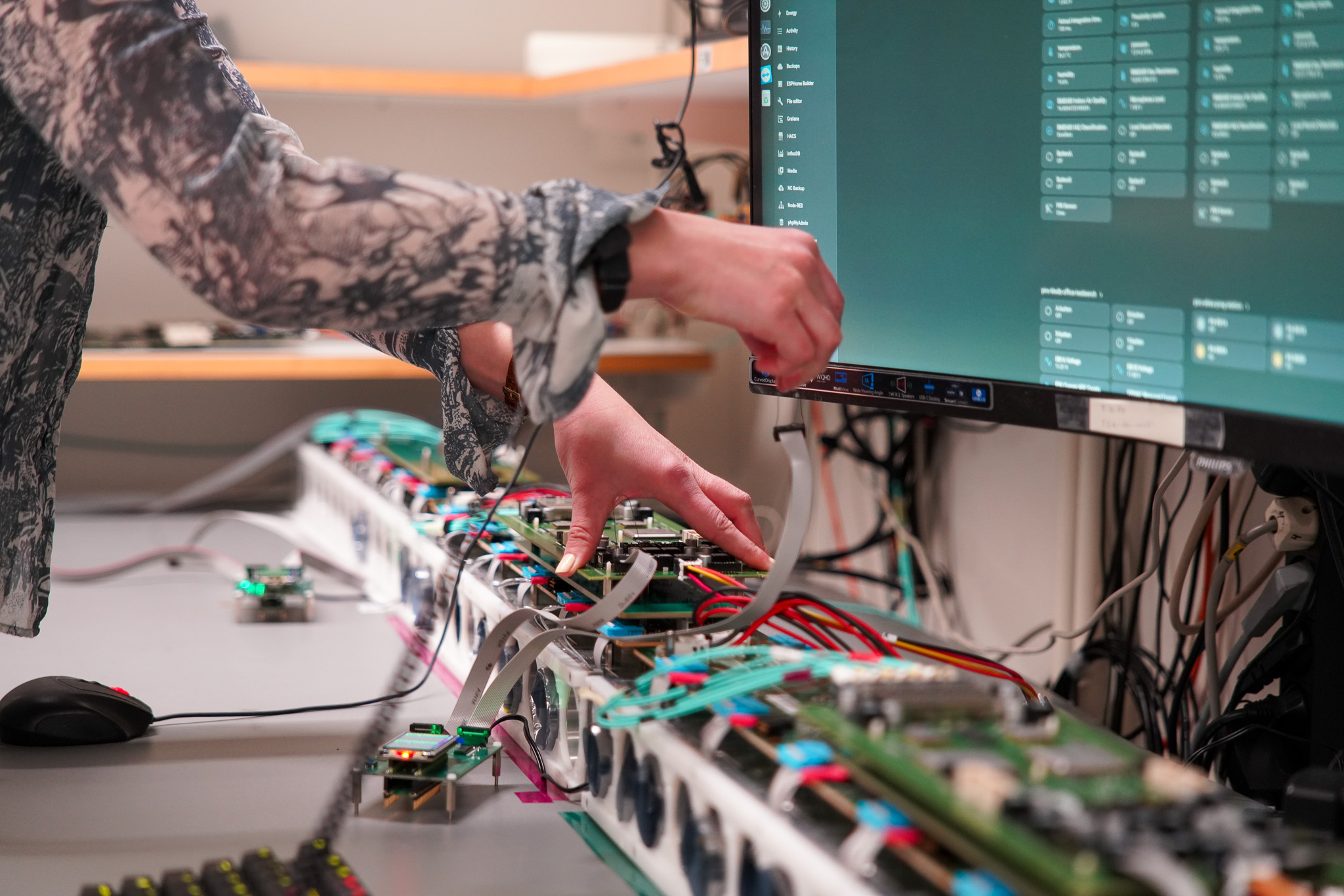
PhD student Julia Salwén (ELPA) learning how to program the new hardware.
Why the readout has to be replaced
The High-Luminosity LHC (HL-LHC) is scheduled to start running in 2030 and will deliver roughly ten times the data rate of today's LHC. More collisions per second means more overlapping events to disentangle, and a much harsher radiation environment for any electronics sitting inside the detector. The existing TileCal readout was neither designed for this rate nor for the radiation doses expected over the HL-LHC's operating lifetime.
Stockholm is responsible for the DaughterBoard, the on-detector hub that gathers digitised signals from each TileCal module, time-stamps them, and ships them out via optical fibres. It pairs CERN-developed radiation-hard chips with commercial programmable logic, and uses a redundant architecture so that a single component failure does not take a whole module offline. The design has been developed in-house at the Department of Physics, and the team has full production responsibility for it. In total, 1,000 boards are needed.
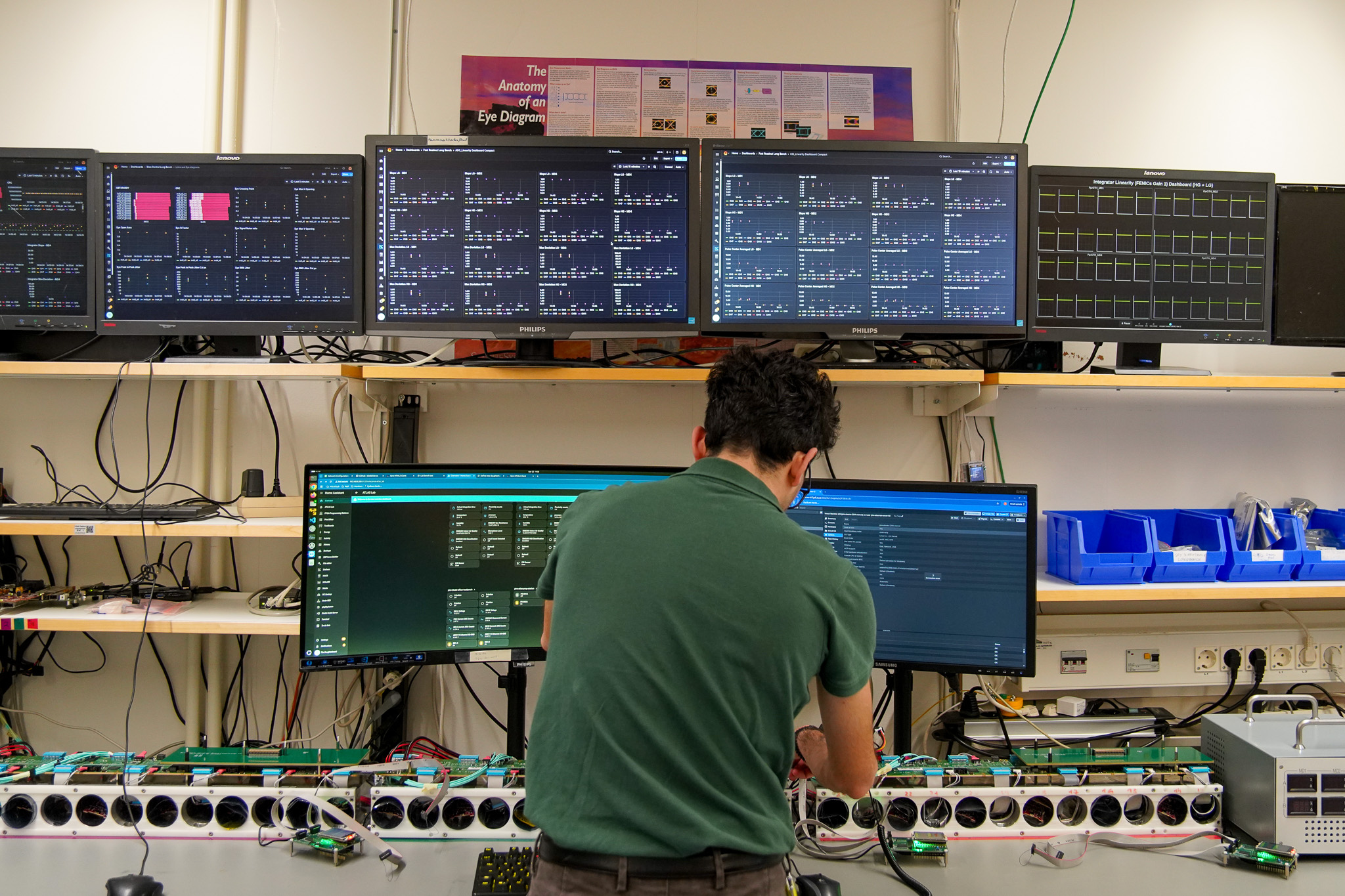
PhD student Federico Bonaldo learning how to program the new boards headed for ATLAS, CERN.
A pre-production batch, and a review at CERN on 12 May
The completed pre-production run covers the first 100 boards, ten per cent of the order. The point of pre-production is not just to produce boards, but to qualify the full process: design, suppliers, assembly, testing, and documentation. It is the same logic a print shop applies when running off a short pilot batch before committing the press to a long run. The yield from Stockholm's pre-production batch came in well above the threshold CERN set for green-lighting the rest.
The boards themselves are designed and tested at the Department of Physics. The actual mounting of the components onto the printed circuit boards — the surface-mount assembly — is handled by a contract manufacturer just outside Stockholm, which ships finished boards back to the department's lab for testing and qualification. The pre-production results were taken to an international expert panel at CERN on 12 May. If approved, the team will launch the production of the remaining 900 boards. Production and testing are scheduled for completion in autumn 2026.
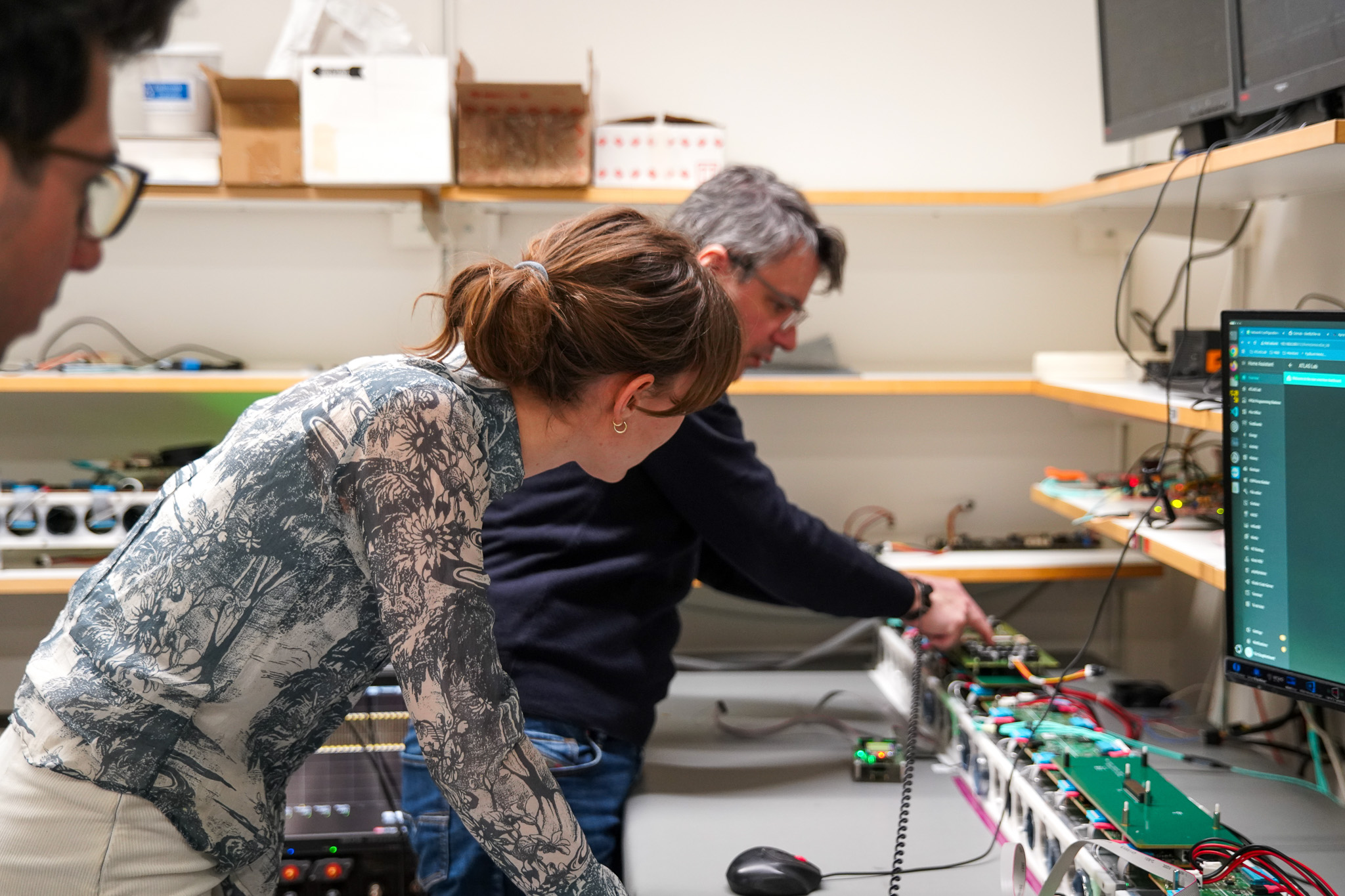
From left: PhD students Federico Bonaldo and Julia Salwén, and Professor Christophe Clément, at the test bench for the radiation-hard DaughterBoard. Salwén and Bonaldo recently joined the project and are being brought up to speed on the test setup at the Department of Physics, Stockholm University.
Installation in the ATLAS pit, 2027
Once production is complete, the boards are bound for the ATLAS cavern at CERN, around 100 metres underground. Installation begins in March 2027 and is scheduled to finish in November 2027. Several members of the ELPA and Instrumentation groups are expected to spend a combined total of several months at CERN during this phase. Julia Salwén and Federico Bonaldo were recently in the lab being walked through the test procedure by Christophe Clément; both are expected to contribute through to installation.
Last updated: 2026-06-22
Source: Department of Meteorology,Department of Physics