
Shape before material: a new design rule for microwave absorbers in cosmic telescopes
A recent study led by postdoctoral researcher Gaganpreet Singh at the Oskar Klein Centre brings together numerical simulations, in-house material fabrication and laboratory measurements at a level of detail not previously reported for this class of microwave absorber. The work shows that the geometry of a millimetre-scale absorber, and not the material it is made of, governs how well it traps incoming microwaves. The study, selected as an Editors' Pick in Applied Optics, could simplify the design of future telescopes observing the afterglow of the Big Bang.
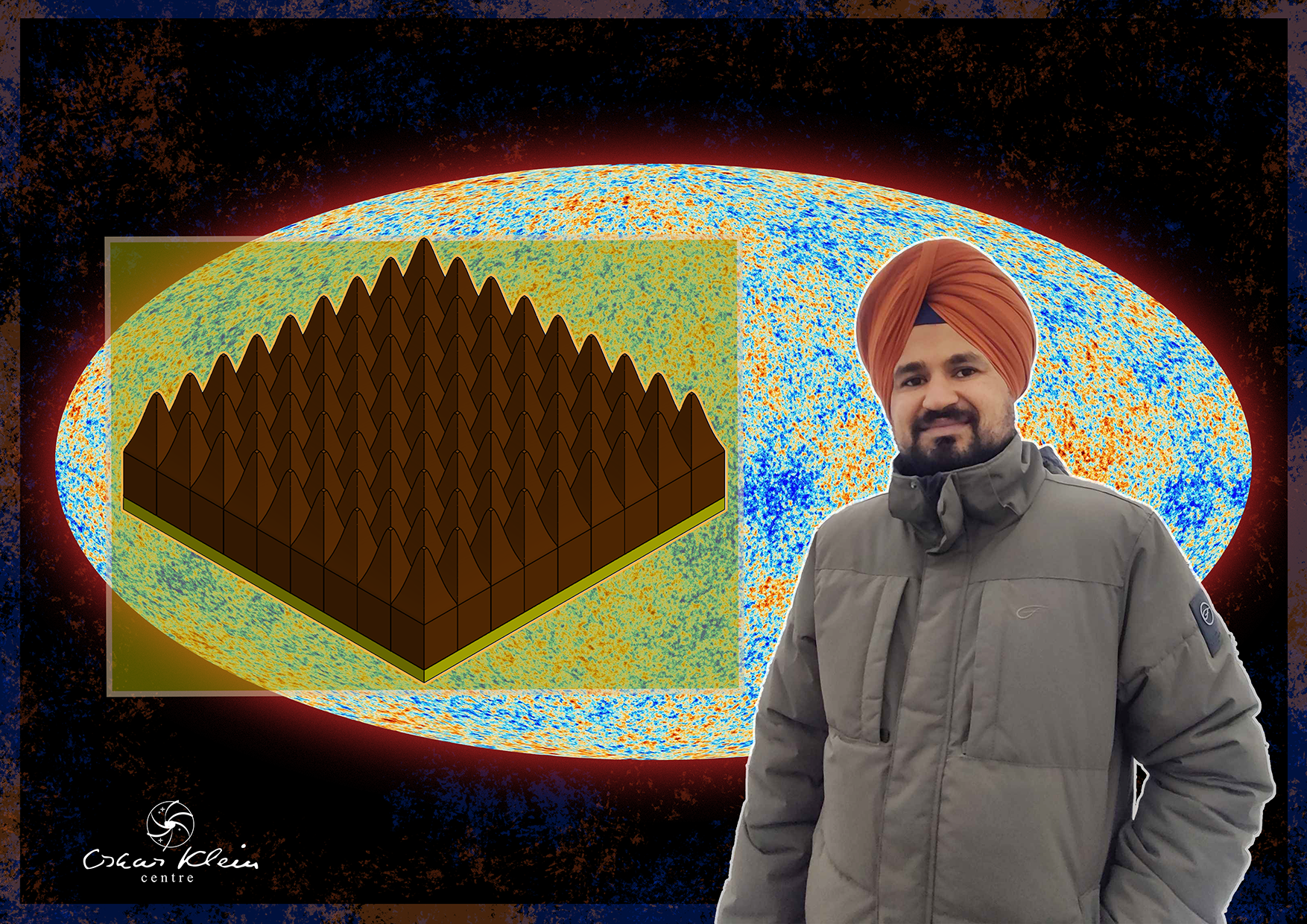
CMB telescopes are designed to detect extremely faint radiation from the early Universe. Any stray microwave signal reflecting or scattering inside the instrument can contaminate the measurement. Microwave absorbers are used to suppress this unwanted light and are placed on internal telescope surfaces. Incoming microwaves enter the structure and are gradually absorbed before they can reflect back into the instrument.
Predicting how much microwave power one of these absorbers actually traps is not a problem with a simple analytical answer. For very simple absorber shapes, approximate analytical equations exist. Real absorbers, however, are not simple. They have three-dimensional tapered shapes, finite unit-cell sizes, scattering between neighbouring structures and material properties that vary with frequency. For such geometries, analytical formulas do not fully capture what happens to the incoming radiation.
At the Oskar Klein Centre (OKC), Singh worked alongside postdoctoral researcher Gagandeep Kaur (Department of Physics, Stockholm University) and Prof. Jon E. Gudmundsson, who is jointly affiliated with OKC and the University of Iceland. The wider team includes researchers at the University of Iceland, Eindhoven University of Technology and the University of Ljubljana. The work was supported in part by the Swedish National Space Agency (Rymdstyrelsen).
Which combination of shape, size and material does the job best?
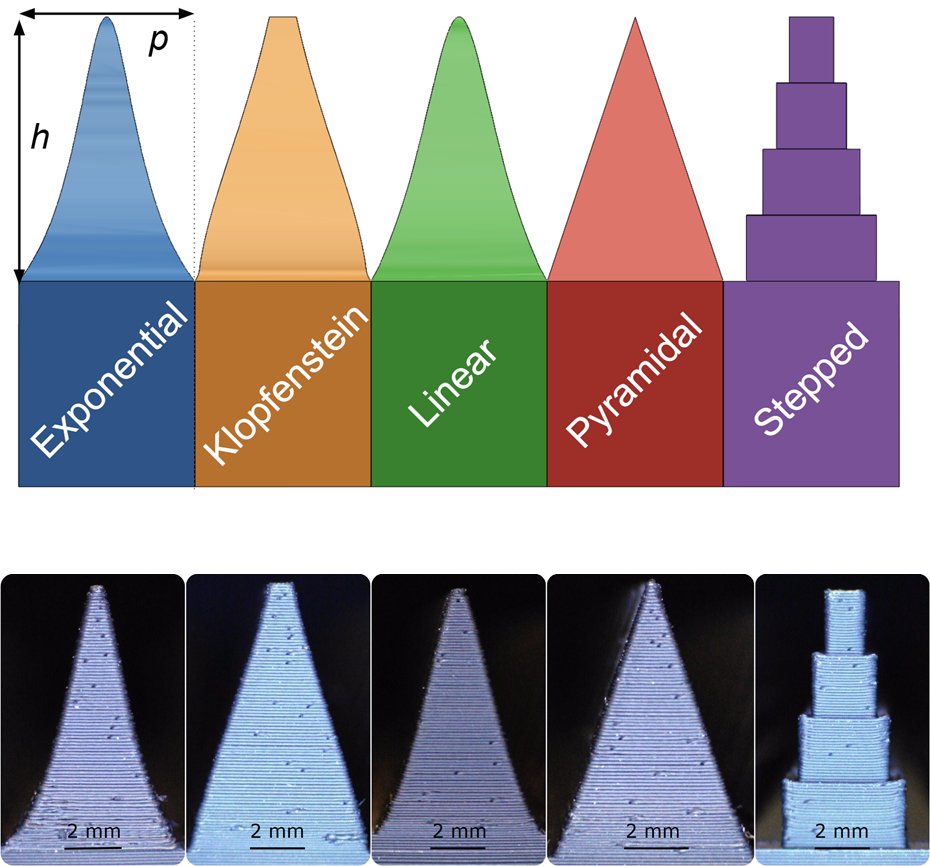
Image 1. The five taper profiles studied in the paper. Top row: schematic cross-sections of the exponential, Klopfenstein, linear, pyramidal and stepped tapers, all with a height-to-width aspect ratio of 1.5. Bottom row: close-up photographs of the 3D printed samples made from carbon-doped high-impact polystyrene, each with a 6 mm unit cell.
Microwave absorbers look a bit like the spiky foam panels on the walls of a recording studio, only much smaller. Imagine that a field of tiny pyramids, each between half a millimetre and eight millimetres tall — from roughly the thickness of a business card up to a grain of rice — sits on a flat base layer and traps incoming microwaves before they can bounce back.
To find the best absorber candidate, the team tested five pyramid profiles while also varying unit cell size and material properties — across the 70–200 GHz frequency range. This range overlaps the 90 and 150 GHz frequency bands that most CMB experiments actually observe in.
The pyramids are about the same size as the wavelengths of the radiation hitting them, and at that scale the standard analytical formulas no longer give accurate predictions. The team relied instead on full computer simulations of each absorber, paired with measurements in the lab. A particular focus of the work was the distinction between two quantities: specular reflectance, which captures only the radiation that bounces straight back off the surface, and total absorption, which also accounts for radiation scattered off at other angles. The simulations show that at the unit-cell sizes relevant for telescope work, these two numbers can diverge.
Geometry wins over material properties
The answer, within the parameter space studied, was somewhat unexpected. The size of each individual pyramid, named unit-cell size by the researchers, dominated the result. When the pyramid base was comparable to the wavelength of the incoming radiation (1–4 mm in this study), four of the five shapes absorbed more than 99.7 % of the signal on average. The classical pyramidal shape came out slightly ahead.
The material properties, which are often the main focus of absorber research, played a weaker role. Three dielectric materials with quite different loss properties gave similar results, provided the geometry was sensible.
"Within the parameter range we studied, the absorber works well as long as the material is sufficiently lossy and the shape is right," says Singh. "That shifts the design effort away from chasing exotic materials and towards geometry."
A second result is methodological: Until now, much of the literature has relied on specular reflectance: the mirror-like reflection of radiation back from the absorber surface. If specular reflection is low, the absorber is often assumed to be good. However, larger pyramidal structures can scatter a significant fraction of the incoming microwave radiation into other angles. In that case, a low specular reflection does not necessarily mean that the microwave power has been absorbed. It may simply have been redirected.
To address this, Singh and colleagues developed a way to quantify the total absorption of candidate absorbers, accounting not only for direct reflection but also for diffuse scattering. This distinction is crucial for CMB telescopes, where radiation scattered into unexpected directions can still find its way into sensitive detectors.
“The standard metric does not always tell you whether the absorber has done its job,” says Singh. “Our work shows that you need to track where the microwave power goes, not only whether it comes straight back.”
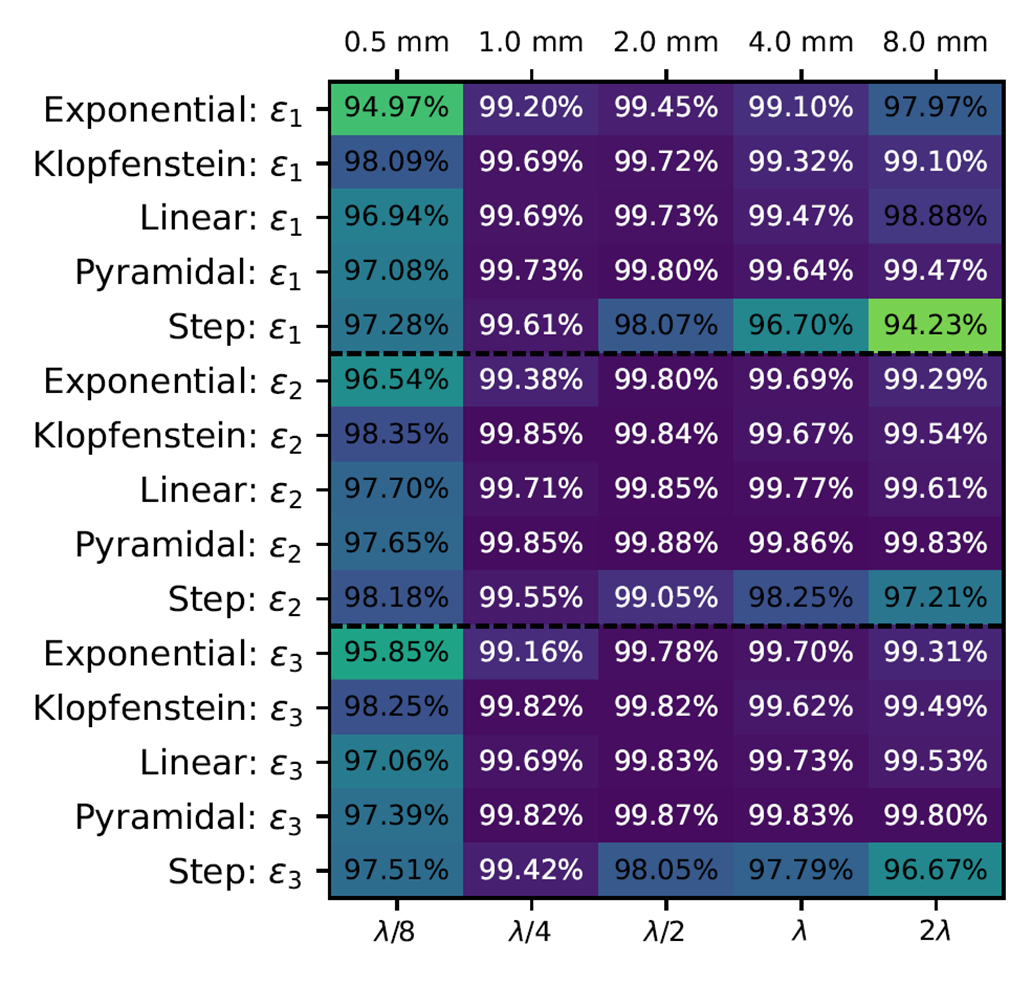
Image 2. Average fractional absorption across the 70–200 GHz band for each combination of taper shape (rows), material (ε₁, ε₂, ε₃) and unit-cell size (columns, expressed both in millimetres and as a fraction of the longest wavelength λ ≈ 4 mm). The best performers sit in the middle of the table, where the pyramid size is close to the wavelength of the incoming radiation.
From simulation to workshop
The numerical effort was substantial. Each electromagnetic simulation ran for six to eight hours, and the full sweep — covering 75 combinations of shape, unit-cell size and material — kept the Sunrise computing cluster at the Department of Physics, Stockholm University busy for two to three weeks. The team estimates that the parameter space covered here exceeds the computational effort of comparable studies in the literature by more than an order of magnitude.
To validate the simulations, the team 3D printed samples from a carbon-doped polystyrene filament and measured them on a reflectometry setup built in-house for the purpose.
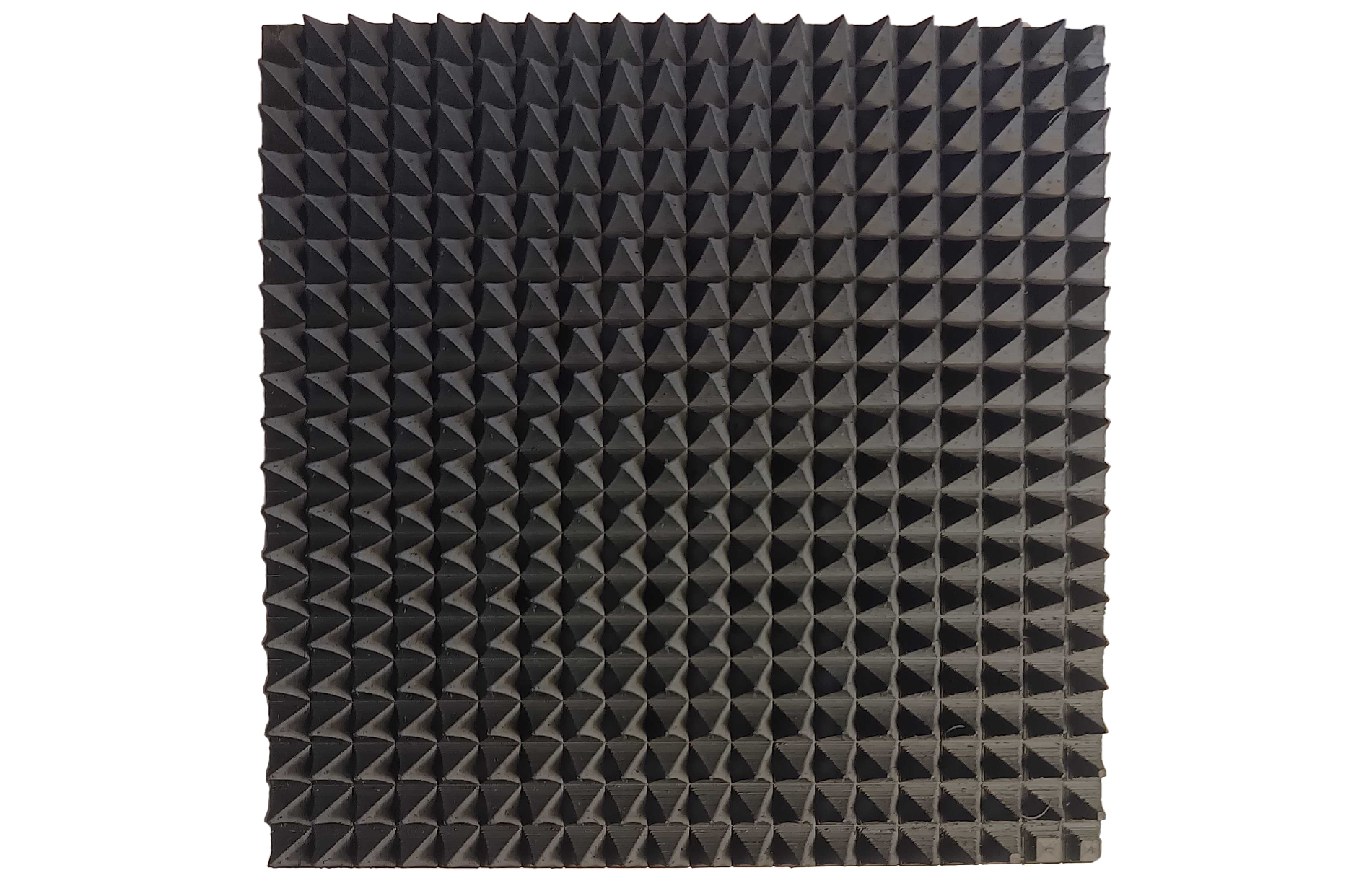
A 3D printed sample from a carbon-doped polystyrene filament.
"This reflectometry setup takes a lot of effort to build, and is one of the best characterisation facilities available for mm-wave characterisation across such a broad range of frequencies, incident angles and receiving angles," says Singh.
The next step is to extend the analysis to oblique angles of incidence, which is closer to how light actually hits absorbing surfaces inside a real telescope. Whether the same geometry-first conclusion holds at an angle is an open question, and one that will require roughly an order of magnitude more compute time than the present study.
Beyond cosmology, the same tapered geometries have practical uses wherever a smooth transition between two materials is needed — reducing reflections in solar cells, for instance, or improving signal quality in biomedical imaging.
Technical information
Publication. G. Singh, R. Balafendiev, M. S. Bisht, T. J. L. J. Gascard, G. Kaur, V. Primožič and J. E. Gudmundsson, "Optimizing broadband microwave absorbers for applications in the 70–200 GHz range," Applied Optics 65 (8), 2603–2612 (2026). DOI: 10.1364/AO.584433. Editors' Pick.
Frequency range. 70–200 GHz, corresponding to free-space wavelengths of roughly 4.3–1.5 mm. This overlaps the 90 and 150 GHz bands used by most CMB experiments.
Geometries tested. Exponential, Klopfenstein, linear, pyramidal and stepped tapers, all at fixed aspect ratio h/p = 1.5.
Unit-cell sizes. 0.5, 1, 2, 4 and 8 mm.
Materials simulated. Three frequency-independent complex permittivities taken from the recent literature: ε₁ = 9.8 + 0.2i, ε₂ = 3.8 + 1.7i and ε₃ = 5.4 + 0.8i.
Best result. 99.88 % average absorption for a pyramidal taper with a 2 mm unit cell and the ε₂ material.
Infrastructure. CST Studio Suite for time-domain electromagnetic simulations; the Sunrise HPC cluster at the Department of Physics, Stockholm University; Prusa 3D printers with high-impact polystyrene filament; an in-house frequency-domain continuous-wave terahertz reflectometry setup (see arXiv:2407.05512).
Funding. Swedish National Space Agency (Rymdstyrelsen); Icelandic Research Fund (grant 2410656-051); European Research Council (CMBeam, 101040169); University of Iceland Research Fund.
Team.
Gaganpreet Singh, Postdoctoral researcher, OKC, Department of Physics, Stockholm University
Gagandeep Kaur, Postdoctoral researcher, OKC, Department of Physics, Stockholm University
Jon E. Gudmundsson, Assistant Professor, Science Institute, University of Iceland, and OKC, Department of Physics, Stockholm University
Rustam Balafendiev, PhD student, Science Institute, University of Iceland
Thomas J. L. J. Gascard, Postdoctoral Fellow, Science Institute, University of Iceland
Mahesh Singh Bisht, Postdoctoral researcher, Department of Electrical Engineering, Eindhoven University of Technology (TU/e), Netherlands
Vid Primožič, Faculty of Mathematics and Physics, University of Ljubljana, Slovenia
Last updated: 2026-06-03
Source: Department of Meteorology,Department of Physics