
From Stockholm to Stanford: OKC researcher awarded Wallenberg fellowship
Ludvig Doeser, who is completing his PhD at Stockholm University and the Oskar Klein Centre later this year, has been awarded a Wallenberg–Bienenstock fellowship at Stanford University. The goal is to take on one of cosmology's central tasks: reconstructing how our Universe evolved into the cosmic web of galaxies we see today by developing an AI-driven digital twin of the local Universe.
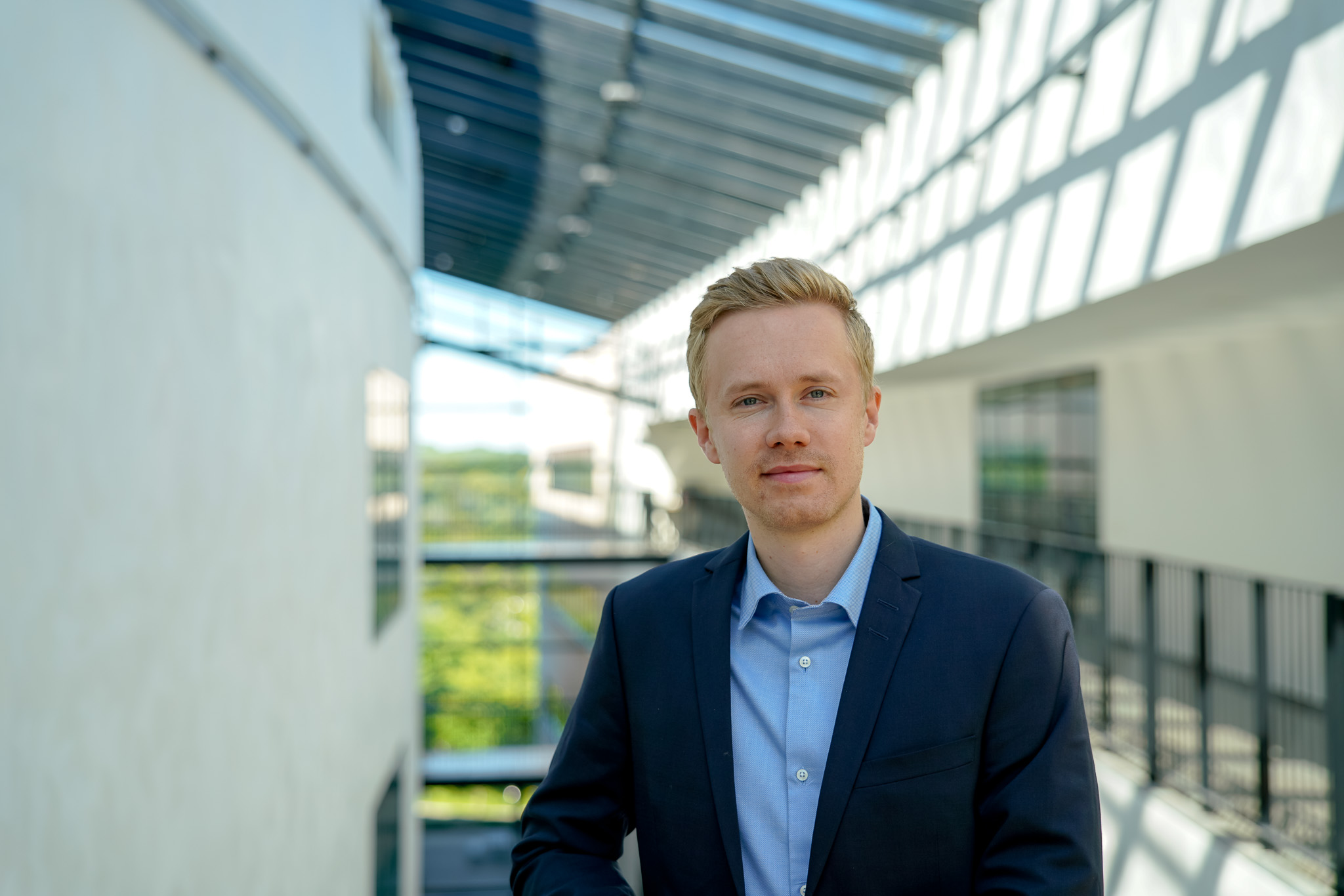
Image: Ludvig Doeser.
Starting in January 2027, Doeser will join the Kavli Institute for Particle Astrophysics and Cosmology (KIPAC) at Stanford, where he will work with Professor Tom Abel and Professor Risa Wechsler. The fellowship, from the Knut and Alice Wallenberg Foundation, will enable him to advance the methods he is developing during his PhD for building an AI-driven digital twin of the local Universe, and prepare them for application to the new galaxy surveys now coming online.
"I am deeply grateful for this unique opportunity and for the KAW Foundation's support of my proposed research direction. This fellowship enables me to continue pursuing my research alongside world-leading researchers and with access to cutting-edge computing infrastructure," Doeser says. "I especially look forward to broadening my scientific network and engaging with a community at such a renowned university that shares my interest in combining AI, physics, and cosmology.”
Building a digital twin of the Universe
Doeser's research investigates how the Universe developed its present-day structure, including the vast network of galaxies known as the large-scale structure of the Universe. The most detailed cosmological simulations already reproduce the Universe in a statistical sense, for example getting the right number of galaxy clusters of a given mass. But reducing a whole galaxy survey to summary numbers throws away most of what it contains, including where galaxies are located and how they are arranged.
His approach, known as field-level reconstruction, instead fits a physical model directly to the full map of galaxies by reconstructing the Universe's initial conditions, corresponding to its state approximately 13.8 billion years ago. Run those conditions forward through a simulation and the result is a "digital twin": a simulated counterpart of the full evolution our cosmic neighbourhood. During his PhD, Doeser has demonstrated within a simulated environment that an AI model could carry out this reconstruction even with the most realistic simulations, which had previously been inaccessible to field-level reconstruction algorithms.
"Unlike traditional approaches that focus on specific objects individually or statistical averages, this framework must explain all observed structures at the field-level simultaneously,” Doeser says. "Importantly, it reveals precisely where and by how much our physical models disagree with the real Universe, providing clues that can lead to new theoretical insights."
Connecting theory to the data
The fellowship is awarded at a particularly exciting time for cosmology. A new generation of surveys — among them ESA's Euclid space telescope, the Dark Energy Spectroscopic Instrument in Arizona, and the Vera C. Rubin Observatory in Chile — is now mapping galaxies in far greater detail than before. Methods that can connect theory to all of that data, rather than to summaries of it, are needed to make the most of it.
"To match the quality of this data, and to extract the physical information from it, we need new methods to connect theory with data," Doeser says. At Stanford he hopes to take "the next step by connecting the methods I develop more closely to the analysis of observational data."
The fellowship is also a personal milestone. "The experience will be invaluable for my long-term goal of establishing an independent research programme that leverages and develops novel computational methods to understand our Universe," he says.
And the science reaches beyond any single survey. "Building an increasingly accurate digital twin of our local Universe allows us to rigorously test theories of dark matter, dark energy, gravity, and galaxy formation directly against observations. It provides a powerful laboratory for understanding how cosmic structures formed and evolved over billions of years," Doeser says.
Digital twin (cosmology)
- A digital twin is a 3D computer model of the Universe, built to match what galaxy surveys actually observe.
- It is made by reconstructing the Universe's initial conditions — roughly how it looked 13.8 billion years ago — and then simulating its evolution forward in time.
- The result is a simulated counterpart of our cosmic neighbourhood that can be studied galaxy cluster by galaxy cluster, and ultimately galaxy by galaxy, and rerun under different physical assumptions.
Field-level reconstruction (methodology)
- Traditional analyses compress a galaxy survey into summary statistics, which discards much of the information it holds.
- Field-level reconstruction instead provides a causal explanation of the data by fitting a physical model to the full 3D map of galaxies, keeping far more of that information.
- Doeser's contribution has been to make this work with realistic, "non-differentiable" simulations by training an AI model to guide the reconstruction.
Last updated: 2026-06-26
Source: OKC