News

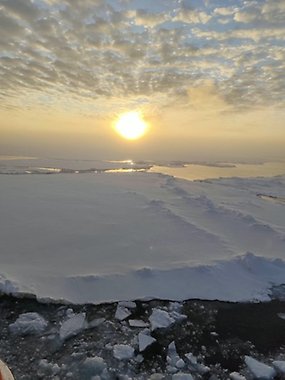
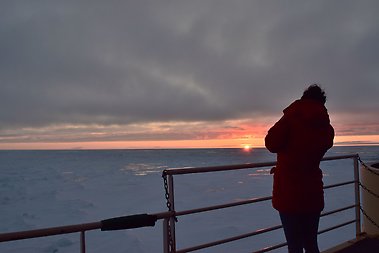
  • Caption: Faustine taking pictures of the beautiful sunset.

    Expedition Arctic Ocean 2026, blog post 17: Goodbye Arctic!

    A few of days ago, on our way south, we saw the first real sunset of the cruise. Shortly before midnight the sun touched the horizon and rose back up from the ice. It was a stunning view, but even more interesting was the atmosphere up on the bridge. People gathering and waiting for the sunset to come. It was really heartwarming to see how many people were eager to admire nature doing its course.

    Department of Meteorology
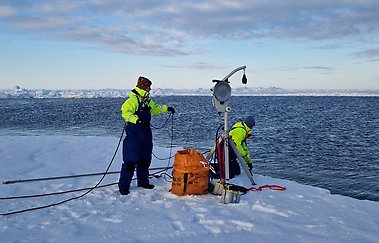
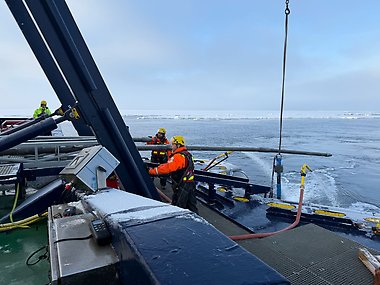
  • Richard Gyllencreutz and Matt O’Regan guiding the 12 m long piston corer (used for collecting sediment cores from the seafloor) into the sea.

    Expedition Arctic Ocean 2026, blog post 15: Inside the Research School

    Five weeks into the expedition, the routines of life aboard Oden are well established, but there is still something new to learn every day. In these three diary entries, Linnea shares lessons from working alongside other research teams, insights into scientific collaboration, and a closer look at the instruments helping us observe the Arctic atmosphere in one of the world's most challenging environments.

    Department of Meteorology
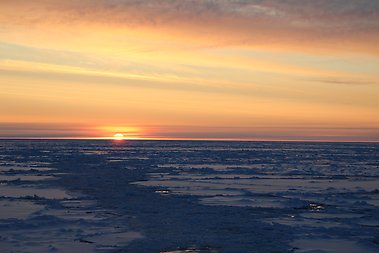
  • Caption: The sun sets over Arctic sea ice on 12 September.

    Expedition Arctic Ocean 2026, blog post 14: Where the sun sets in the North

    We had our first sunset last night. Well, I think it set although it was hard to tell. According to online sun angle calculators the sun was entirely below the horizon, yet we continued to see what appeared to be a sliver of sun hovering above the horizon for what seemed like hours.

    Department of Meteorology
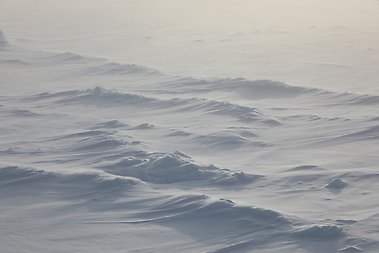
  • Snow accumulating around and blowing over sea ice ridges.

    Expedition Arctic Ocean 2026, blog post 13: Blanket

    We just had an amazing blizzard, at least for Arctic standards. The snow was coming down, like one of those powder days back home in the Colorado mountains when you can’t wait to get up to the slopes to ski some light and fluffy turns.

    Department of Meteorology
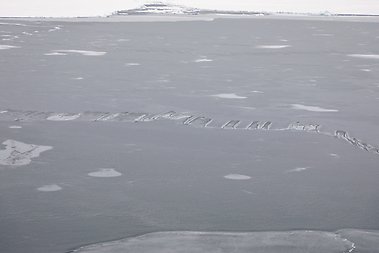
  • Caption: Grease ice forming on open water areas, pictured here with finger rafting.

    Expedition Arctic Ocean 2026, blog post 12: Greasy

    There has been a fascinating transition happening in the past two days. The open, ocean water in between ice floes has started to freeze. This process begins with the formation of grease ice. It is clearly some sort of “solid” interface sitting on top of the water, although it is still quite flexible allowing waves to propagate through.

    Department of Meteorology
  • Caption: Sun at 10:45 am visible from Oden, somewhere in the Arctic Ocean.

    Expedition Arctic Ocean 2026, blog post 11: Sunset and sunrise

    It’s been a couple of weeks since we reached the North Pole and now we are moving around the other side of the Arctic Ocean. Since we left from Svalbard we have lived in constant daylight, but lately we have been experiencing almost a day-night cycle. In the morning when we wake up, it’s very bright outside.

    Department of Meteorology
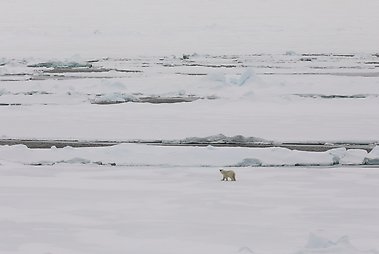
  • Caption: Polar bears are known to be very curious, this one kept turning to look at us.

    Expedition Arctic Ocean 2026, blog post 9: Polar bear!

    Yesterday we saw a polar bear! It is actually not the first one we have come across, we also saw one a couple of days ago, but that one was so far away that it was hard to see it even with binoculars. But last night I got a call on my ship phone as I had just gone to bed, and Faustine told me that there was a polar bear close to the ship. I called Melissa, in the met team phone chain we had established in case there was a bear sighting – no one wants to miss that!

    Department of Meteorology
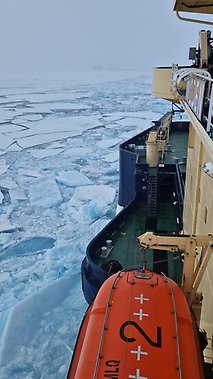
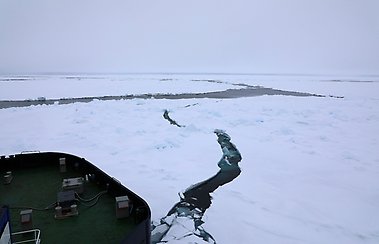
  • Caption: Oden pushes through an area of heavy ridging in the sea ice.

    Expedition Arctic Ocean 2026, blog post 8: A (somewhat) more typical Arctic

    I’ve felt increasingly uneasy about the state of the Arctic system as we’ve travelled north, and then south after passing the North Pole. So much open water. Large stretches, and one after another. It made for smooth sailing, but it’s not a good sign for the ice. At the same time, apart from our first day in the ice, we’ve seen almost no open melt ponds (perhaps a better sign for the ice!).

    Department of Meteorology
  • Expedition Arctic Ocean 2026, blog post 7: What do scientists act like?

    I was asked if I went on vacation prior to this expedition. Several people I have spoken with spent time on holiday before the expedition. I have spent the summer working almost every day, preparing major projects for my PhD before I departed for Oden, knowing that I will not be able to attend to them while I am away.

    Department of Meteorology
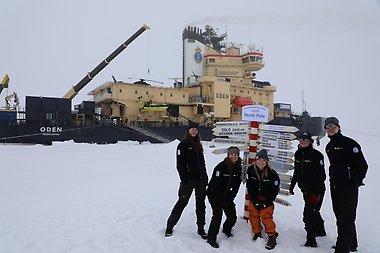
  • Caption: The meteorology and aerosol team on the ice, with the traditional North Pole pole indicating the distance to the participants' hometowns (from the left: Linnea Huusko and Irene Bellagente (Stockholm University), Missy Westland (University of British Columbia), Faustine Mascaut (Chalmers University of Technology), and Matthew Shupe (University of Colorado, NOAA, and Stockholm University).

    Expedition Arctic Ocean 2026, blog post 6: The North Pole

    Today we arrived at the North Pole! When we started getting close to the pole we all gathered on the bridge as the crew guided Oden as close as possible to 90°N. As far as I was able to tell, we reached 89°59.9960’N, which is only a few meters from the true North Pole (measured from the center of the ship). We celebrated reaching the pole with (nonalcoholic) bubbles and a fanfare on cornet and clarinet.

    Department of Meteorology