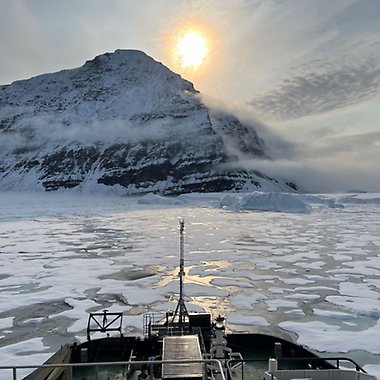
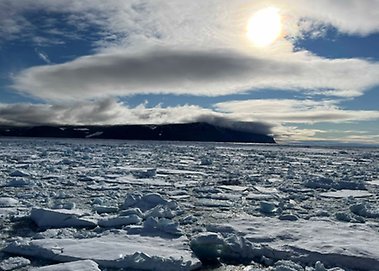
August 20, 2024, Johan Nilsson. For the last few days, Oden has been operating just outside the Victoria Fjord. The setting is beautiful and dramatic. 2024-08-20; 82°N, 50°W
August 15, 2024, Johan Nilsson. We have now reached deep into the Arctic and are at 82 degrees north, just off the coast of Greenland. Currently, we are at the entrance to the Sherard Osborne Fjord, which Oden visited in 2019.
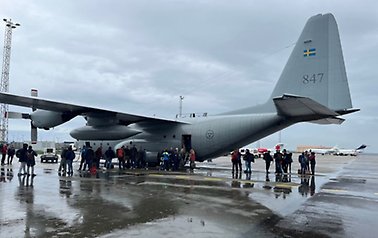
August 7, 2024, Johan Nilsson. Oden has just begun its journey northwards from Pituffik (formerly Thule). Oden was anchored in the fjord outside Pituffik Air Base, which is the northernmost location with permanent residents in western Greenland.
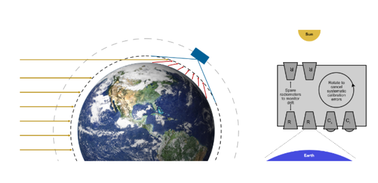
MISU’s researcher Thorsten Mauritsen has been awarded funds from the Swedish National Space Agency to develop the satellite project Earth Climate Observatory (ECO) which is competing to be part of the European Space Agency ESA’s program Earth Explorer. The project is one of four main candidates and in 2029 one of these candidates will be chosen by ESA for the program.
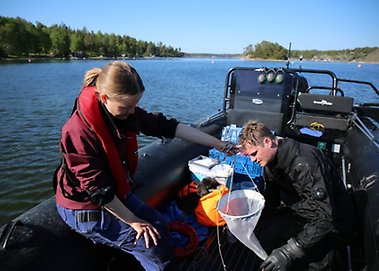
Large predatory fish have become harder to find in the coastal bays of the Baltic Sea, which are now dominated by sticklebacks. Many of these bays have also become more turbid and show signs of severe eutrophication. Scientists have seen this shift spread from the open sea to coastal environments and are now looking for explanations as to why this has happened and whether it could contribute to unforeseen climate impacts. In one of the largest field sampling programmes of the year, the FORCE project map changes and how best to restore coastal predatory fish stocks and biodiversity. From Västervik to Östhammar, the composition of fish species, plants and algae living in 32 different bays will be analysed. In addition, samples of nutrient levels and plankton will reveal the water quality in these areas. The sampling station at Krysshamnsviken in the Stockholm archipelago is a hive of activity, with several fishing nets being thoroughly sorted and rinsed on the adjacent boat jetty and beach, while samples are collected by divers and assistants in a rib boat out in the bay. Krysshamnsviken is one of 32 sites that FORCE researchers surveyed in 2014 to investigate the relationship between fish species, vegetation and water quality. Now, 10 years later, they are back to see how these have developed. " These bays are very different. They have different amounts of predatory fish and sticklebacks, as well as different levels of protection from fishing. The number of seals and cormorants in these areas also vary. In total, this gives us a better picture of the causes and possible measures, such as fishing closures, to improve the environmental status," says Johan Eklöf, Professor in Marine Ecology at the Department of Ecology, Environment and Plant Sciences at Stockholm University and project leader for FORCE. Link between sticklebacks and climate change The decline in predatory fish such as pike and perch and the increase in sticklebacks is affecting many natural values. The situation has contributed to turbid bays with more filamentous algae and severe symptoms of eutrophication. More predatory fish help to keep water areas clean and clear, and could counteract these symptoms. The researchers are now trying to find out whether stronger populations also could be linked to climate effects. " We will investigate whether areas with a lot of predatory fish are better at storing carbon than areas dominated by sticklebacks, where carbon turnover is higher," says Johan Eklöf.
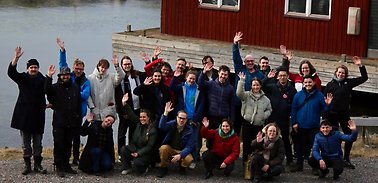
The ARTofMELT science team met the first time after the expedition in May and June 20223 for a three-day science workshop at Stockholm University 22-24 April. The meeting was a great success and everyone left exhausted but also invigorated and eager to keep working together on understanding when, where and how the Arctic starts to melt in spring.
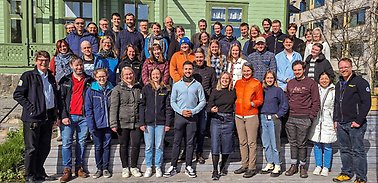
Solving complex questions about interactions between the sea and climate change, and how they relate to society, requires a broad set of skills. In a new research school, PhD students from diverse scientific disciplines at Stockholm University get a unique opportunity to learn how transdisciplinary approaches and research communication can lead to sustainable management of coastal environments. What unites students in from widely varied subjects like marine geology, business accounting, and ecotoxicology? They all provide important perspectives necessary to answer questions on societal challenges and solutions to climate change in coastal seas. During a kick-off meeting for the research school Perspectives on climate change in coastal seas in March, 14 new PhD students were introduced to this framework that will be their research focus for the coming years. "I feel proud to be part of this program, and though this transdisciplinary context is new to me, I think I have a lot to bring to the table," says Emma Flévaud, PhD student in environmental law. Adding new pieces to the puzzle The oceans face multiple climate-related pressures such as acidification, oxygen deficiency and rising temperatures. These, among others, cause feedbacks that release potent greenhouse gases into the atmosphere, reinforcing the climate effects. However, under healthy conditions with prospering ecosystems, the coastal zones have effective carbon storage capacities and can be important carbon sinks. "If we manage the coastal zones right, they could globally contribute to 20 percent of the greenhouse gas emission reductions we need to fulfill the Paris Agreement," says Christoph Humborg, Scientific Director at Stockholm University Baltic Sea Centre and one of the initiators of the research school. This intricate puzzle is partly understood and described in science, and questions remain about the links between climate change, biodiversity and the full potential of the coastal zones to serve as climate mitigators. In research initiatives like CoastClim experts in ecology, modeling, marine physics, and atmospheric sciences explore these links. For the next couple of years, the students from Stockholm University will be involved in research questions that add important information in this context.
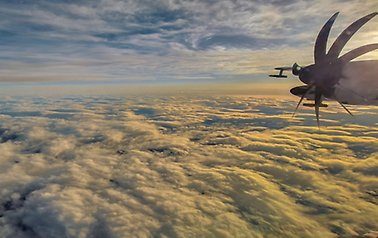
During the four weeks I have followed the CAESAR field campaign in Kiruna, the meteorological conditions have still not been ideal to study the phenomena we are interested in – Could Air Outbreaks. But we still have got six flights and now conditions are turning more favorable.
There are large gaps in the knowledge of the relationship between aerosols and clouds, which makes it the largest uncertainty factor in climate models. Annica Ekman, Department of Meteorology, and Paul Zieger, Department of Environmental Science, have received funding for the project ”Clouds and climate transitioning to post-fossil aerosol regime: CleanCloud” from Horizon Europe. The project aims at substantially increasing the knowledge about the interplay between aerosols and clouds and improving the representation of related processes in climate models.