


Baltic Breakfast: The ocean is warming – and the Baltic Sea is changing even faster
Stratification in the Baltic Sea is increasing at a much faster rate than the global average, and marine heatwaves are becoming more frequent and intense. At Baltic Breakfast, oceanographer Fabien Roquet and marine researcher Norman Göbeler explained how warming is reshaping the sea, and how the change is outpacing science.
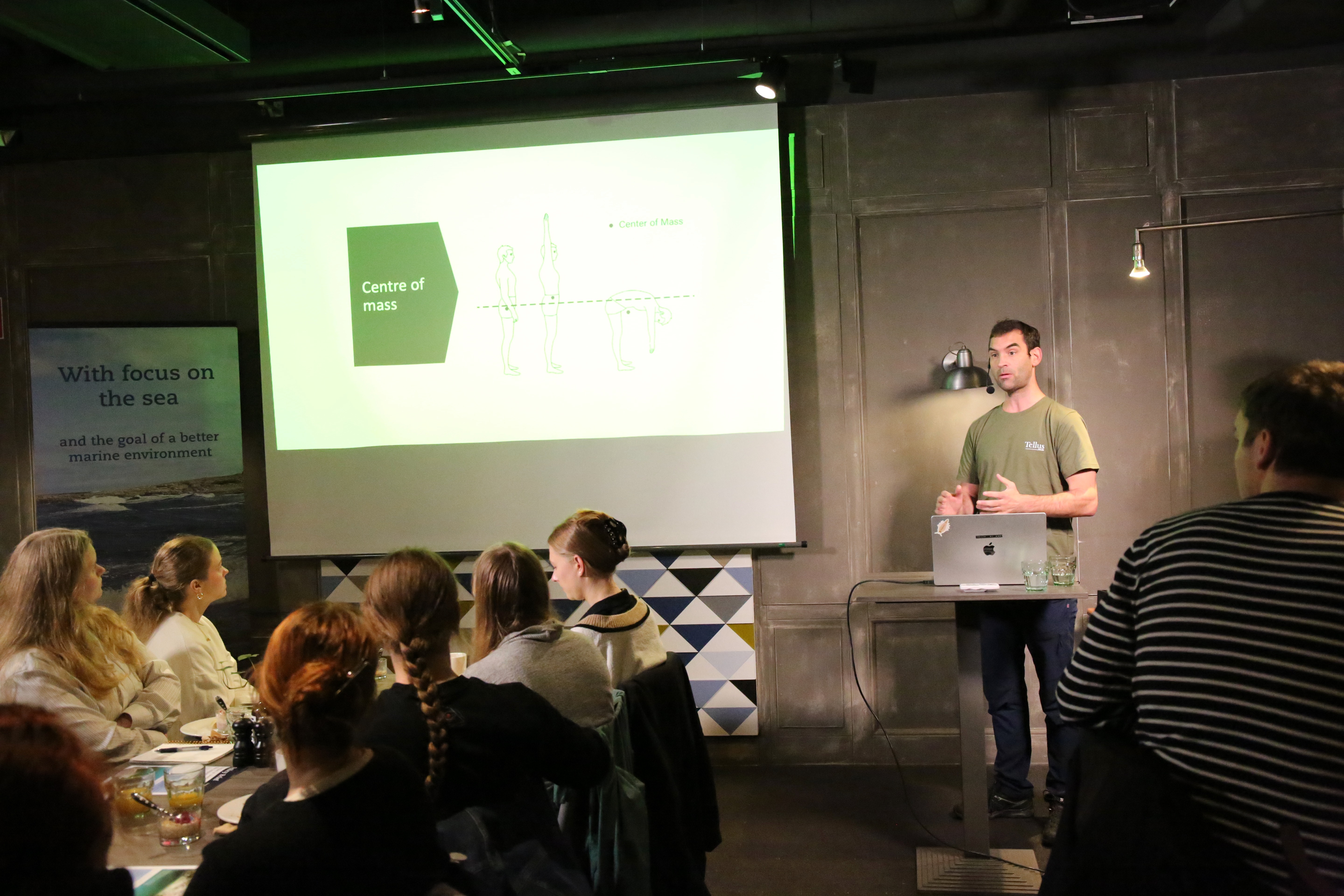
Fabien Roquet, Professor in Physical Oceanography at the Department of Marine Sciences, University of Gothenburg.
“Almost 90 per cent of the excess heat goes into the ocean,” says oceanographer Fabien Roquet, University of Gothenburg. The result is record-high sea surface temperatures.
“Because water has a very high heat capacity, even small temperature changes represent enormous amounts of energy,” he explains.
Unsurprisingly, this changes the ocean, including the way the water is layered according to density, or stratification. Stratification is important because density acts as a barrier to the exchange of properties and sets the main direction of water flow, Roquet says.
“In particular, it controls the exchange of nutrients, which is very important for marine production. It controls the exchange of heat, of carbon – and therefore the capacity of the ocean to store excess carbon from the atmosphere – and of oxygen. So it has a deep influence on climate and marine life. If stratification changes, that of course has very wide impacts on all aspects of the ocean.”
A layered ocean is becoming more layered
The latest report from the IPCC, the UN body that assesses the scientific evidence on climate change, concludes that stratification has most likely increased since at least 1970.
To quantify this change, Roquet's approach is to track the ocean's centre of mass. As the upper ocean warms, its volume increases and its density decreases, which pushes the centre of mass down.
“The higher the stratification, the lower the centre of mass,” he says.
Applying the method to ECCO, a reconstruction that combines an ocean model with satellite and in situ observations for 1992–2017, he finds a clear global trend of about 1 per cent increase in stratification per decade. Roquet’s presentation projects where the trend leads by the end of the century:
“If we continue with that trend – and given current politics there is no reason to think it is going to change – we should expect around a 10 per cent increase, plus or minus 5 per cent, in the global stratification of the ocean.”
The Baltic Sea is a hotspot
The increase is uneven. It is fast in the Arctic and the tropics, and in a preliminary analysis of the European seas, the Baltic stands out:
“The Baltic is a hotspot of stratification increase, where stratification has increased by 10 per cent per decade, so much faster than the global average.”
Moderator Gun Rudquist asks a follow-up question on the consequences of this change: should we think of them as negative consequences, or can they actually be positive?
“When things change, you just have to see what the new reality is. But I would describe the consequences as net negative. For many decades it will disrupt the ecosystems, and it will probably also amplify some of the other changes that are happening,” Roquet answers. “If it is more stratified in summer, then the warm layer is thinner, so the amplitude of seasonal variability is expected to increase.”
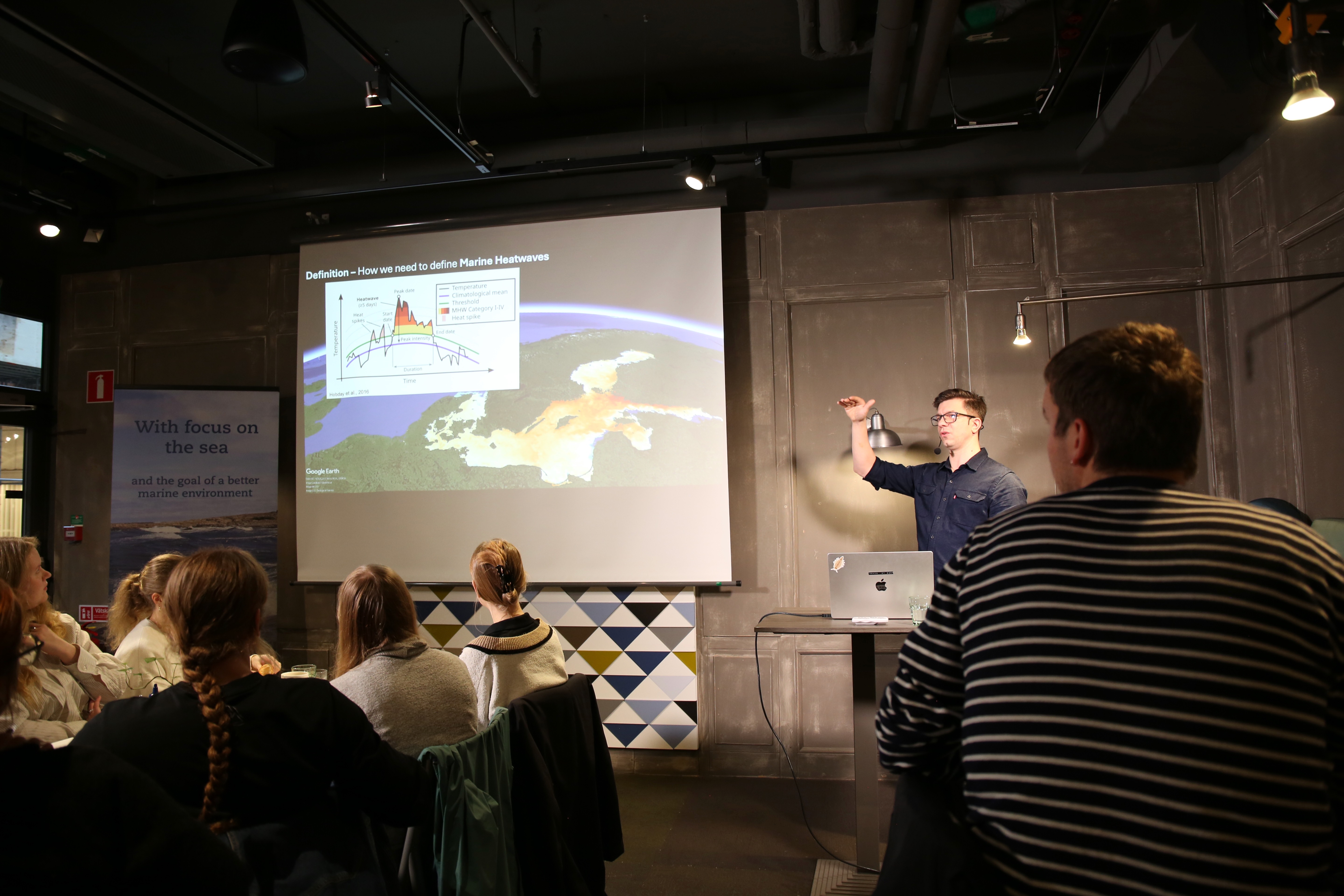
Norman Göbeler, reseacher at Tvärminne Zoological Station, Helsinki University.
Marine heatwaves: growing frequency and intensity
But it is not only the mean temperature and the stratification of the water that are changing. So are the frequency and intensity of marine heatwaves.
The summer of 2018 brought a large heatwave over Europe, causing drought, crop failures and wildfires. What received less attention was the massive marine heatwave that hit the Baltic Sea.
“A heatwave in the ocean doesn't produce any smoke,” says Norman Göbeler, a postdoctoral researcher at the Tvärminne Zoological Station, University of Helsinki, quoting a colleague. “It's similar to a wildfire on land, but we don't see it.”
When a heatwave occurs on land, it comes with public warnings. As an example, Göbeler points to the webpage of the Public Health Agency of Sweden, which says, in essence, that Sweden is not used to high temperatures, so negative health effects can appear at considerably lower temperatures than, for example, in Southern Europe. The same goes for marine ecosystems, he states.
Definition of a marine heatwave
A marine heatwave is defined using 30 years of data: the temperature must exceed the 90th percentile for the specific place and time of year for at least five days. The definition builds in local adaptation. In 2018, the temperature reached around 20°C in the northern Baltic, which counted as a strong heatwave. The southern Baltic Sea also experienced a strong heatwave, with temperatures around 25°C.
“So it depends on the local place, and on what the respective ecosystem is adapted to,” says Göbeler, adding that heatwaves can occur in any season, including winter.
Göbeler’s workplace, the Tvärminne Zoological Station on the Finnish coast near Hanko, is a good location for studying these changes, as the station has in situ data dating back to 1926. They show that the average temperature in the surface layer has increased drastically, particularly after the 1980s, and that extreme events have become more frequent, particularly after 2000.
“That is not to say they didn’t happen in the past, of course, but the frequency is drastic nowadays,” says Göbeler.
Different processes in summer and winter
So how do these extreme events happen? The Baltic is a very shallow sea, small relative to the global oceans, and it stretches from a maritime to a subpolar climate. It is therefore very much affected by atmospheric changes. However, the processes are a bit different for summer and winter heatwaves, says Göbeler.
During the summer, a heatwave can be caused by a high-pressure system sitting over Scandinavia, with low winds, cloudless skies and high air temperatures – nice summer weather for us humans, but also weather that causes very severe warming in the sea, particularly in the surface layer.
Winter heatwaves, on the other hand, result from a deep low-pressure system over the Atlantic and high pressure over Europe, which brings strong, warm winds from the North Atlantic into the Baltic Sea.
“These mix the water, bringing up the warm bottom water to the surface, reaching coastal systems. Winter heatwaves are also usually more persistent once they happen,” says Göbeler.
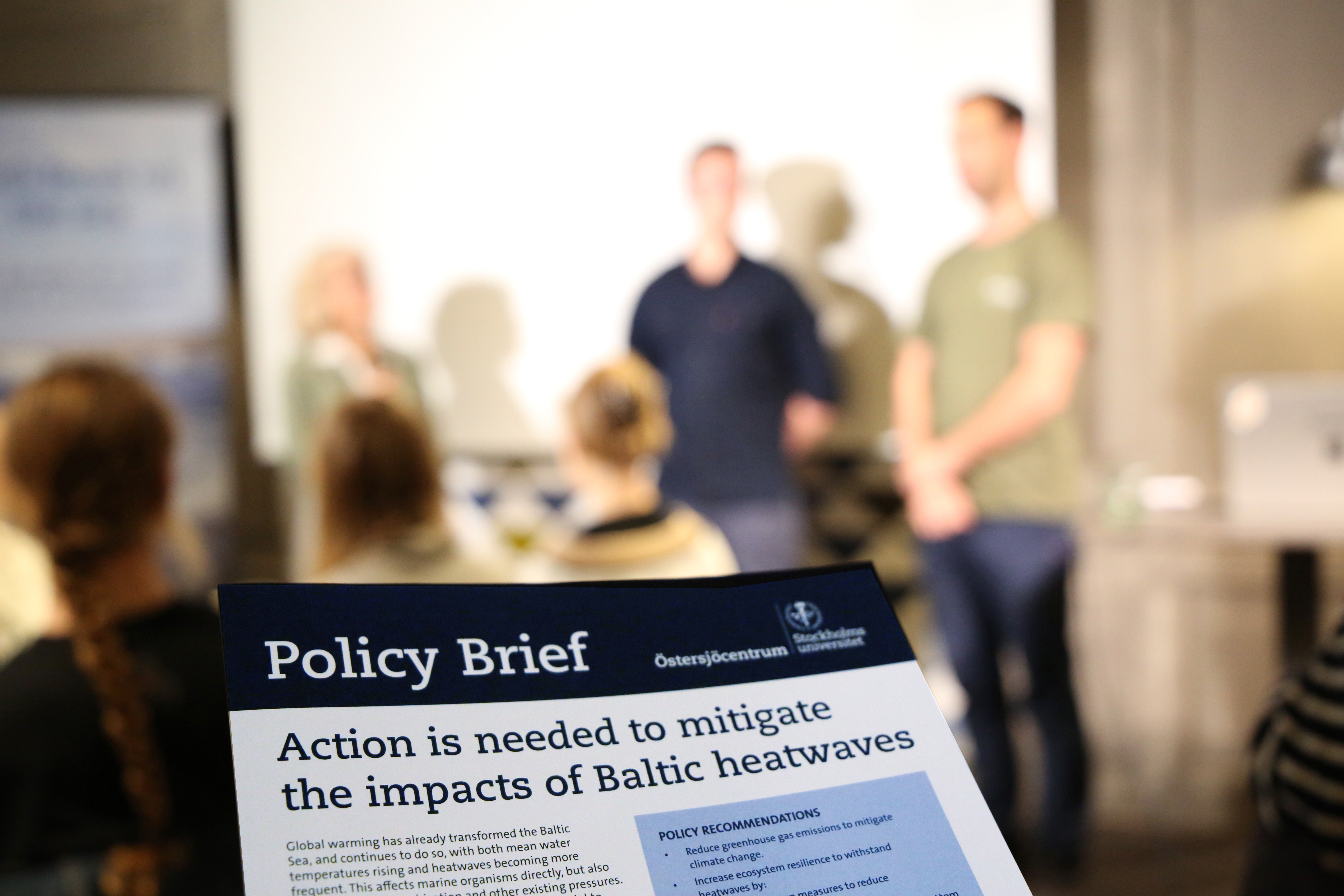
A new policy brief about marine heatwaves was released at the Baltic Breakfast seminar.
Effects on organisms and ecosystems
When it comes to the effects of heatwaves on marine organisms, Göbeler outlines three perspectives that are linked but can be looked at separately: the stress on organisms, shifts in ecological processes, and changes in ecosystem functioning.
Every organism has a certain tolerance range of temperature, and when it is exceeded, performance declines.
“During a heatwave, a species may exceed its critical temperature and then has to act upon it or experience mortality. But we are talking about an ecosystem with a multitude of species, and species number two may have a good time at those temperatures, and then proliferate and dominate during that time.”
Heatwaves at different times of the year cause different ecological effects, he continues. Winter heatwaves reduce herring larvae in spring, and the same has been found for the Baltic clam Macoma. Warming in spring can also cause malformed embryos. Spring heatwaves ca, om the other hand, increase growth in seagrass habitats.
Many of the problems, Göbeler explains, occur due to an energy imbalance.
“It is often a mismatch between when an organism needs energy and when food is actually available that causes problems.”
Warmer water, less oxygen
A heatwave strengthens the thermal stratification, which can interrupt the vertical mixing of the water and the flow of energy from the surface to the deeper layers. Warm water also holds less oxygen.
“So you have two processes happening at the same time: the warming causes outgassing of oxygen, and the animals and other organisms living there respire more and take up more of that oxygen,” says Göbeler. “And we are thinking of the Baltic Sea, which already has problems with anoxia and hypoxia.”
On the sea floor, the effects are visible too.
“I typically work with benthic animals on the sea floor,” says Göbeler. “We see increased process rates, increased bioturbation, which can cause increased nutrient release to the water column and also increased greenhouse gas production.”
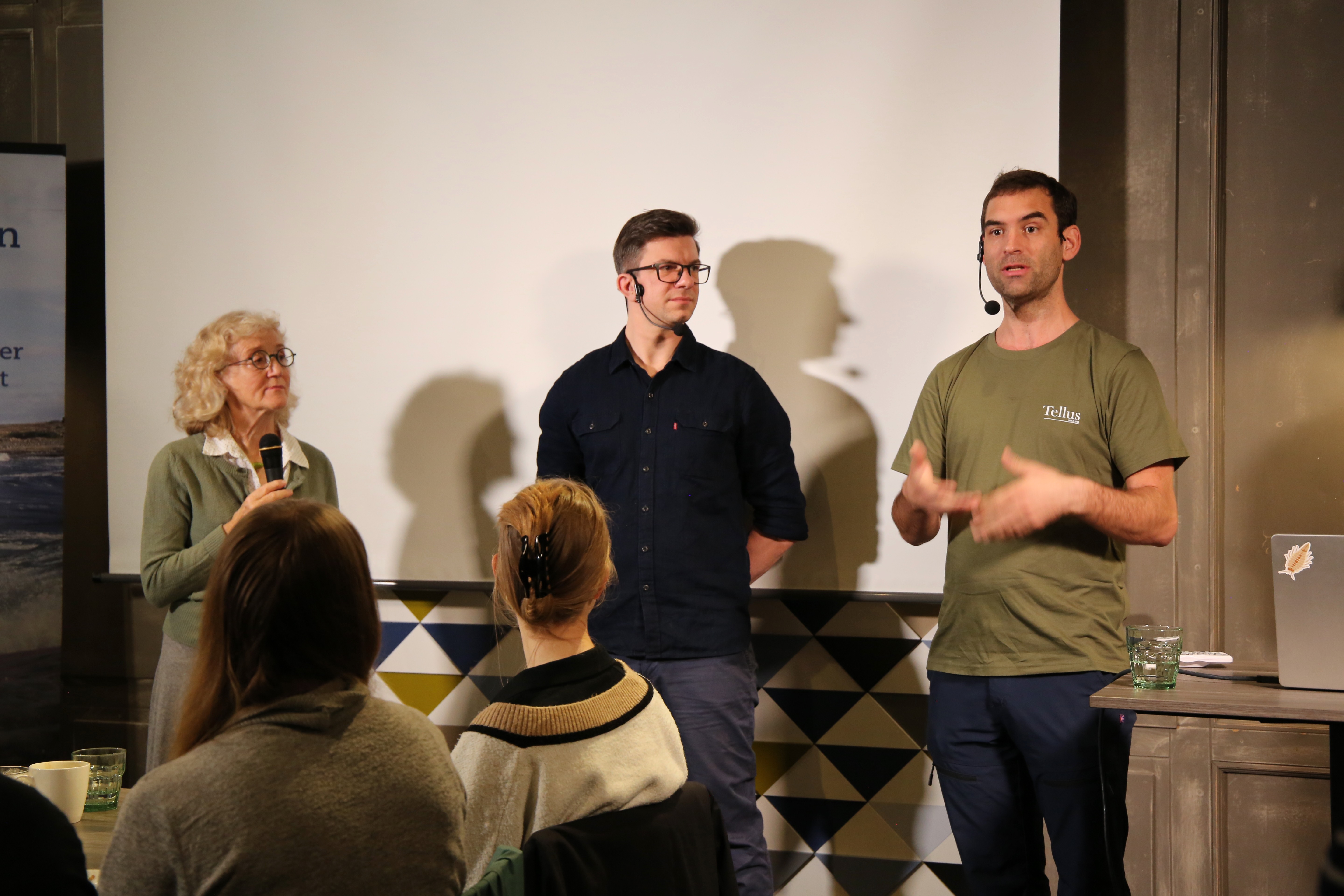
Moderator Gun Rudquist together with the researchers Norman Göbeler and Fabien Roquet.
Change faster than science can follow
Göbeler stresses that most knowledge about heatwaves comes from the open ocean rather than from the coastal zones where many key habitats are found. It is relatively easy to fly over the Baltic and see a cyanobacterial bloom, he notes, but much harder to see what happens to habitats beneath the surface.
To deepen the understanding, Göbeler’s team has built a system to expose natural habitats to heatwaves in the field. Preliminary results show that the same species can experience a heatwave differently depending on the habitat. In addition, many other types of studies are under way, including other experiments and modelling.
Göbeler’s conclusion is stark: marine heatwaves are intensifying and amplifying the Baltic Sea’s existing problems, such as eutrophication and expanding hypoxic zones.
“The change we are seeing nowadays is ridiculously fast and nonlinear. We only see a part of what is actually happening.”
Monitoring is not keeping pace, so some phases of the change may be missed, he adds.
“In short, we are currently in a time where the change is happening faster than we can follow. We need to speed up our science and speed up the changes that we are making.”
Text: Lisa Bergqvist
Last updated: 2026-11-09
Source: Stockholm University Baltic Sea Centre