News

  • Stockholm University film awarded at Explorers Festival

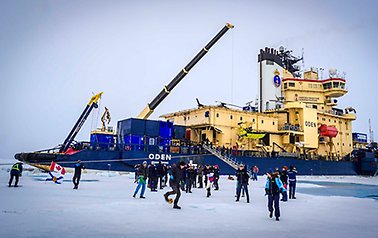
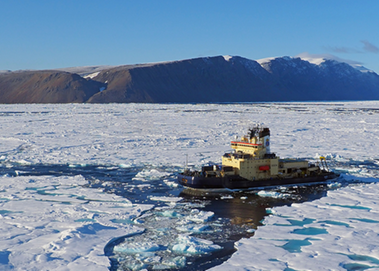
    The Stockholm University film ”Chasing the Arctic Melt” was awarded ”Best Science Film” at the Explorers Festival in Iceland in November. The film takes place aboard the icebreaker Oden, where a group of scientists study the rhythm of the Arctic melt, revealing the human side of research. See the film produced by Stockholm University
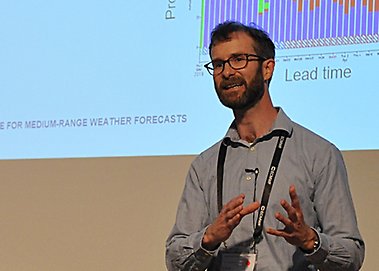
  • Linus standing talking and gesturing in front of a big screen presentation.

    Linus Magnusson, ECMWF, Adjunct Professor at MISU

    Linus Magnusson from ECMWF, the European Centre for Medium-Range Weather Forecasts, is appointed Adjunct Professor at MISU on 10 percent, from 1 September. He will e.g. supervise Master degree projects, do Arctic research related to forecast evaluation and model/observation improvements, support planning and forecasting during Arctic campaigns, and some preparation of course material.

    Department of Meteorology
  • Mesocosm experiments can reveal how warming and animal communities affect greenhouse gas emissions

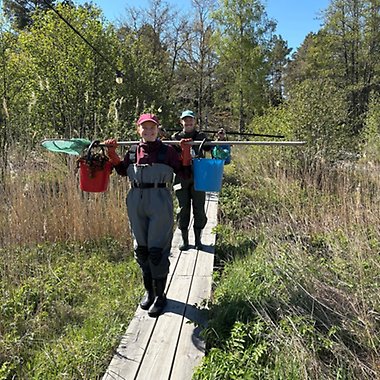
    Creating controlled mini-ecosystems, called mesocosms, is one way for researchers to study factors that influence processes in the sea. This summer, a large experiment of this kind was conducted at the Askö Laboratory, to investigate how emissions of greenhouse gases from shallow coastal bays are affected by global warming and by animal communities in the water and sediment. Understanding the connection between coasts and climate is a key question for researchers in CoastClim . This summer, Sara Westerström and Moritz Nusser from the Research School Perspectives on Climate Change in Coastal Seas took a new approach to investigating how small animals in the water and in the seafloor can affect greenhouse gas emissions, both now and in a warmer future.

    Stockholm University Baltic Sea Centre
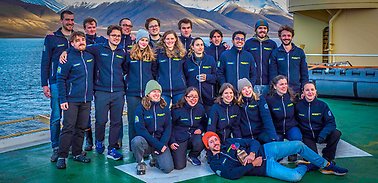
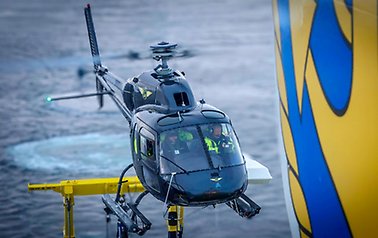
  • The 21 students in the research school gathered on helicopter deck.

    The expedition Arctic Ocean 2025, blog post 7: A last hello and goodbye

    The research school onboard the research ice breaker Oden has come to an end. In the evening the day before yesterday we did our last research station and deployed a mooring in the marginal ice zone, where the pack ice meets in the open ocean; a permanent buoy under the the surface that is tethered to the ocean floor and will stay there for the next years. 

    Department of Meteorology
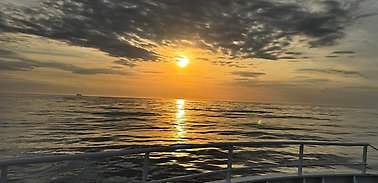
  • Sunset over the Atlantic Ocean. Ship railing in the foreground.

    Mapping Deep Ocean Currents: Uncovering the Hidden Pathways of Overflow Waters

    The recent SWERVE funded FAROX cruise, led by Léon Chafik on RV Skagerak, set out to explore how dense overflow waters move between the Nordic Seas and the North Atlantic. By collecting unprecedented measurements of temperature, salinity, currents, and turbulence, the team mapped deep currents and investigated their role in shaping the climate system.

    Department of Meteorology
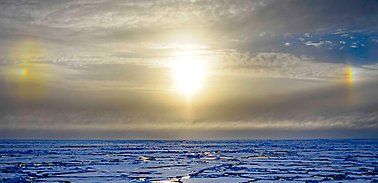
  • Cloudy sky, blue ice, bright sun, "sundogs" to the left and right, rainbow coloured.

    The expedition Arctic Ocean 2025, post 4: Sediment samples – climate archive millions of years old

    Over three weeks have gone for this years Oden expedition to the central Arctic Ocean and we have passed the midpoint with less time left than spent. We have managed to take some more sediment samples; the several meters deep samples represents a climate archive that may go millions of years back in time. Also a rare spotting of the sun, this time with two so-called "sundogs".

    Department of Meteorology
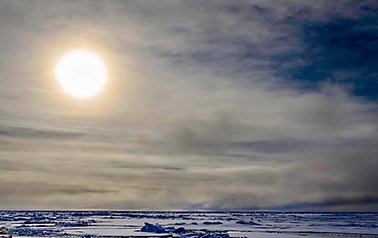
  • Arctic sun, clouds and ice. 

    The expedition Arctic Ocean 2025, blog post 3: Summer Arctic, stubborn cyclone and sediment cores

    A little over a week has passed since the Research school on icebreaker Oden passed the North Pole and we are now relatively far south but on the other side of the pole which has some weird consequences. While the sun doesn't set, it does vary over the day. Since we are still on UTC time (sometimes called Greenwich Mean Time) this means that where we are now, the sun is the lowest in the middle of our day and vice versa.

    Department of Meteorology
  • People playing on the ice, with icebreaker Oden in the vackground.

    The expedition Arctic Ocean 2025, blog post 2: Arriving at the North Pole

    A week has passed on the Swedish/Canadian icebreaker expedition to the central Arctic Ocean and late Saturday afternoon we arrive at the North Pole where we stayed until the very early hours of Sunday. Everyone got together on the bridge and as we arrived on the North Pole we cheered eachother with a glass of (alcohol free) bubbles. After the crew had moored us to an ice floes, we were allowed off the ship for some free time and also the mandatory group photo.

    Department of Meteorology