


Expedition Arctic Ocean 2026, blog post 16: Observing the Arctic Ocean, from Oden and from the ice
Onboard Oden, we are trying to understand how a changing climate is affecting the Arctic. To do that, scientists observe almost every part of the Arctic system: the atmosphere above us, the sea ice around us, the ocean beneath us, the seafloor and its sediments, and the organisms living both in the water and in the ice.
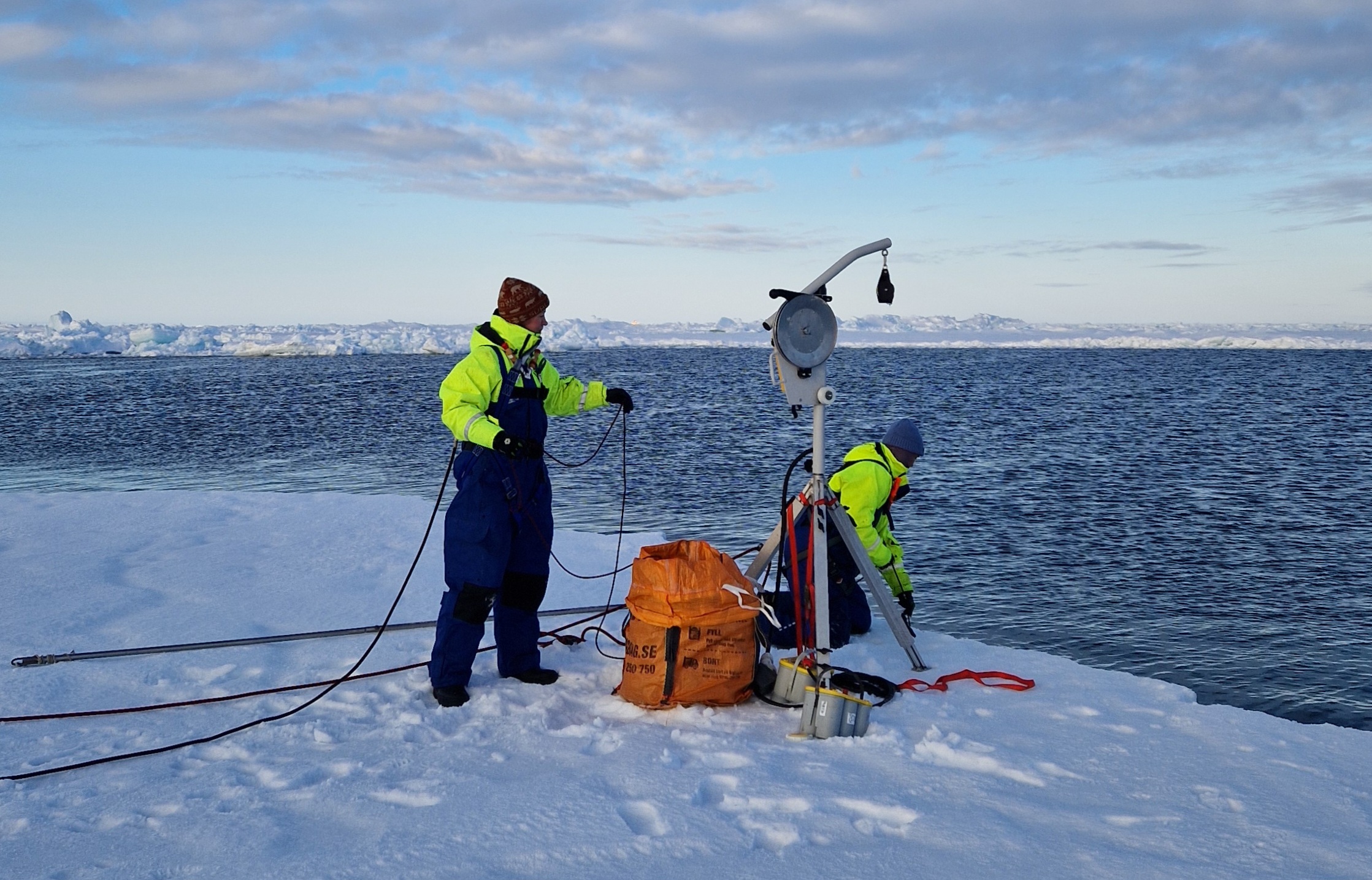
Caption: Susanna Hentschel and Hanna Winge deploying the VMP tool for turbulence observations.
But at the centre of much of this is the ocean.
The Arctic is, after all, largely an ocean surrounded by continents. For me, as a physical oceanographer, this is great news. The ocean connects many of the different research questions onboard, which means that I get to work alongside scientists studying everything from sea ice and the atmosphere to biology and the seafloor. Together with my fellow oceanographers onboard, I am interested in how currents and different water masses move through the Arctic Ocean.
The ocean is far from uniform. Water arriving from the Atlantic has different properties from water entering from the Pacific, while water close to the surface is strongly influenced by melting and freezing sea ice, precipitation and exchanges with the atmosphere. By observing where these water masses are, how deep they are found and how they move, we can learn more about the circulation of the Arctic Ocean.
But there is one obvious difficulty: How do you observe an ocean hidden beneath the Arctic sea ice? Luckily, we have quite a few tools for the job.
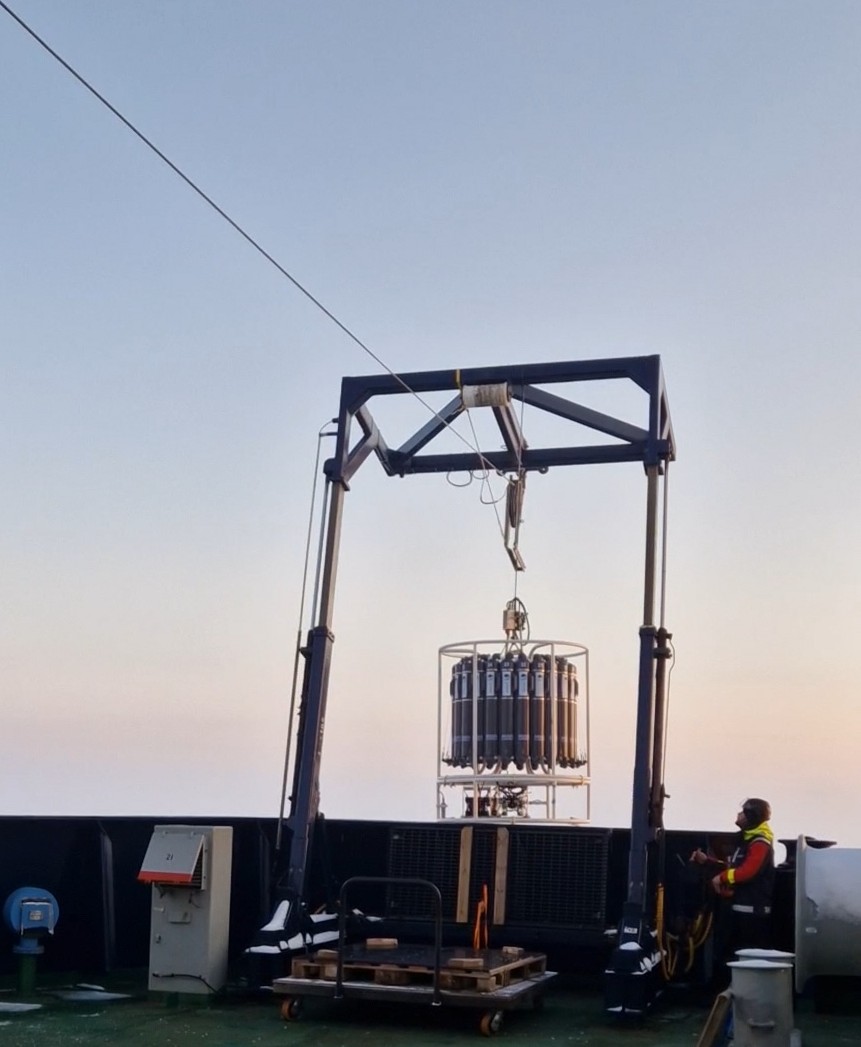
Caption: The CTD being lowered to the ocean floor, more than 4000 meters below the surface.
Four kilometres down – and back again
One of our most important instruments onboard Oden is the CTD, short for “Conductivity, Temperature and Depth”.
The CTD is lowered from the ship through the water column, sometimes almost all the way to the seafloor. Much of the central Arctic Ocean is several kilometres deep, so a full cast can take hours as the instrument travels down through the ocean and eventually returns to the surface.
During its journey, the CTD continuously measures the properties of the surrounding seawater. The result is something like a vertical snapshot of the ocean. Layer by layer, we can see how the water changes from the cold surface beneath the ice to the deeper waters thousands of meters below us. Changes that may look small – a fraction of a degree in temperature or a subtle change in salinity – can tell us that we have crossed from one water mass into another.
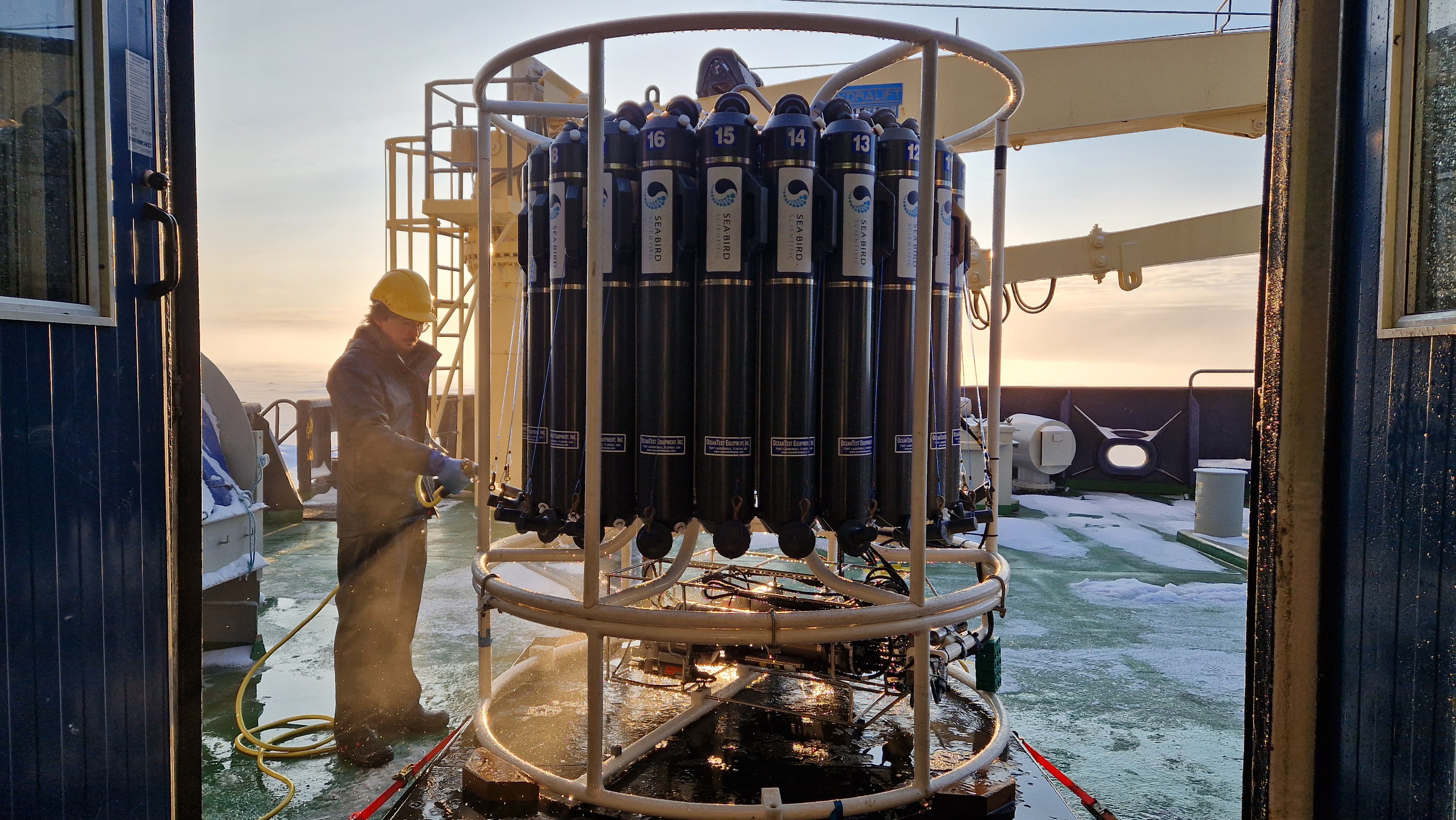
Caption: The CTD being returning with water samples from all different depths from bottom to the surface.
And the CTD does more than measure.
Surrounding the instruments is a large circular frame carrying a series of bottles. On the way back towards the surface, we can close these bottles at selected depths, trapping seawater from different parts of the ocean.
Back onboard, those bottles become a shared resource for many of the scientists on Oden. The water can be analysed for nutrients, algae, microorganisms and many other components. A single CTD cast can therefore connect physical measurements of the ocean with biological and chemical observations.
It is a good example of how interconnected the science onboard really is.
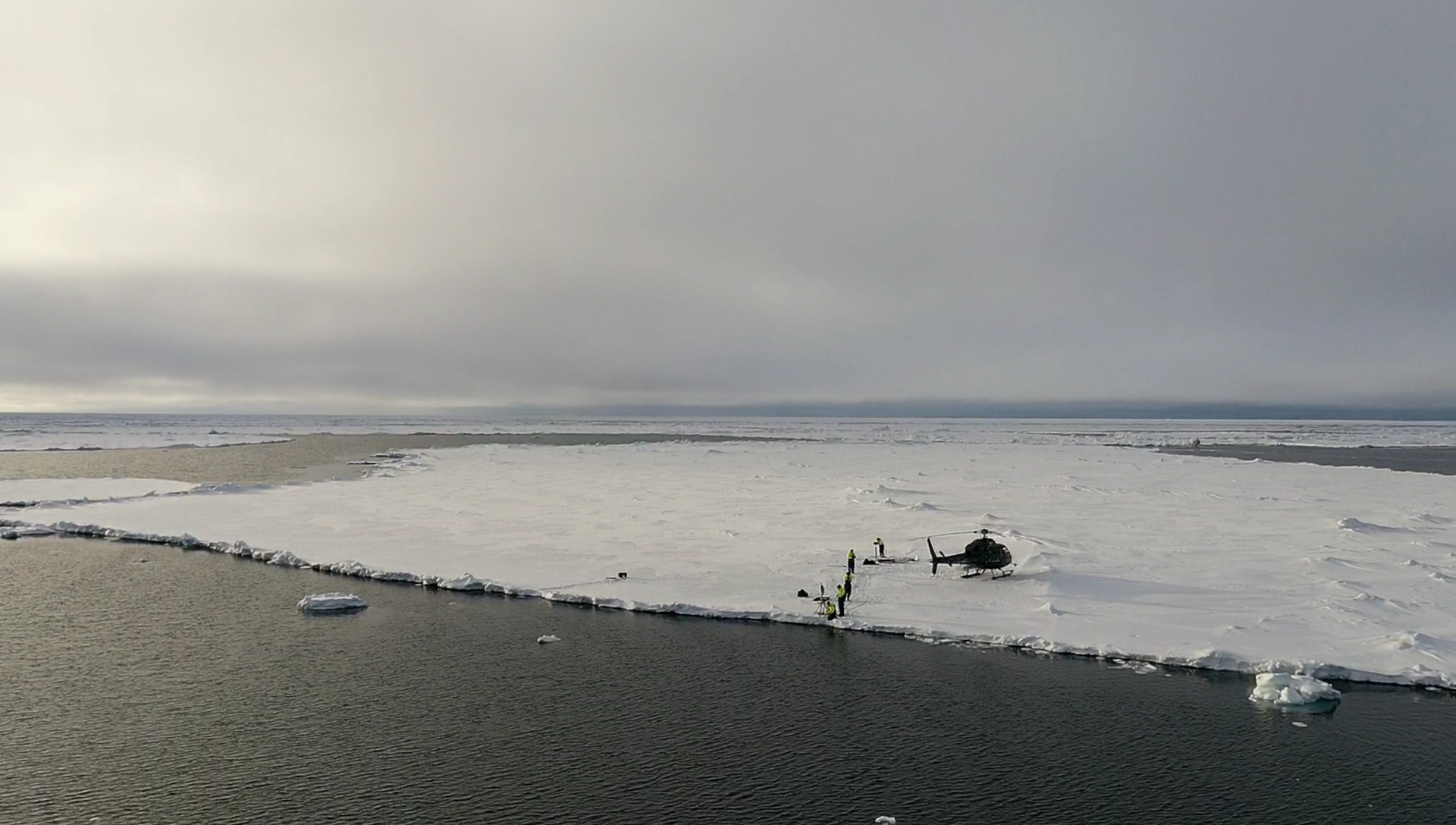
Caption: Making ocean observations at the ice edge.
Sometimes the ship is too big
Oden is an excellent platform for observing the Arctic Ocean. But sometimes there is a problem with measuring from a ship.
The ship itself.
Oden is large, powerful and designed to move through thick Arctic sea ice. Her propellers, hull and movements disturb the water around her. For many measurements this is not a major problem, but when we want to understand the relatively delicate currents and turbulence immediately beneath the sea ice, the ship can become a very large disturbance in exactly the water we want to observe.
So sometimes, instead of bringing the ocean to our instruments onboard Oden, we bring our instruments to the ocean.
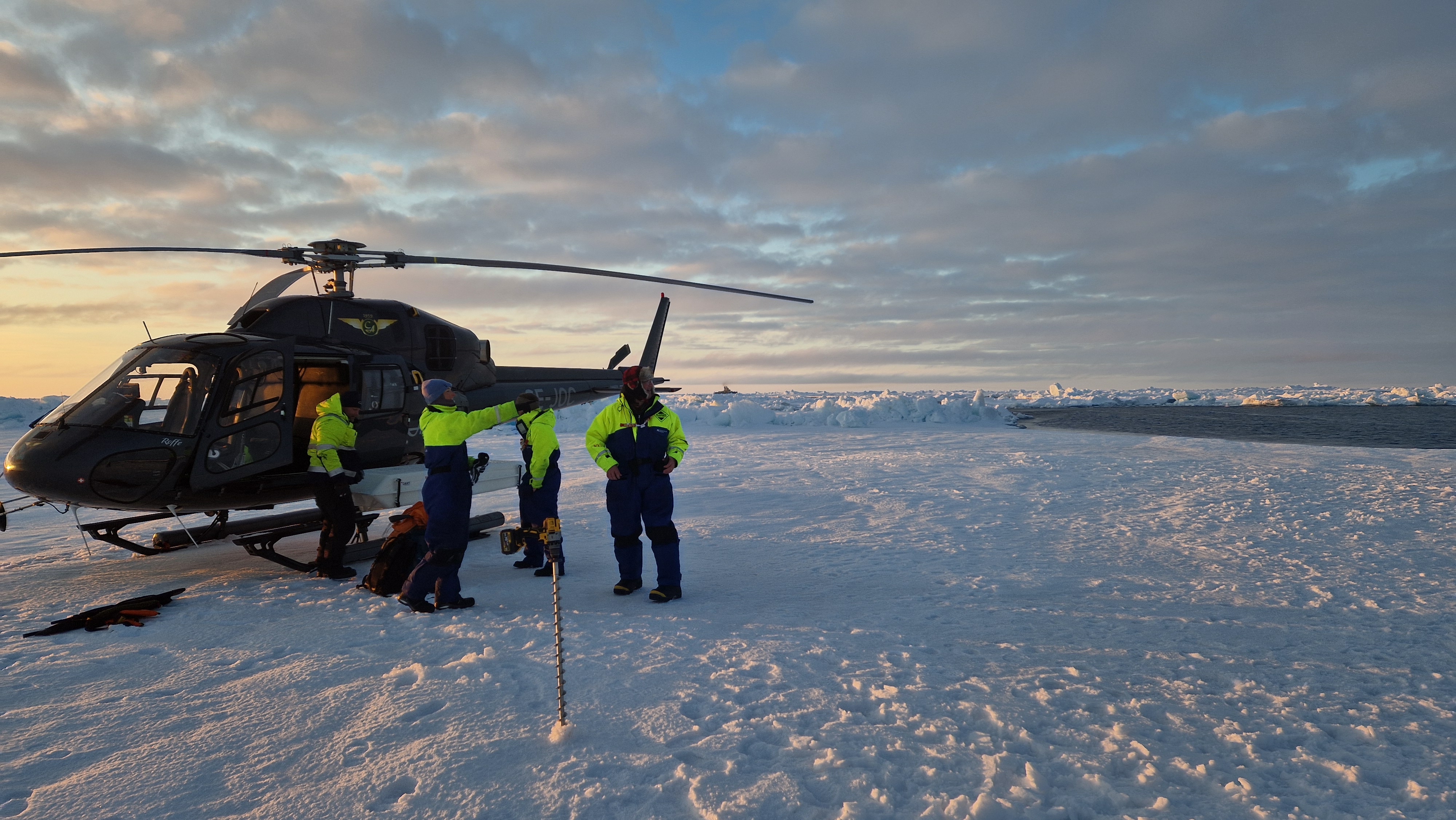
Caption: Unpacking the helicopter and getting ready for observation on the ice floe.
We load our equipment into a helicopter and fly away from the ship to a suitable ice floe.
Before we can start working, the area has to be checked for polar bears and the ice assessed to make sure that it is safe. Then, standing at the edge of the floe, surrounded by ice and an apparently endless white horizon, we lower our instruments directly into the ocean below.
Here we can observe the upper ocean away from the noise and movement of the ship.
These measurements give us another view of the Arctic Ocean: how the water moves directly beneath the ice, how temperature and salinity change with depth, and how energy and momentum are transferred between the ice and the water below.
Caption: Susanna Hentschel and Hanna Winge deploying the VMP tool for turbulence observations.
It is a very different way of doing oceanography compared with lowering a CTD thousands of
Each instrument gives us another small piece of information about an ocean that is mostly invisible beneath our feet.
Put all those pieces together, observations from the ship, from the ice, from the atmosphere, from the seafloor and from the organisms living in between, we can gradually build a picture of how the Arctic system works.
And, ultimately, how it might change in a warmer world.
/Hanna Winge
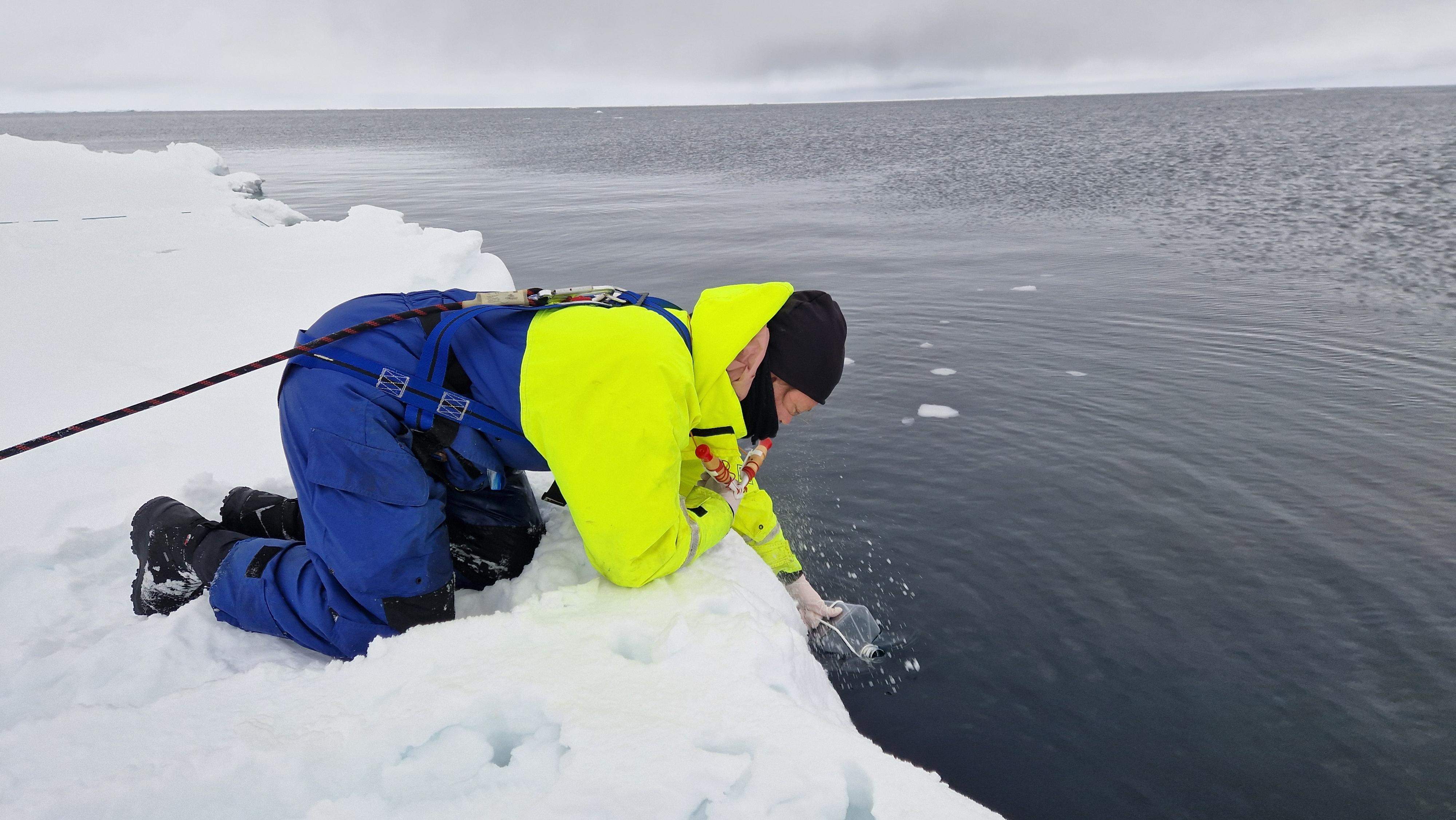
Caption: Linnea Huusko taking water samples from the ice edge.
Last updated: 2026-09-25
Source: MISU