


Major international research expedition underway at Tvären
A large-scale, international and multidisciplinary research expedition is currently taking place at Tvären, a circular bay in the Baltic Sea near Studsvik in Södermanland, roughly 100 km south of Stockholm.
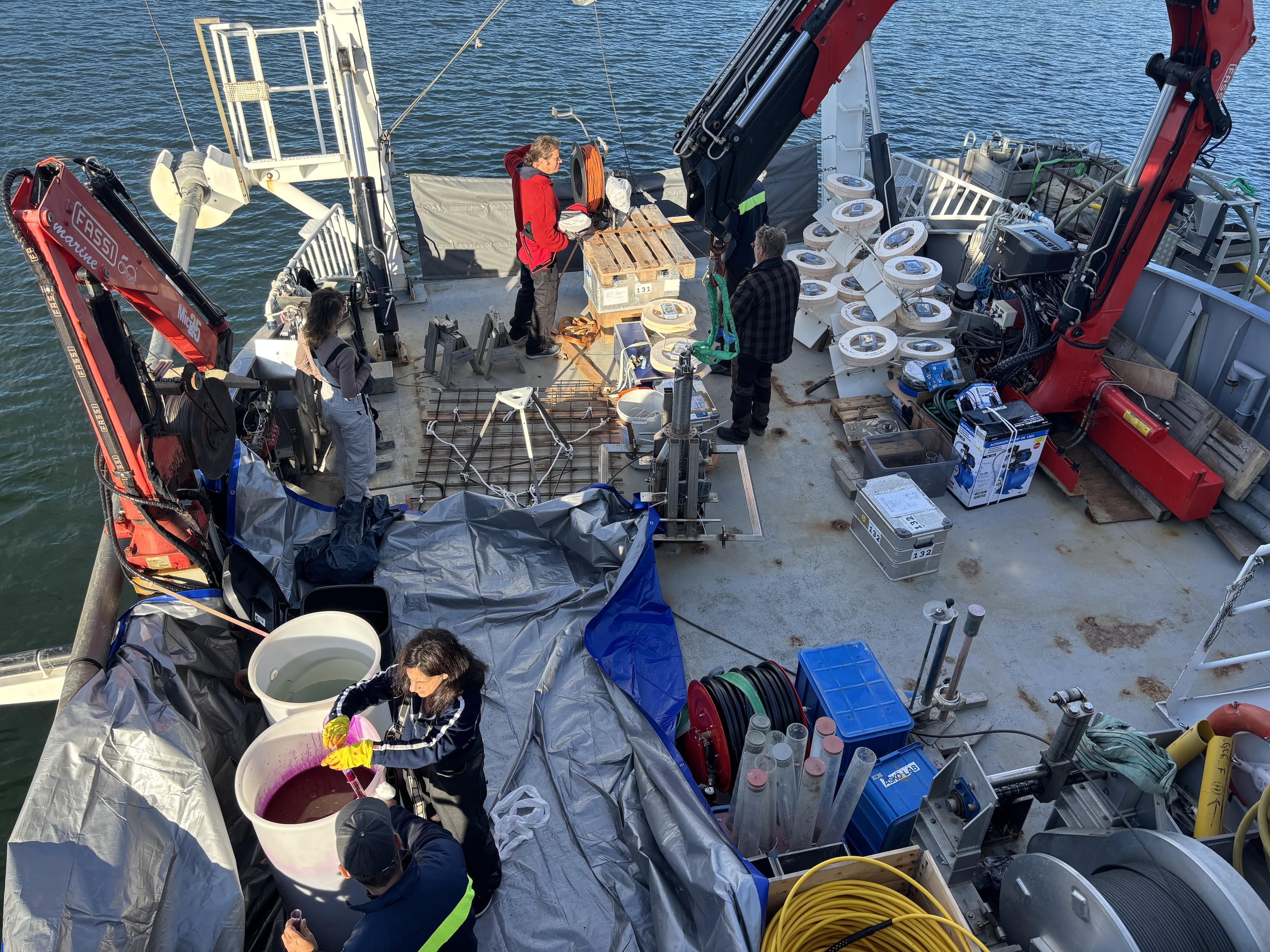
The campaign brings together researchers from several departments at Stockholm University, together with colleagues from the Leibniz Institute for Baltic Sea Research Warnemünde (IOW) in Germany and the University of Brest in France. The team is working aboard research vessel R/V Electra af Askö to study the processes controlling greenhouse gas dynamics in this small coastal basin.
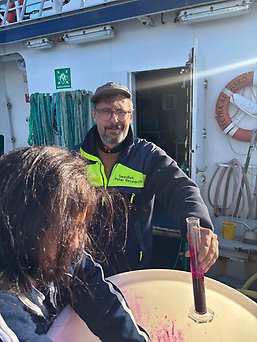
Associate Professor Christian Stranne, at the Department of Geological Sciences, is leading the campaign. Photo: Christoph Humborg
The first intensive phase of the expedition, focusing on physical oceanography, has now been successfully completed. Researchers released a fluorescent dye into the water and followed it for several days as it spread vertically through the water column. It was complemented by horizontal flow measurements at different depths with drifters as well as acoustic measurements (ADCP).
The experiment is designed to measure how rapidly the water is mixed vertically – an important process controlling how dissolved substances such as methane are transported from deeper waters towards the surface.
"The experiment worked extremely well. We were able to follow the tracer for several days and observe how it gradually spread through the water column. This gives us a way of directly measuring the vertical mixing and ultimately helps us understand how quickly dissolved methane and other substances can be transported upwards,” says Christian Stranne, Associate Professor at the Department of Geological Sciences and leader of the campaign.
The campaign is now moving into a second intensive phase, with increased focus on what happens at the interface between the seafloor and the water above. Researchers will collect sediment cores, porewater and water samples and combine these with measurements of methane and other greenhouse gases, seafloor mapping and acoustic observations of methane bubbles escaping from the sediment.
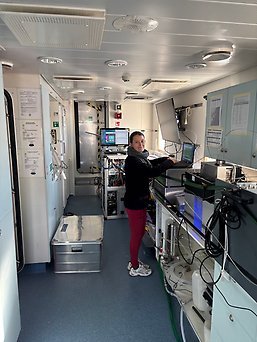
Researcher Julika Zinke, Stockholm University Baltic Sea Centre, is measuring greenhouse gas fluxes during the campaign. Photo: Christoph Humborg
By bringing together physical oceanography, geology, sediment biogeochemistry, microbial ecology and greenhouse-gas measurements, the researchers hope to understand the entire pathway from methane production in the sediment, through transport and transformation in the water column, to its potential release into the atmosphere.
The longer-term ambition is to develop Tvären into a natural observatory where repeated measurements and experiments can reveal how greenhouse-gas emissions from coastal environments vary over time – and how they may respond to future environmental change.
Last updated: 2026-09-25
Source: Stockholm University Baltic Sea Centre