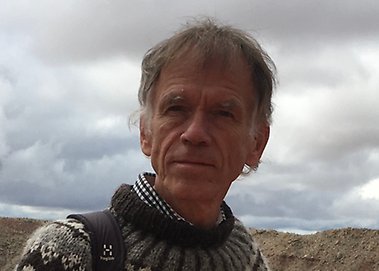
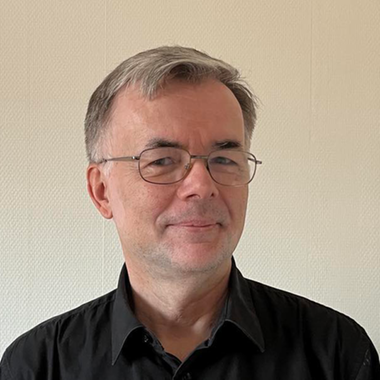
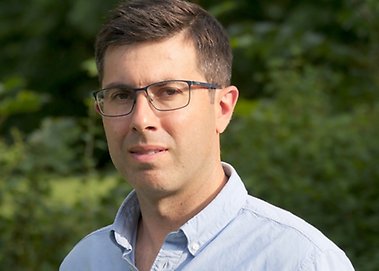
Jesper Sollerman, professor and vice director of the Department of Astronomy at Stockholm University has been chosen as a new Swedish delegate to the council of the European Southern Observatory (ESO).
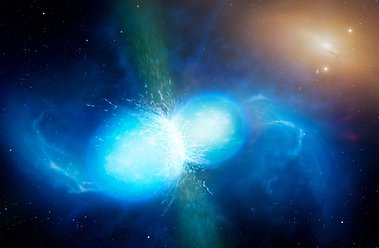
The Into Change Award is presented to exceptional European research by the Danish Ministry of Higher Education and Science. The 2025 price was awarded to the ENGRAVE project which includes several participating scientists from Stockholm University. The ENGRAVE project tries to understand how the heaviest elements form inside kilonovae.
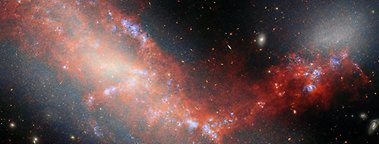
In a new study, led by Giacomo Bortolini from the Department of Astronomy at Stockholm University, a collision of two dwarf galaxies has been observed in exquisite detail. By using the power of the James Webb Space Telescope individual stars in the galaxies can be found and characterized which helps us understand how the interaction between the colliding partners affects them. The data from the study was also used to produce a beautiful image featured as the European Space Agency Picture of the Month for November 2025.
The European Research Council (ERC) has awarded Evan O’Connor, associate professor at the Department of Astronomy, the prestigious ERC Consolidator grant. He is one of thirteen researchers at Swedish universities that were awarded the grant this year.
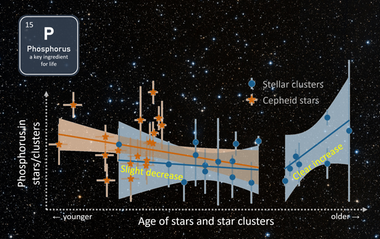
A Stockholm University led team has produced the first age resolved map of phosphorus of our Milky Way. By combining near-infrared spectroscopy with precise age tags from open stellar clusters and classical Cepheid stars, the researchers uncovered a two-track timeline for how this life linked element accumulated in our Galaxy’s recent past.
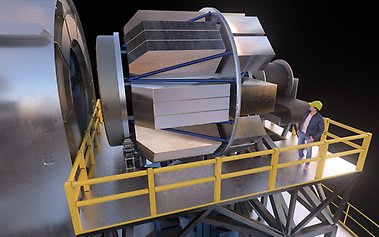
On Monday 1st of December, the European Southern Observatories (ESO) has signed an agreement with a large international consortium for the design and construction of the Multi-Object Spectrograph (MOSAIC), an instrument for ESO’s Extremely Large Telescope (ELT). Able to measure the light from more than two hundred sources at the same time, MOSAIC will be used to trace the growth of galaxies and the distribution of matter from the Big Bang to the present day. Astronomers from Stockholm University are involved in both construction of the instrument, and the scientific exploration that will be done with it.
Axel Brandenburg, professor at Nordita and the Department of Astronomy, has been awarded both a prestigious ERC Synergy Grant and a Swedish Research Council (VR) grant to advance his research on the very first microseconds of the universe. The ERC-funded project, COSMOMAG, brings together an international team of leading scientists to probe the origins of the cosmos using magnetic fields.
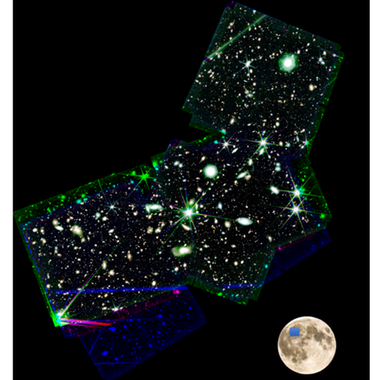
A study led by Pablo Pérez-González at the Centro de Astrobiología in Spain with collaborating scientists from the Department of Astronomy at Stockholm University recently discovered nine galaxies that are candidates to being the most distant galaxies known. By using a combination of images taken with the NIRCam instrument on the James Webb Space Telescope (JWST) these galaxies could be picked out from more nearby objects. The light coming from these galaxies was sent out a mere 100-200 million years after Big Bang, which means that they could be some of the very first galaxies formed in the universe.
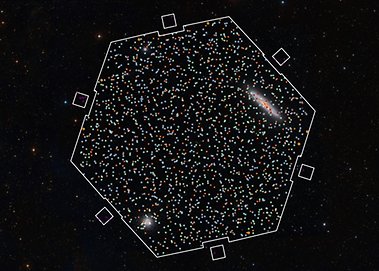
On October 18 2025, the 4-metre Multi-Object Spectroscopic Telescope (4MOST) facility, installed on the VISTA telescope at the European Southern Observatory’s (ESO) Paranal Observatory in Chile, obtained its first light. This milestone is a crucial step in the lifecycle of a telescope and marks the moment in time when it is ready to begin its scientific journey.
The Department of Astronomy is looking for an ambitious, highly qualified astrophysicist to join us as a tenure-track Assistant Professor in Astronomy (starting early 2027). Our department hosts Sweden’s largest concentration of astronomers (approximately 80 staff, including 25 PhD students) and we work across solar physics, exoplanets, star formation, stellar physics, supernovae, galaxies, and astrophysical cosmology. We welcome both observers and theorists, and expertise in advanced data science or machine learning is considered a plus. As a member of our team, you’ll have access to cutting-edge research facilities (ESO, ESA, LOFAR, SKA, Swedish Solar Telescope, and supercomputing resources), as well as a strong international research environment including the physics departments of Stockholm University and the KTH Royal Institute of Technology, Nordita and the Oskar Klein Centre for Cosmoparticle Physics. Stockholm is an attractive and vibrant city to live in. The Astronomy department is situated at the AlbaNova university center close to the main university campus and KTH. Stockholm University is an equal opportunity employer, and we especially encourage women to apply. Learn more and apply.
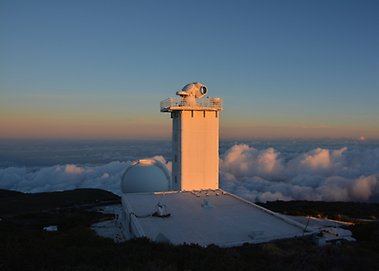
The Swedish 1-m Solar Telescope (SST) on the Spanish island of La Palma has undergone a significant upgrade. Operated by Stockholm University, this telescope now has a larger field of view, whilst critically maintaining sharpness. Additionally, it has gained the ability to measure light polarisation in a new range of wavelengths.
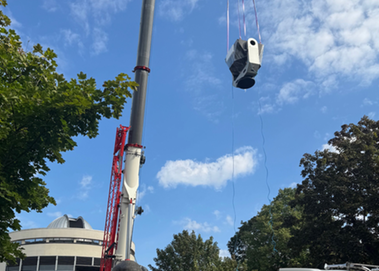
The work to install a new telescope at AlbaNova University Centre just started. The telescope has a diameter of 80 cm and will be used for public shows, education, and for research in quantum optics. On Wednesday the 10th of September the new telescope was moved into place by a large crane.