


James Webb captures the collision of two dwarf galaxies
In a new study, led by Giacomo Bortolini from the Department of Astronomy at Stockholm University, a collision of two dwarf galaxies has been observed in exquisite detail. By using the power of the James Webb Space Telescope individual stars in the galaxies can be found and characterized which helps us understand how the interaction between the colliding partners affects them. The data from the study was also used to produce a beautiful image featured as the European Space Agency Picture of the Month for November 2025.
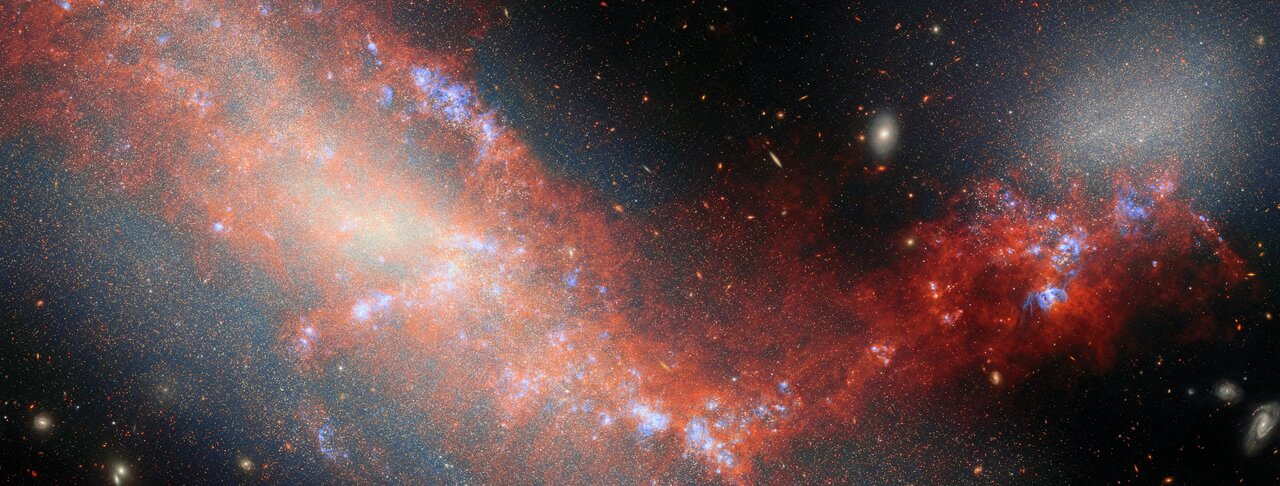
This JWST color composite image displays the two interacting dwarf galaxies. NGC 4490 fills most of the left side, while NGC 4485 appears in the upper right. A bright red stream of emission from hot dust connects them. Pockets of vivid blue ionized gas dot the length of this stream. Image credit: ESA/Webb, NASA & CSA, A. Adamo (Stockholm University), G. Bortolini, and the FEAST JWST team.
The James Webb Space Telescope (JWST) has captured a stunning view of two dwarf galaxies locked in a gravitational interaction. Known as NGC 4490 and NGC 4485, the pair lies roughly 24 million light-years away in the constellation Canes Venatici (The Hunting Dogs). Aside from the Milky Way’s own dwarf galaxy companions, the Large and Small Magellanic Clouds, this duo represents the closest example of an interacting dwarf–dwarf system in which astronomers can resolve individual stars and observe a stunning bridge of gas that links them. Webb’s infrared vision cuts through dust revealing structures and star-forming regions that are invisible in the optical.
Dwarf galaxies share many characteristics with the earliest galaxies in the young Universe: they are relatively less massive, have low abundances of heavy elements (astronomers call these “metals”), and are dominated by gas rather than stars. This unique system offers us the possibility to study in great detail how dwarf galaxies collide, merge, or steal gas from one another, helping us understanding the processes that shaped galaxy growth in the distant past.
The new image incorporates data from JWST’s Near-Infrared Camera (NIRCam) and Mid-Infrared Instrument (MIRI). This combination reveals the galaxies in extraordinary depth, highlighting the luminous stream of gas and stars that stretches between them. The larger galaxy, NGC 4490, appears on the left side of the image, while the smaller NGC 4485 shines in the upper right. In a new paper, led by Giacomo Bortolini from the Department of Astronomy at Stockholm University, individual stars within both systems were resolved. This made it possible to map the locations of young, middle-aged, and ancient stellar populations, tracing the sequence of events that unfolded during their interaction.
By charting the history of this cosmic pair JWST offers new insight into how dwarf galaxies interact, says Giacomo Bortolini, and, in doing so, it provides a glimpse into how galaxies across the Universe have grown and evolved over time.
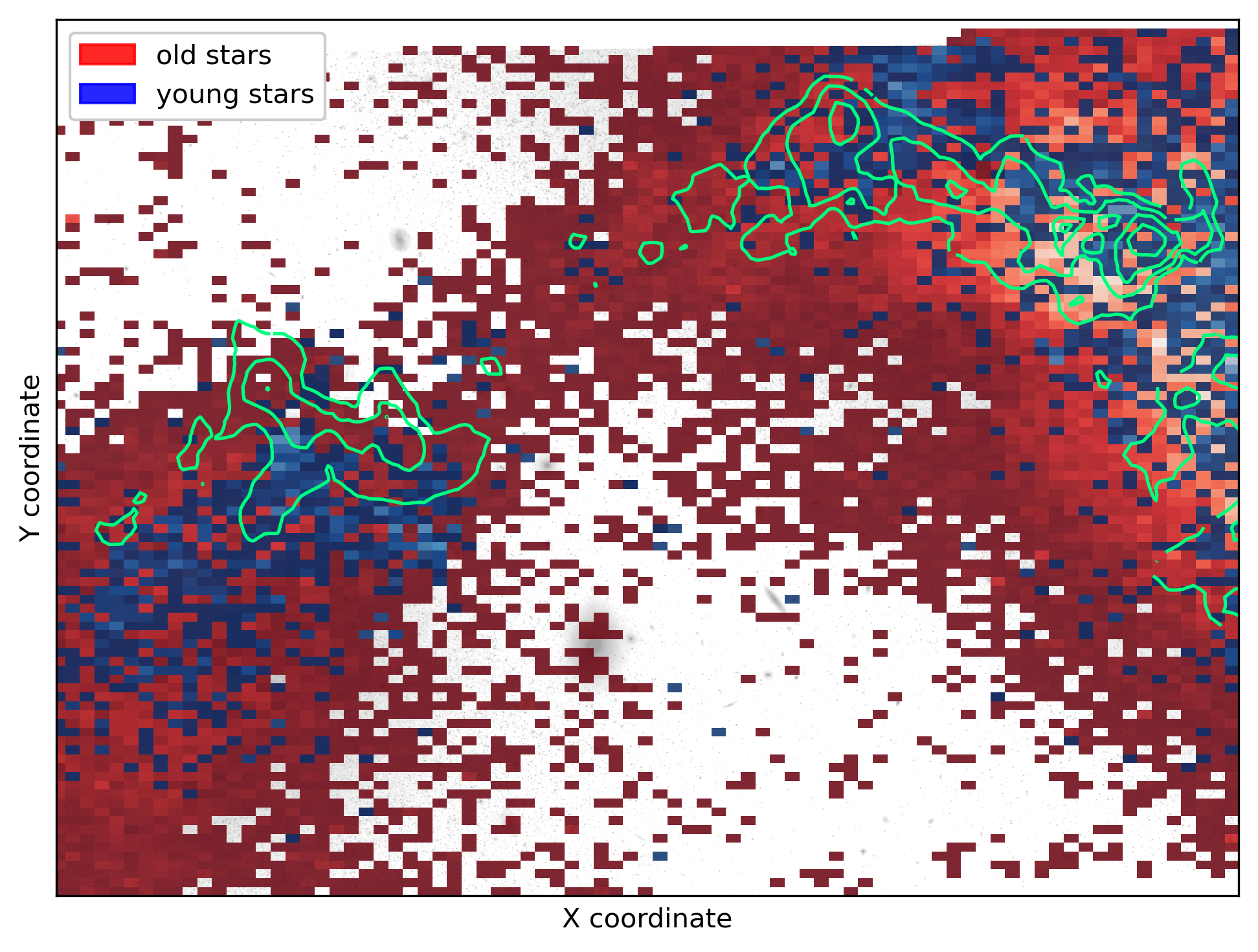
Comparison between the spatial distribution of stars in the bridge region between NGC4485 and NGC 4490 of young, massive stars (in blue) and old, less massive stars (in red). The green contours mark the position of the observed hydrogen gas which is the fuel from which stars form. Credit: G. Bortolini.
This reconstruction suggests that about 200 million years ago, the two galaxies swept past each other before drifting apart again. During this close encounter, NGC 4490 pulled a ribbon of gas from NGC 4485, leaving a trail that now stretches between them. Along this bridge, and throughout the galaxies themselves, the interaction triggered bursts of star formation. Bright blue clumps throughout the scene mark regions where massive stars and star clusters younger than 30 million years are ionizing the surrounding gas.
The system was targeted by JWST as part of the Feedback in Emerging extrAgalactic Star clusTers (FEAST) program. FEAST is an international collaboration of astronomers led by Angela Adamo, also involving several PhD students and postdocs, from the Department of Astronomy at Stockholm University.
The unprecedented power of JWST to observe infrared light has made it possible to study stars, gas, and dust inside nearby galaxies in much greater detail than before, says Angela Adamo. With FEAST we are starting to truly understand how the interplay between these components drive galaxy evolution.
More information
This news article is an extended version of ESA’s Picture of the Month release text.
The image at ESA’s Picture of the Month website (including high resolution versions)The paper on the study was published in the Astrophysical Journal.
Contact
Giacomo Bortolini, Department of Astronomy, Stockholm University, giacomo.bortolini@astro.su.se
Angela Adamo, Department of Astronomy, Stockholm University, angela.adamo@astro.su.se
Last updated: 2025-12-11
Source: Department of Astronomy