


One element, two tracks: the unusual time evolution of phosphorus in our Milky Way
A Stockholm University led team has produced the first age resolved map of phosphorus of our Milky Way. By combining near-infrared spectroscopy with precise age tags from open stellar clusters and classical Cepheid stars, the researchers uncovered a two-track timeline for how this life linked element accumulated in our Galaxy’s recent past.
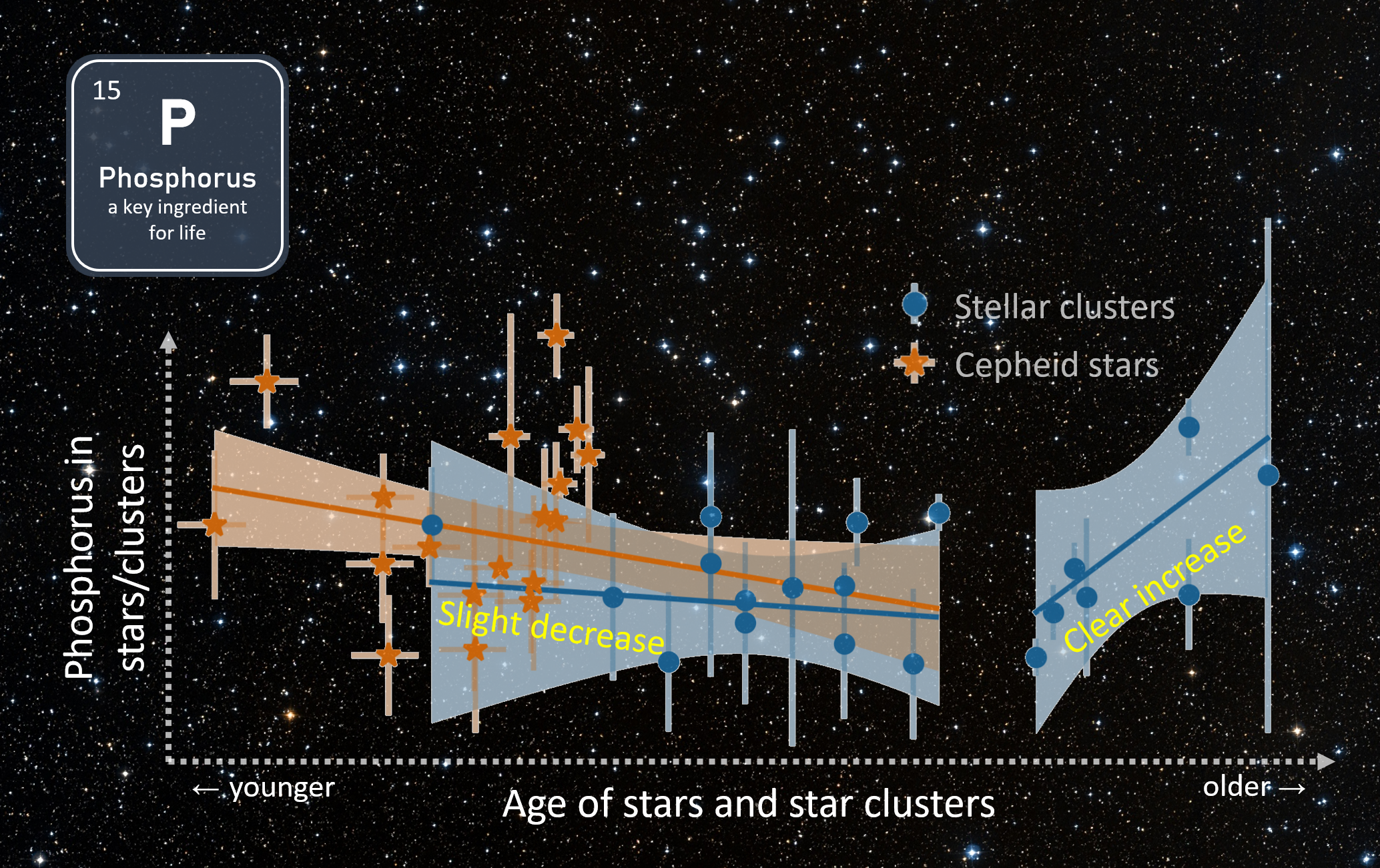
Evolution of phosphorus abundance versus age. The data reveal distinct behaviors for younger and older stellar populations. Credit: M. Jian.
We meet many elements every day, from silicon, lithium, and carbon in our phones to the oxygen and nitrogen in the air. These elements ultimately come from the stars. After the Big Bang produced mostly hydrogen, helium, and a trace of lithium, heavier elements were forged in stellar interiors, supernovae, kilonovae and so on, then recycled into new stars and planets, including the Sun, and the Earth inside our Milky Way.
In a new study by Dr. Mingjie Jian at the Department of Astronomy, Stockholm University the target is phosphorus. It is part of the body’s “hardware”: it helps build bones and teeth together with calcium. Yet the origin of phosphorus is not well understood. In this study phosphorus lines in the near-infrared wavelength range are used to show that older clusters (older than one billion years) have an increased abundance of phosphorus with age; while younger populations (younger than one billion years) including young variable stars show flat to only mildly changing phosphorus abundances. The two tracks, indicated by the orange and blue lines in the figure above, need to be explained by two different phosphorus formation scenarios.
Our phosphorus-age diagram acts like a chemical clock,” says Mingjie Jian, the lead author of the paper. “It tells us when the Galaxy stocked the shelves with a life-linked element and which stars did it.”
For the younger clusters, the picture is relatively straightforward. They all lie close to the Sun and formed from the same large reservoir of gas. Low-mass stars, when entering their last stage of life, expel phosphorus through stellar winds, adding small but steady amounts to the local interstellar gas near the Sun. This slow “top-up” explains why the youngest stars/clusters inside the trend on the left exhibit slightly higher phosphorus abundances.
The older clusters show a different behavior. They formed from gas that had been enriched for different lengths of time by previous generations of stars. In the oldest clusters, this enrichment happened quickly early on, whereas in somewhat younger ones it was slower and more gradual. The phosphorus abundance reflects these different histories. As shown in the figure above, among the older clusters the ones that experienced the fastest early enrichment (and are now the oldest) contain the most phosphorus.
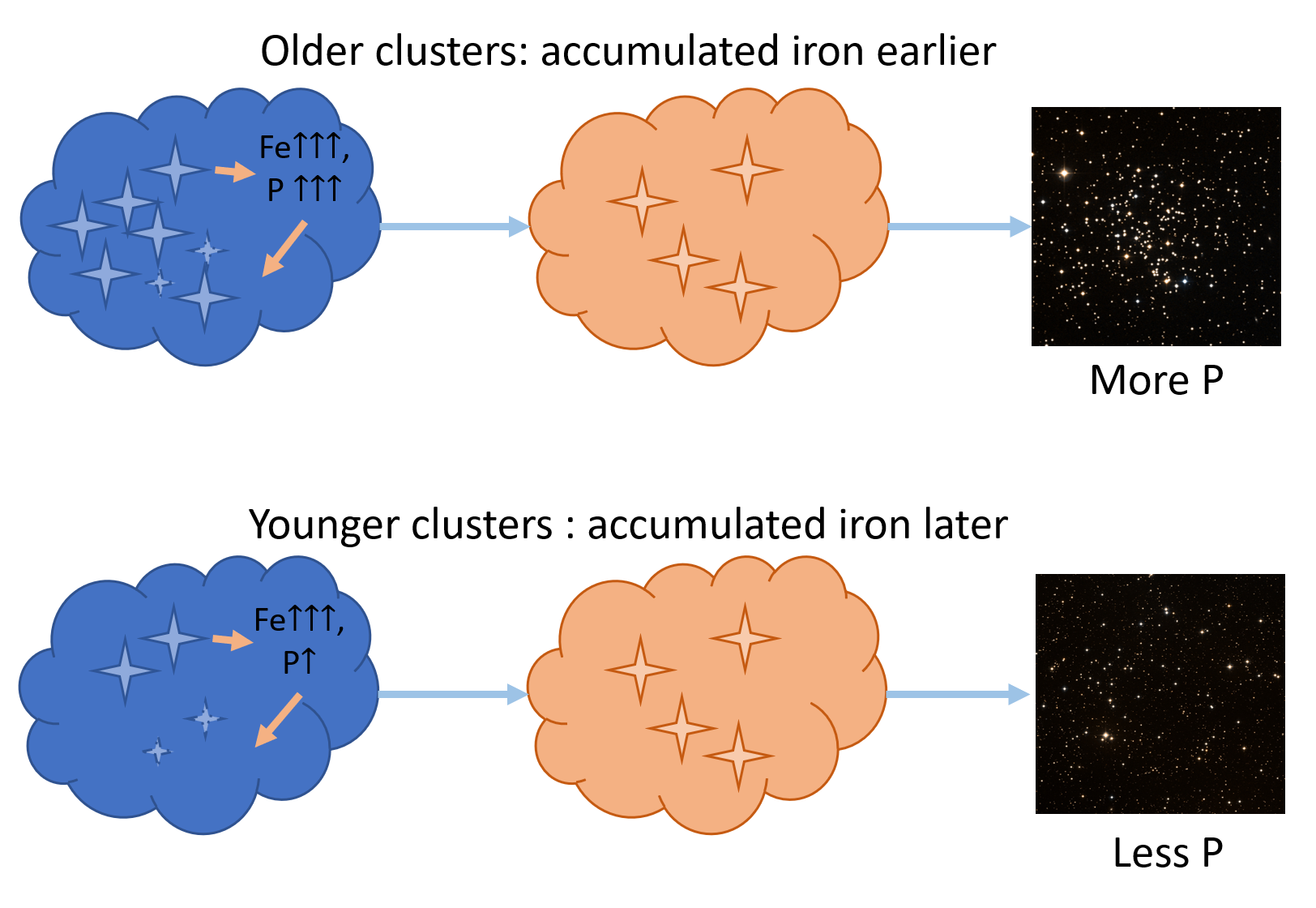
A schematic diagram showing the formation of phosphorus (P) for older open clusters. Credit: M. Jian.
Most previous phosphorus studies focused on how it varies with other elements but lacked reliable ages for the stars. Without ages, it’s hard to tell when different stellar sources dominated phosphorus production. Open clusters solve this: their stars share the same age and composition, so phosphorus can be placed on a timeline rather than just with other elements.
Seeing an early, massive star driven track alongside a later, low-mass powered track changes the timeline for life’s ingredients in our corner of the Milky Way, adds Dr. Xiaoting Fu, the second author of this work from Purple Mountain Observatory. It also gives modelers a sharper target for simulating how phosphorus evolve in our Milky Way .
The study observed stars of 24 open clusters together with 20 young variable stars using GIARPS at the Telescopio Nazionale Galileo located in La Palma, Spain. The data is part of the Stellar Population Astrophysics (SPA) large program (led by Livia Origlia from INAF - OAS Bologna) and the open cluster (led by Angela Bragaglia from INAF - OAS Bologna) as well as variables program (led by Guiseppe Bono from Universita' di Roma Tor Vergata).
Learn more
The results are published in a paper in Monthly Notices of the Royal Astronomical Society.
This research makes use of the instrument GIARPS mounted at the Italian Telescopio Nazionale Galileo on La Palma, Spain.
The research is part of the SPA project.
Contact
Mingjie Jian, Department of Astronomy, Stockholm University — mingjie.jian@astro.su.se
Last updated: 2025-12-08
Source: Department of Astronomy