News

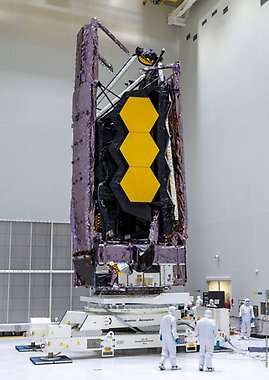
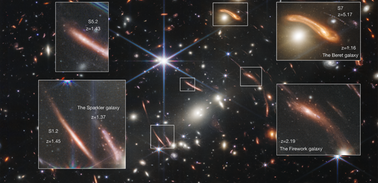
  • Star formation in distant galaxies by the James Webb Space Telescope

    Thanks to the James Webb Space Telescope’s first images of galaxy clusters, researchers have, for the very first time, been able to examine very compact structures of star clusters inside galaxies, so-called clumps. In a paper published in the Monthly Notices of the Royal Astronomical Society, researchers from Stockholm University have studied the first phase of star formation in distant galaxies.

  • Celebrating the SST at 20 years

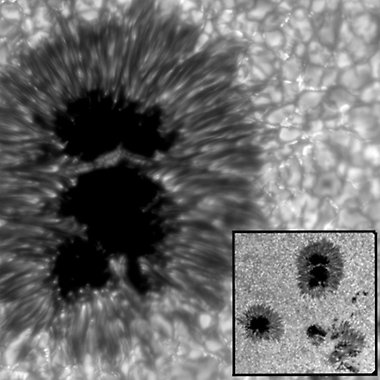
    20 years ago, in spring 2002, the Swedish 1-m Solar Telescope (SST) saw first light. The full aperture of the telescope was opened on May 21. Already on the next day, May 22, the seeing got good. The very first exposure that was saved on disk was on a sunspot group. It demonstrated in a dramatic way that the telescope produced diffraction-limited images. This image was part of the data used for the first scientific publication  on the discovery of dark cores in penumbral filaments - which was  published in Nature  later in 2002.   During the two decades that have passed since then, the SST has acquired several advanced instruments. It has thus been able to stay on the frontline of solar research and its publication list is continuously growing. Happy birthday SST! 

    Institute for Solar Physics
  • CHEOPS observes dark-blue giant planet

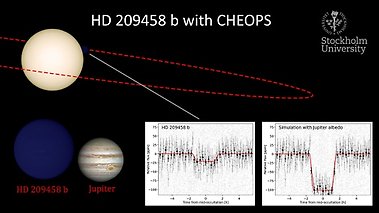
    The planet around the star HD 209458 was the first discovered to transit its star. This enabled precise measurements of the planet’s mass and size. The planet HD 209458 b, or Osiris as it’s nicknamed, is bigger and lighter than Jupiter, and orbits its star tightly taking 3.5 days for a single revolution. Now the space telescope CHEOPS has measured reflected light from the planet by observing how flux from the star-planet system decreases when the planet passes behind the star. HD 209458 b

    Department of Astronomy