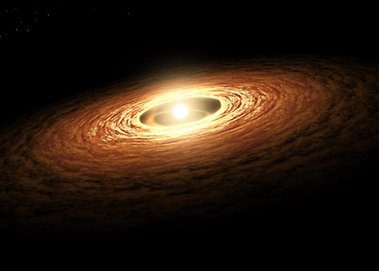
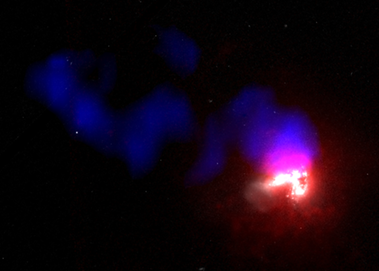
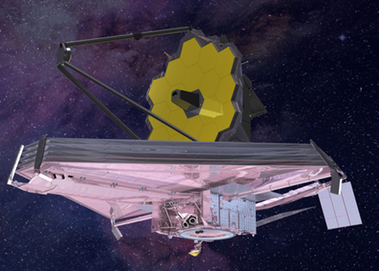
A new study conducted by an international collaboration reveals new insights in how planets might be formed around low-mass stars. The team studied a disk of gas around a young, low mass star using the James Webb Space Telescope. Their results can possibly give us information about what type of planets that might form around the low-mass star. Göran Östlin and Göran Olofsson, Professor and Professor Emeritus respectively at the Department of Astronomy at Stockholm University, are two of the contributing parties. In a new study, conducted by an international team of astronomers, a disk of gas around a low-mass star has been observed using the James Webb Space Telescope (JWST). The star is known as ISO-Chal-147 and is located roughly 600 light-years away from the Earth. It is a young star at an age of 1 to 2 million years with a mass of 11% of our Sun. Young stars generally have a disk of gas around them. These types of objects are referred to as protoplanetary disks. As time goes on, planets start to form when gas pile up onto smaller objects in the disk, causing them to accrete mass and become bigger. In this way, a stellar system can form around the star. This process is what happened in the early age of our own solar system.
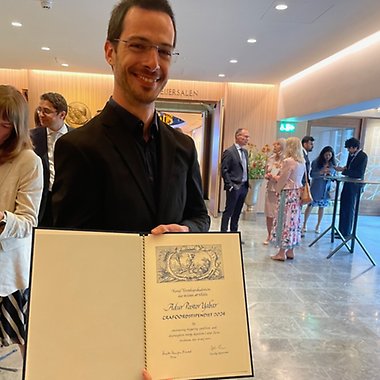
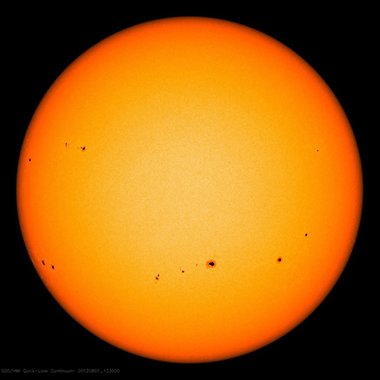
Two weeks ago, the Crafoord Days 2024 were celebrated in Lund and Stockholm. The celebrations took place between the 13th and the 16th of May. Jaime de la Cruz Rodriguez and Adur Pastor Yabar, researchers at the Institute for Solar Physics and Department of Astronomy at Stockholm University, participated in the celebrations. The Crafoord Prize symposium in astronomy was held on the 15th of May at the Royal Swedish Academy of Sciences, where the laureates and invited speakers gave lectures on their subjects focused on the topic “New Avenues in Solar and Stellar Physics”. One of the invited speakers was Jaime de la Cruz Rodriguez, researcher at the Department of Astronomy and Institute for Solar Physics, who presented his research. In the presentation titled “A High-Resolution View of Solar Oscillations and Waves”, he discussed his work on the connection of waves and shocks in the solar atmosphere to the chromospheric heating problem. The chromospheric heating problem is one of the longstanding questions in solar physics. Contrary to intuition, the solar atmosphere gets increasingly hotter when moving outward from the surface. This problem has been known for roughly a century, and solar physicists are still trying to find the key underlying processes behind this highly complex phenomenon.
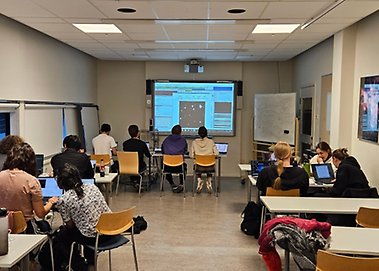
Last week, master and PhD students utilized observations from the Nordic Optical Telescope to publish classifications of six different supernovae in the Observational Astrophysics II course. Last week, master and PhD students conducted observations at the Nordic Optical Telescope (NOT) as a part of the course Observational Astrophysics II. The NOT observations are used in an exercise to classify different types of supernovae. The students took their own data of six different objects and classified five of these as type Ia SNe, and one as a type II SN. Jesper Sollerman, the group leader of the Supernova group at the Department, provided the students with the targets to observe and gave the students a preparatory seminar on supernova target discovery and selection.
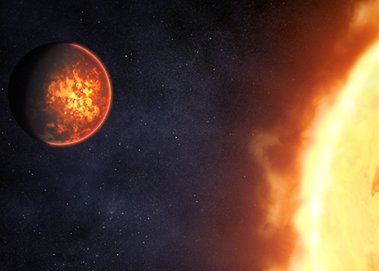
The exoplanet 55 Cancri e probably has an atmosphere dominated by carbon dioxide or carbon monoxide, according to a new study published in Nature. The planet was previously speculated to lack atmosphere, but new observations from the James Webb Space Telescope have enabled researchers to study the atmosphere around the Earth-like rocky planet.
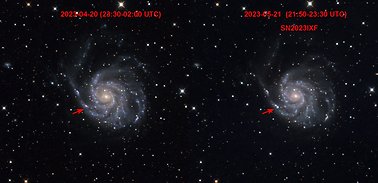
In the latest issue of the journal Nature, researchers from Stockholm University participate in a study of a supernova explosion where the astronomers made the Hubble telescope turn and look in a different direction than planned. The ultraviolet light from the explosion shows that the exploding red giant star was embedded in gas that puffed out in the years before the final bang. Supernovae – exploding stars – suddenly appear in the night sky. The closest supernova in nearly 10 years, SN 2023ixf, was discovered by a Japanese amateur astronomer on Friday evening, May 19 last year (2023). Just 20 million light-years away in the Whirlpool Galaxy (M101) in the Big Bear constellation, it became a favorite among Earth's astrophotographers (see Image).
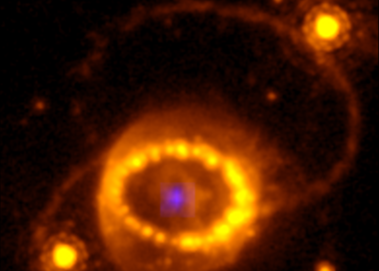
Scientists can finally show that a neutron star formed from our most well-studied supernova, SN 1987A. The breakthrough was made possible thanks to the James Webb telescope.
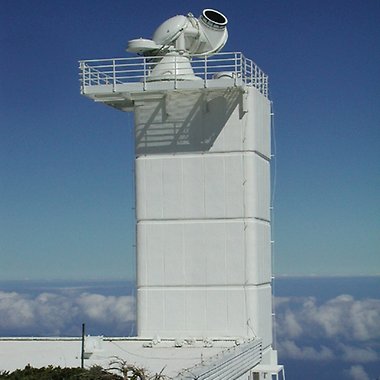
The Swedish Solar Telescope (SST) was featured in the German documentary “Die Sonne”, produced by the European public service channel Arte. Jorrit Leenaarts (Professor) and Jaime de la Cruz Rodriguez (Docent) at the Institute for Solar Physics appear in the documentary and talk about the SST and show the audience how a day of an astronomer looks like.
This year’s Crafoord Prize in Astronomy is awarded to Douglas Gough, Jørgen Christensen-Dalsgaard and Conny Aerts for their development of methods that allow us to “see” the insides of stars and the Sun. Similar to how seismology is used to learn about the insides of the Earth, astroseismology can be used in order to gain an understanding of the
Karin Lind is an Associate Professor in the group for stars, planets and astrobiology at the Department of Astronomy. What is your field of interest? I determine the chemical composition of stars using optical spectrographs on large telescopes. The elemental abundances are ”stellar DNA”, through which we can unravel the history of the cosmos and the physics of planets, stars and galaxies. Could you please describe your current project in simple terms? I am the Galactic Project Scientist for the 4MOST instrument that will collect spectra for many millions of stars in the Milky Way and its satellite galaxies. 4MOST will see first light at the Vista telescope at Paranal Observatory in Chile in 2024/2025.
An international team, led by Dr. Alexandra Le Reste from Stockholm University and the Oskar Klein Centre, used the MeerKAT radio telescope to investigate processes at the origin of the Epoch of Reionization, a crucial period occurring a billion years after the Big Bang. The study, made possible by MeerKAT's increased sensitivity relative to older telescopes, reveals how galaxy mergers might have influenced the transformation of the Universe during this epoch.
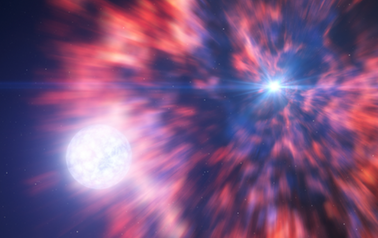
A supernova explosion powered by a black hole consuming its binary companion. This is an interpretation forwarded in the latest issue of the journal Nature, where astronomers from Stockholm University participate in a study of a recent cosmic explosion. Supernovae are the explosions of massive stars. Supernova SN 2022jli was discovered in May 2022 in the nearby (75 million lightyears) galaxy NGC 157 in the constellation Cetus. Detailed monitoring of the fading supernova using the Zwicky Transient Facility at Palomar showed a periodic change in brightness, implying that two objects were involved in the deadly dance.
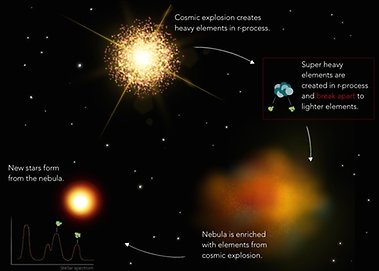
Where do we come from? How were all our atoms created? These are some of the intriguing questions that a group of astronomers called the R-Process Alliance are trying to answer. Today, they publish a new groundbreaking study in the prestigious scientific journal Science, where they show footprints from the cosmic creation of super heavy elements. Terese Hansen, researcher at the Department of Astronomy, is one of the co-authors. Where do we come from? How were all our atoms created? These are some of the intriguing questions that a group of astronomers called the R-Process Alliance are trying to answer. Today, they publish a new groundbreaking study in the prestigious scientific journal Science, where they show footprints from the cosmic creation of super heavy elements. Terese Hansen, researcher at the Department of Astronomy, is one of the co-authors. "Rapid neutron capture is an awe-inspiring cosmic phenomenon, responsible for the creation of the heaviest elements in our universe," explains Dr. Terese Hansen, Stockholm University, astronomer and co-author on the paper. "However, the site where the r-process occur which lead to the creation of super heavy elements has been a mystery to us, at least until now”. Dr. Hansen is one of the founding members of the R-Process Alliance. The R-Process Alliance has unveiled a groundbreaking revelation in their latest project, cracking the code to the formation of super heavy elements. As these elements form in the r-process to achieve their super heavy status, they become inherently unstable, ultimately fragmenting into elements like silver and palladium. This cascade of elemental disintegration has left a tell-tale signature in the atmospheres of stars, a silver fingerprint that the R-Process Alliance believe is the remnants of super heavy elements breaking apart. "In our pursuit of understanding the r-process, we have identified a distinct accumulation of silver and palladium in the atmospheres of stars," notes Dr. Hansen. "These elements are the offspring of super heavy elements that have undergone fragmentation, providing a tangible insight to the processes occurring in the extreme cosmic environments that form the nebulae where new stars are born." What makes this discovery particularly significant is that it offers a glimpse into the production of elements heavier than any man-made counterparts. While these super heavy elements remain elusive to direct observation, the indirect evidence found in stellar atmospheres serves as a testament to what may have happened in the environment that eventually led to the birth of new stars. The implications of this research extend far beyond the realm of astrophysics. By meticulously mapping the chemical compositions of stars, the R-Process Alliance is not only uncovering the ‘where’ and ‘when’ of rapid neutron capture events but also providing crucial insights into the quantity of heavy elements, such as silver, generated by these cosmic explosions. In short: it provides us with an unprecedented understanding of element formation in the universe. The study is based on observation of 42 stars in the MilkyWay. The team investigated 31 elements observed in 34 previous studies.
Every year, Fysikum hosts a Christmas Lecture where physics experiments for all ages are presented. This tradition is in honor of Michael Faraday, who gave annual Christmas Lectures at the Royal Institution in London where he demonstrated scientific questions in an entertaining and informative way. This year, Jens Melinder from the Department of Astronomy will partake and talk about the James Webb Space Telescope. The lecture is free of charge and given the 7th of December at 18:15-20:00 in FR4 (Oskar Kleins auditorium) at AlbaNova.
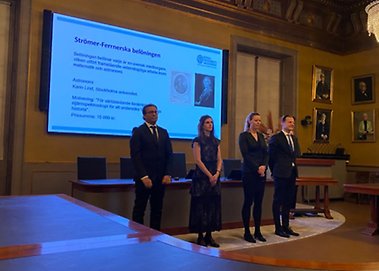
On Tuesday, the 28th of November, two of our researchers were honored at the Royal Swedish Academy of Sciences. Karin Lind was awarded the Strömer-Ferrner Prize 2023, and Jaime de la Cruz Rodriguez received the Letterstedt’s prize for impressive research 2023 for their contributions to science and astronomy. During Tuesday the 28th of November, two of our researchers participated in a prize ceremony at the Royal Academy of Sciences. Karin Lind received the Strömer-Ferrner reward with the motivation "For world-leading research in stellar spectroscopy to investigate the history of the Milky Way”.