


The ENGRAVE team awarded the Into Change Award for research into how the heaviest elements formed.
The Into Change Award is presented to exceptional European research by the Danish Ministry of Higher Education and Science. The 2025 price was awarded to the ENGRAVE project which includes several participating scientists from Stockholm University. The ENGRAVE project tries to understand how the heaviest elements form inside kilonovae.
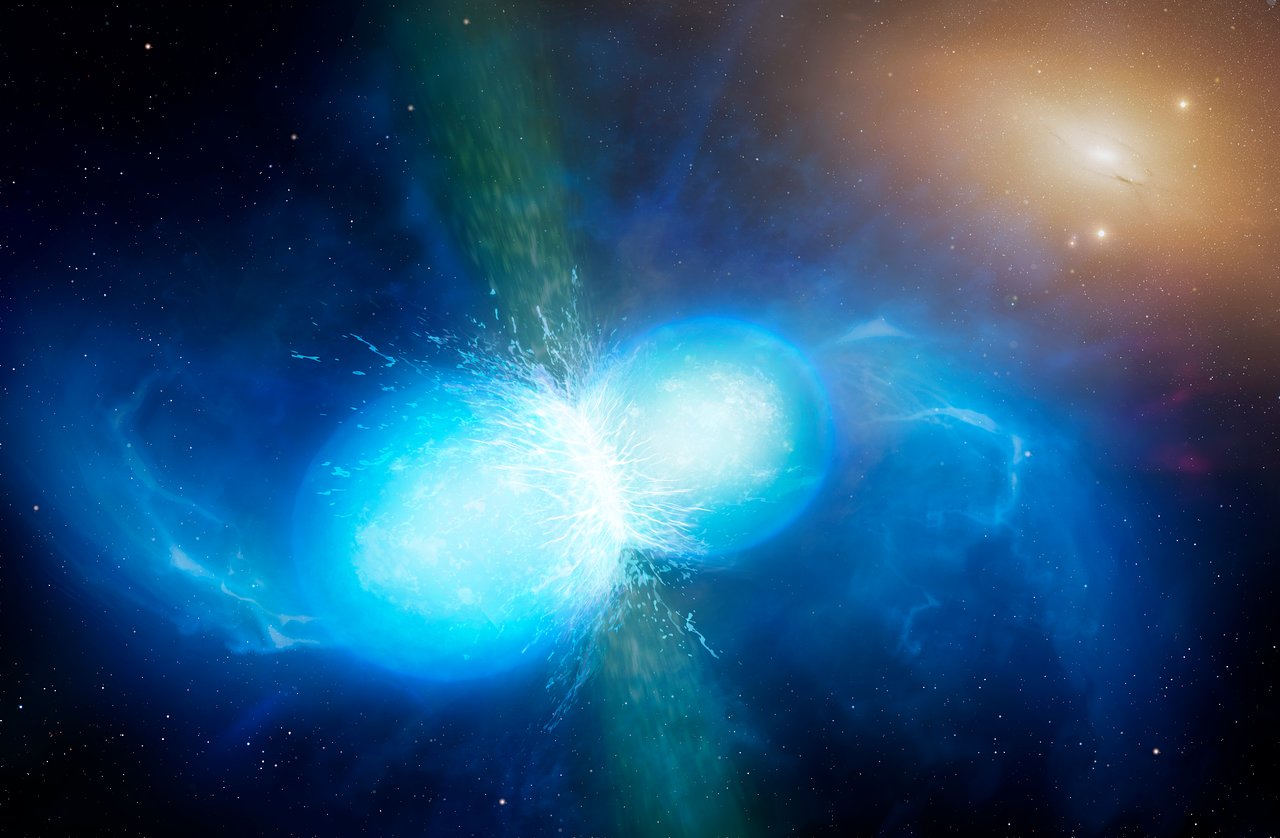
Artist’s impression of two neutron stars colliding.
ENGRAVE is a large international collaboration which includes several researchers from Stockholm University. The research goal of the project is to understand the origin of the heaviest elements (for example, gold). This involves both theoretical work with advanced computer simulations and observations of merging neutron stars, the so called kilonovae.
For half a century the general consensus was that heavy elements are forged when stars explode as supernovae. But numerical models of what happens when two neutron stars collide showed that a large part of these elements (the so called r elements) form in in this process.
Our theoretical work on a more exotic alternative scenario, the collision of two neutron stars, clearly showed that they must be major sources of the heaviest elements. It is wonderful to see that the observations of the ENGRAVE collaboration could actually prove that this is true!”, says Stephan Rosswog, member of the ENGRAVE team, and professor of theoretical astrophysics at the University of Hamburg and Stockholm University.
The collision between the two very compact neutron stars generate gravitational waves which on some occasions can be observed by gravitational wave observatories (such as the Laser Interferometry Gravitational Observatory, LIGO). But a large amount of radioactive material is also formed during the collision. This material then emitts light that can be observed by telescopes observing in visual or infrared light. In ENGRAVE a new and formidable European collaboration has been created to study the light from kilonovae, and to test the theoretical predictions.
This price acknowledges and rewards the strategy used to pool the resources and expertise of hundreds of scientists. We work together to answer one of the most crucial questions in astrophysics at the moment – where did the the heaviest elements come from?, says Anders Jerkstrand, member of ENGRAVE and senior researcher from the Department of Astronomy at Stockholm University.
Facts
The Into Change Award is awarded by the Danish Ministry of Higher Education and Science and consists of both a price to named researchers and support for future research, in total around 10 million Swedish crowns. The ENGRAVE research team includes hundreds of scientists, out of which roughly ten work at Stockholm University, Stephan Rosswog and Anders Jerkstrand, among others. Jesper Sollerman is a member of the ENGRAVE steering group.
More information
Read more about the Into Change Award and ENGRAVE.
Read more about Anders Jerkstrand's SUPERSPEC project.
Read more about Stephan Rosswog's Gravity Meets Light project.
Contact
Jesper Sollerman, tel: +46855378554, jesper@astro.su.se
Anders Jerkstrand, tel: +46855378511, anders.jerkstrand@astro.su.se
Last updated: 2025-12-18
Source: Communications Office