


Prestigious ERC Synergy grant awarded to Axel Brandenburg
Axel Brandenburg, professor at Nordita and the Department of Astronomy, has been awarded both a prestigious ERC Synergy Grant and a Swedish Research Council (VR) grant to advance his research on the very first microseconds of the universe. The ERC-funded project, COSMOMAG, brings together an international team of leading scientists to probe the origins of the cosmos using magnetic fields.
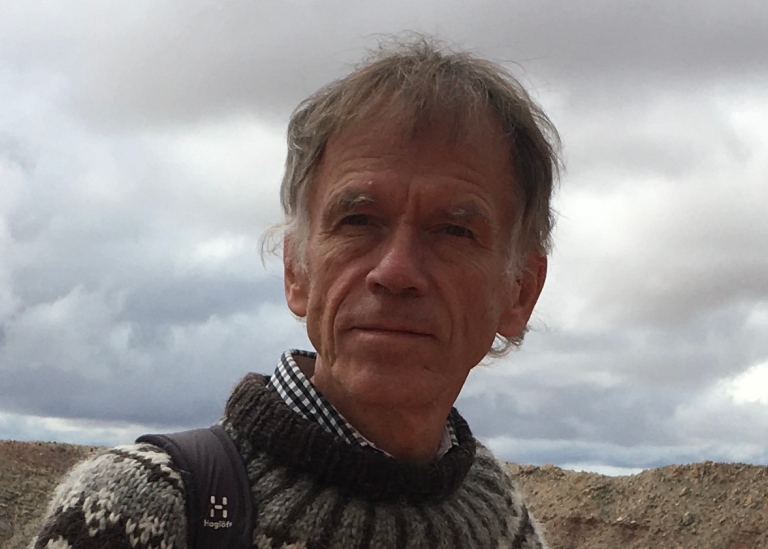
Axel Brandenburg. Photo: Sirkka Sanila
The grant allows us to shed light on the Universe’s first microseconds using cosmological magnetic fields, a project so broad that any of us alone would be unable to reach results without the help of others, says Axel Brandenburg, Nordita (Nordic Institute for Theoretical Physics), Stockholm University.
The COSMOMAG project will combine observations across multiple observational channels such as gamma rays, radio waves, cosmic rays, the cosmic microwave background, and gravitational waves, with advanced simulations. By studying the magnetic fields of the universe, the team wants to reconstruct the physical processes that took place in its earliest moments. Understanding these first microseconds of the universe also reveals some of the most fundamental physical processes such as how the Universe became hot and uniform after its very early exponential expansion, how the forces of nature split apart, and how matter, antimatter, and dark matter first appeared.
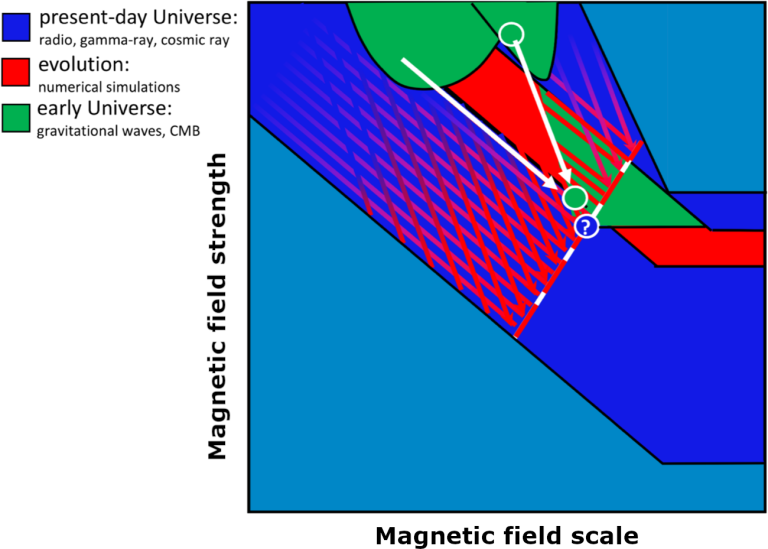
The relationship between the cosmological magnetic field strength and the physical scale they are active on. The arrows shows how these have changed over cosmic time from around 300 000 years after Big Bang until now. The coloured regions show which methods can be used to observe and simulate the processes. Image credit: Axel Brandenburg.
Measuring the cosmological magnetic field strength and scale (i.e., the spatial size over which the magnetic field changes) is very challenging. Observationally, the constraints on the overall magnetic field properties in the Universe comes from observations of the Cosmic Microwave Background in the very early Universe (roughly 300 000 years after Big Bang) and from radio/gamma ray observations of galaxies in the nearby Universe. But in between, and before, these times we have to rely on numerical simulations to map out how and why the magnetic field appeared and changed. Within the COSMOMAG project Axel Brandenburg and his team will perform these simulations.
We hope to find out whether significant magnetic fields were generated by the end of the very early exponential expansion of the universe, when the electromagnetic and weak forces decoupled, or when quarks became confined. By combining expertise in theory and simulations with that in various modern observations, we can use magnetic fields to probe the conditions of the universe when important beyond-standard-model processes occurred, says Axel Brandenburg.
Brandenburg leads the project together with Andrii Neronov (Université Paris Cité and École Polytechnique Fédérale de Lausanne), Franco Vazza (University of Bologna), and Chiara Caprini (CERN and University of Geneva).
Facts
In an astronomical context magnetic fields arise from charged particles (e.g. ionized hydrogen atoms or electrons) in motion. When the motion of the particles has some systematic order, for example a swirling motion, these magnetic fields can grow. Large scale magnetic fields can be generated and maintained through astrophysical processes in stars, galaxies, but also in the early Universe. Over time magnetic fields can lose strength by dissipative processes where the energy is transferred from the ordered into random motions (turbulence).
More information about COSMOMAG
Nordita press release on the award.
Presentation of the awarded Synergy grants on the ERC webpage.
Last updated: 2025-12-02
Source: Department of Astronomy