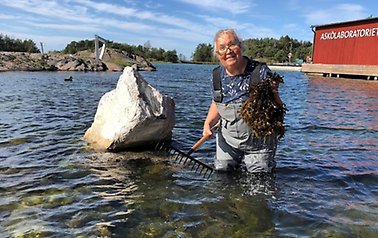
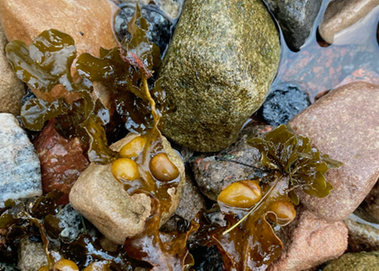
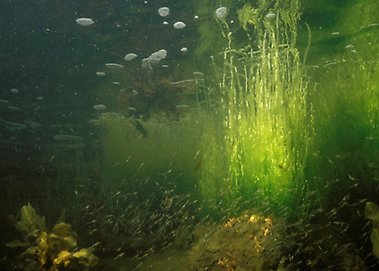
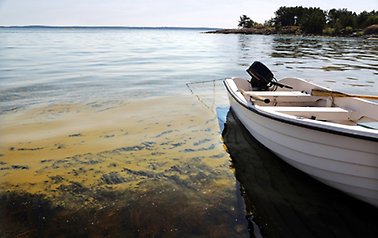
Improved wastewater treatment has led to better water quality in the Stockholm archipelago, and a new study shows that bladderwrack has now returned to the inner part of Trälhavet, north of the city. The study also shows that archived herbarium material can be an important tool for detecting environmental changes, says researcher Lena Kautsky.
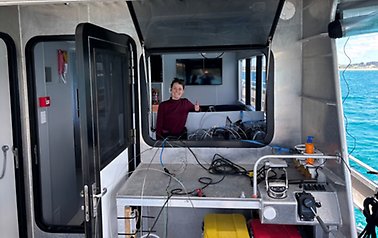
Marine researchers from Stockholm University and the University of Helsinki have temporarily changed their site of research; from the Baltic Sea to New Zealand. Using their unique set of instrumentation, they are spending three weeks exploring patterns in greenhouse gas emissions along the coastline. The preliminary results agree with the findings from the Baltic Sea that stressed and degraded coastal ecosystems become net emitters of greenhouse gases, and highlights the importance of proper management of coastal areas. Within the research platform CoastClim , researchers at Stockholm University and the University of Helsinki have spent the past three years investigating the links between coastal biodiversity and greenhouse gas dynamics in the Baltic Sea. The objective has been to quantify the role of healthy or degraded coastal habitats in the life cycles of greenhouse gases such as carbon dioxide and methane, and the links to climate change. Now they have adopted a global perspective on the issue, and a group of CoastClim researchers are currently in New Zealand for a three-week sampling campaign. "The New Zealand coastline is very different from the Baltic Sea and therefore gives us an idea of the generality of our findings", explains Christoph Humborg, scientific leader of Stockholm University Baltic Sea Centre and CoastClim. Precise measurement techniques Christoph Humborg and his colleague at Stockholm University; Julika Zinke, have been conducting online measurements of greenhouse gases (including carbon dioxide, methane and nitrous oxide) along New Zealand’s coastal waters, particularly around the Auckland region, using the WEGAS system. The system was developed at Stockholm University to enable collection of precise data on greenhouse gas emissions in water and air simultaneously, and has now been installed on the research vessel from the Institute of Marine Science, Auckland University.
Samples of bladderwrack have been sent into space as a first step towards understanding its mysterious reproduction. "An absolutely breathtaking experience," says Professor Emeritus Lena Kautsky, who was at Esrange in Kiruna for the launch. "Now we hope to move forward by sending bladderwrack to the International Space Station for a longer period of time". At 5 am a cold November morning, at Esrange Space Center, in the very north of Sweden, Professor Emeritus Lena Kautsky is nervously awaiting the latest news. The weather has been shaky the last days, and a change of wind or an unexpected fog could jeopardise everything. Will the rocket carrying sixteen small shoots of bladderwrack really be allowed to set off this morning? For more than 30 years, she has been puzzled by a question: why does bladderwrack ( Fucus vesiculosus ) always reproduce at full or new moon in the Baltic Sea? Could it be that the algae feel the gravitational pull of the moon? The rocket launch she is waiting for could bring her one step closer to solving the mystery. Bladderwrack reproduction involves the release of eggs and sperm from female and male plants into the water where fertilisation takes place. In the Atlantic, this synchronisation is understandable because it is linked to the tides; when the water is at its lowest, the bladderwrack is exposed to the air and dehydrates. When the tide turns, the seaweed is covered with water again and releases its eggs or sperm, and the fertilised egg can easily reach the bottom and settle.
The Baltic Sea ecosystem is subject to multiple pressures at the same time. This can lead to a loss of biodiversity and reduce the sea's ability to maintain important ecosystem functions. There is a strong need for improved assessments of these combined impacts in marine spatial planning and fisheries management, and now researchers in the BalticCAT project have made further progress in developing data and methods for such assessments.
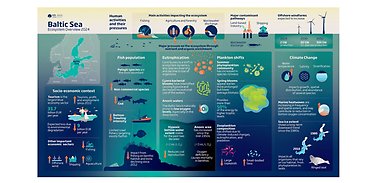
How is the Baltic Sea really doing? The International Council for the Exploration of the Sea (ICES) gives an overview in a new publication, with contributions from researchers at the Baltic Sea Centre, among others.
It's done - we have a new European Commission in place to start work on 1 December. That's after the world's most difficult job interviews have been completed.
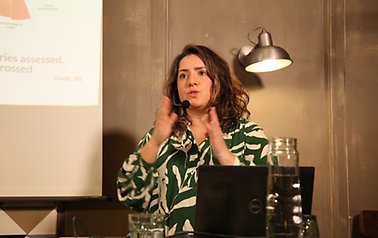
Patricia Villarubia-Gómez tried to go plastic-free, but became anaemic. Now she is working as a researcher to change the system in which plastic is all around us. At the last Baltic Breakfast, she and Associate Professor Fredric Bauer from Lund University explained why primary production of plastics needs to be reduced and what's at stake at the global plastics negotiations in South Korea. The whole current narrative about plastics is misleading. With this statement, Patricia Villarubia-Gómez, a PhD student at the Stockholm Resilience Centre, opens the Baltic Breakfast seminar. "We consider plastics as a waste problem that is created by poor countries with poor littering behaviour, and that it is very easy to recycle, clean up and get out of the mess. And we are still talking about plastics as safe and that social benefits exceed the potential impacts.
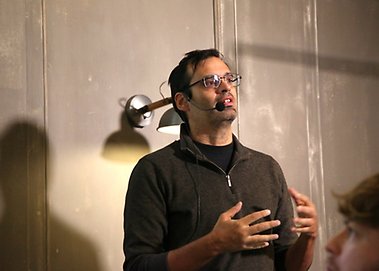
National and international legal acts require monitoring of the environmental status and the demands are increasing. Meanhile, funding does not follow or are even under the threat of cut-backs. Are there ways forward to secure the continued long-term observations with more cost-efficient methods? The latest Baltic Breakfast took a closer look. Aquatic environments are affected by human activities, sometimes dramatically and sometimes in more subtle ways. The key to keep track of changes and what measures are most effective, is environmental monitoring. Through several monitoring programs, large scale impact on, for instance, eutrophication and toxins on biodiversity and ecosystem health are assessed. " This work is vital, and also critical for researchers. The environmental monitoring is the best tool we have to follow ecosystem scale responses to environmental change", said Francisco Nascimento, Associate Professor at the Department of Ecology, Environment and Plant Sciences, Stockholm University. At the same time, demands from environmental goals, legislations and directives are increasing, while funding remains unstable and unpredictable. Nascimento finds these things a challenge to meet. " We can ask ourselves if the traditional methods that we have are sufficient to comply with all new demands and if they can deliver on all these", he said. In his research, Nascimento investigates the possibilities to complement two of the existing monitoring programs in the Baltic Sea with new techniques.
More no-take zones should be introduced in Sweden to protect fish and crustacean stocks and marine ecosystems. This is according to researchers from Stockholm University and the Swedish University of Agricultural Sciences in a new policy brief. But it is important that the areas are extensive and designed correctly.
The Baltic Sea is highly eutrophic, with anoxic seabeds and large algal blooms. But if the countries surrounding the sea had not reduced nutrient discharges, the situation would have been much worse. “Thanks to the measures taken, the Baltic Sea has avoided an ecological disaster”, says researcher Eva Ehrnstén.
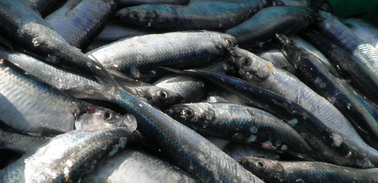
A doubling of the total allowable catch (TAC) of herring in the central Baltic Sea and a substantial increase in the Gulf of Bothnia were among the outcomes of the negotiations on catch limits for 2025 in the EU Council of Ministers. “Absolutely devastating for the herring stocks and for the Baltic Sea ecosystem”, comments fisheries scientist Henrik Svedäng at the Baltic Sea Centre.
The European Commission has proposed an increase in total allowable catch of herring in the Gulf of Bothnia by 21%. This is a proposal with a number of risks. It is also a proposal that implicitly accepts a year of no progress towards meeting a key objective of the common fisheries policy, and targets under the Marine Strategy Framework Directive that should have been met already by 2020. And the proposal is based on a foundation of uncertainties. Last year, the Swedish and Finnish governments pushed through allowable catches far above what the Commission proposed. This year there are strong arguments for lower catches than the Commission proposes. Analysis by Charles Berkow, published 2024-10-10. When the European Commission made its proposal for fishing opportunities , or total allowable catches (TACs) in 2025 for the main Baltic Sea fisheries in August, there were no numbers for the Gulf of Bothnia herring. The scientists working with the International Council for Exploration of the Sea (ICES) had announced back in May that their models and the data did not match, and they needed to do some more work. ICES presented its forecast for growth of the stock in an advice sheet on 16 September, and the Commission made its proposal for next year’s TAC a week later. Sort of. The Commission proposal came in the form of a “Commission Services Non Paper”, which explicitly states that the document “cannot in any circumstances be regarded as the official position of the Commission”. It is intended for the fisheries ministers in the Council, as a basis for their negotiations and decision on next year’s TAC. Proposal: A massive increase, despite missed targets The Commission proposed a TAC for 2025 of 66 446 tonnes, a 21% increase on this year’s TAC of 55 000 tonnes. The Commission notes in its proposal that ICES “estimates that the spawning stock biomass of the Bothnian herring is below the conservation reference point Btrigger”. This is significant, as a main objective of the Common Fisheries Policy (CFP) and the Multiannual plan (MAP) governing major Baltic fisheries is to restore and maintain “populations of harvested species above levels which can produce maximum sustainable yield” .