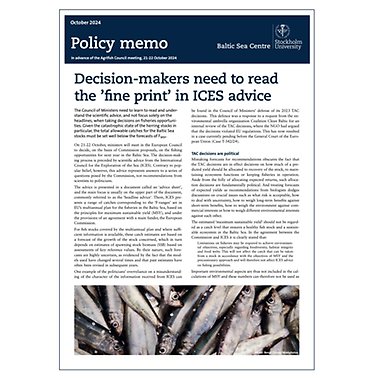
Council of Ministers must learn to read and understand scientific advice, rather than just focus on the headlines, when making decisions on fishing opportunities. This is the message of a new policy memo ahead of the Agrifish Council on 21-22 October
The accumulation of nutrient legacies on land and in inland waters will lead to excessive nutrient loads to the Baltic Sea for still a long time to come, according to a new study. That's one side of the story. On the positive side, measures already taken to reduce the inputs of nutrients to the catchment will have an impact on future loads to the sea as legacies are depleted, thereby reducing the need for additional mitigation measures. In a recently published comprehensive modelling study, researchers at the Stockholm University Baltic Sea Centre, have analysed more than a century of nutrient dynamics in the Baltic Sea catchment, covering 1.6 million km2 and 14 countries. The construction of a model enabled them to link the net anthropogenic inputs of nitrogen (NANI) and phosphorus (NAPI) to the Baltic Sea catchment to the waterborne loads to the sea from 1900 and up to today.
The BALTSEM model is a well-used tool for studying the effects of nutrient inputs to the Baltic Sea and has been used in the HELCOM Baltic Sea Action Plan. The modelling tool has now been further developed to include methane fluxes, which can provide important knowledge about the climate impact of the Baltic Sea.
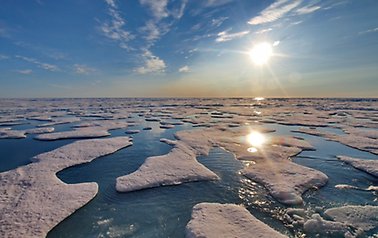
Ikaite is a special form of limestone that often forms in very cold seawater, in the polar oceans. A study led by Stockholm University researchers suggests that this highly unknown mineral plays an important role in the ocean's uptake of carbon dioxide.
A large portion of the methane found in brackish coastal surface sea waters originates from bubbles formed in the seafloor, according to a new study. This finding could be important in quantifying total greenhouse gas emissions from the coasts, and suggests that these emissions are currently being underestimated. Published 2024-09-12. Methane is a potent greenhouse gas, the second most important contributor to global warming after carbon dioxide. Hence, it is critical to understand its origin and behaviour to mitigate climate change. Although methane is largely formed through natural processes, emissions can be amplified by human activities, such as excessive nutrient inputs to the sea causing eutrophication. In a new study , researchers from Stockholm University and the University of Helsinki have examined the dynamics of methane in brackish coastal environments to improve understanding of its emissions to the atmosphere. They discovered that dissolved methane in the surface water originates from dissolution of bubbles that are being formed in the seafloor and traverse up through the water column – so-called ebullition – rather than diffusion of dissolved methane from the seafloor. “This is important, because it suggests that the total methane emissions from brackish coastal areas are likely being underestimated as some bubbles make it to the atmosphere”, comments Martijn Hermans , the lead researcher of the study. Methane transport in the sea – two pathways Methane is formed when organic material, such as dead plants, algae and animals decompose. In saline coastal waters this process usually takes place deeper down in the seafloor, and almost no methane makes it to the water column, let alone the
The implementation of the EU Common Fisheries Policy is far from fulfilling its purpose, and there has been too little effort to achieve coherence between fisheries and environmental policy. This is a comment from the Baltic Sea Centre's experts in response to a Commission consultation on the evaluation of the policy.
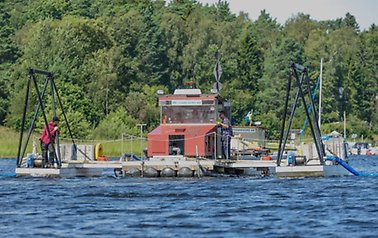
The aluminium treatment of the previously eutrophic bay Björnöfjärden posed no significant risk to humans, animals or vegetation, a new study shows. Aluminium levels increased in the water, fish and algae after the treatment, but only temporarily, and the transport of aluminium to nearby areas was low.
Next summer, the third UN global ocean conference will be held in Nice, France. The organizers are asking for proposals for measures needed to reach the goals for the sea. The Baltic Sea Center has responded and highlighted the themes and measures compiled by researchers and experts at Stockholm University in our new publication "Important measures for the Baltic Sea".
Securing the world's water supply is one of the greatest challenges of our time. Research at Stockholm University is now presenting an alternative method for quantifying the global risk of water scarcity. Results indicate higher risks to water supply than previously expected if accounting for the environmental conditions and governability where rain is produced.
Securing the world's water supply is one of the greatest challenges of our time. Research at Stockholm University is now presenting an alternative method for quantifying the global risk of water scarcity. Results indicate higher risks to water supply than previously expected if accounting for the environmental conditions and governability where rain is produced.
The European Commission proposes to increase the quota for central Baltic herring by more than 100 percent next year. Quotas for sprat, salmon and the collapsed herring stock in the Western Baltic are also proposed to be reduced.