This year both prizes of the anual Dyrssen Award for to the two best Master's theses in the marine field goes to students at the Department of Geological Sciences at Stockholm University. The first prize goes to a study conducted at the Askö Laboratory. Congratulations to both winners, Thea Bisander and Emelie Ståhl!
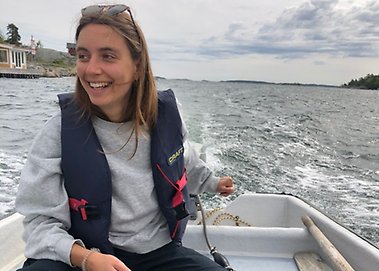
Imagine being able to do your Master's work by the Baltic Sea during the summer. India Findji, who studies marine biology at the University of Groningen in the Netherlands, managed to fulfill that dream this summer. She did her work at the Stockholm University field station Askö Laboratory, together with Jonna Källås, another Master's student from Sweden. India and Jonna both did their work within the large research project Thriving bays and investigated whether boat traffic has any clear influence on the water-clarity in the shallow bays of the Baltic Sea. India heard about the project through a professor at her own university. She contacted the researchers and became increasingly interested. – It sounded really exciting to discover Sweden and explore the Baltic Sea, says India. And I was not disappointed. The Stockholm archipelago is beautiful, I had never seen anything like that before. I loved spending so much time outdoors and living in a remote field station. It was also really fun to get to know Jonna and our supervisors Jocke and Sofia, and to learn about their Swedish culture. A piece of the puzzle for healthy bays The ‘Thriving bays’ project aims to investigate management measures to reverse the negative development seen in many shallow bays in the Baltic Sea. In many areas, clear, fish-rich waters with meadows of underwater plants and numerous small animals and fish fry have turned into a murky algae soup without predatory fish. – There are usually several reasons underlying this sad transformation, says India, but the role of boat traffic has never been properly investigated in the area. My study was about finding out to what extent boats can affect the health of shallow bays, and which criteria make the bays more or less sensitive to boat traffic.