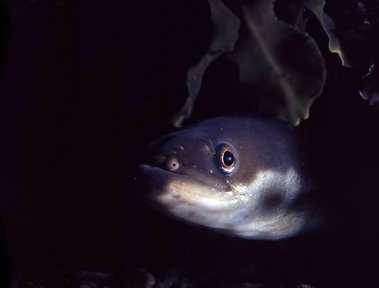
The migration of adult eels from northern European seas continues to decline. This is revealed by a new study based on international, fishery-independent trawl surveys. The results also suggest that the level of fishing mortality for eels in Swedish coastal waters has been significantly underestimated. "The situation for eels is very critical, and it is unreasonable to consider the impact of Baltic coastal fishing to be minor," says the article's author, Henrik Svedäng.
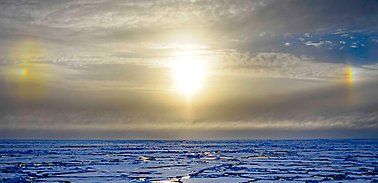
Over three weeks have gone for this years Oden expedition to the central Arctic Ocean and we have passed the midpoint with less time left than spent. We have managed to take some more sediment samples; the several meters deep samples represents a climate archive that may go millions of years back in time. Also a rare spotting of the sun, this time with two so-called "sundogs".
The EU Commission is proposing reduced total allowable catches (TACs) for several fish stocks in the Baltic Sea next year, taking into account the risk of stock collapse. For certain fish stocks, the proposed catch are significantly lower than those presented by the International Council for the Exploration of the Sea (ICES) in its 'headline advice'. “This is largely a very positive proposal. Now it's up to the Council of Ministers to follow it,” comments Sara Söderström, a fisheries researcher at Stockholm University Baltic Sea Centre. Five per cent. According to the EU’s multiannual management plan for Baltic Sea fisheries , the estimated probability of fish stocks covered by the plan running the risk of collapsing (more technically expressed as the spawning biomass falling below the biological limit B-lim) must not exceed this figure. Nevertheless, the EU Council of Ministers has repeatedly agreed on TACs that exceed this risk level. When doing so, they have justified this by referring to forecasts of ‘maximum sustainable yield’ from researchers at ICES. When ICES presented the scientific basis for this autumn's negotiations on next year's catches at the end of May, the calculations showed that the total catch of herring in the Gulf of Bothnia would need to be reduced by 62 per cent, from this year's 66,446 tonnes to 25,560 tonnes, in order not to violate this “five per cent rule”. At the same time, the first paragraph of the document, often referred to as the ‘headline advice’, gave a forecast of a maximum sustainable yield of 55 869–62 684 tonnes. The Commission's TACs proposal, however, takes account of the risks in line with the five per cent rule in the regulation, proposing a permitted catch of 25,560 tonnes for the Gulf of Bothnia.
A new discovery about how sea spray forms on coastlines may change our understanding of the oceans’ impact on climate. In coastal areas, aerosol concentrations have been greatly underestimated — but globally, they may have been overestimated. The findings, from a study that included a researcher at Stockholm University, could also affect air quality in coastal cities. And it all began during a car journey on a windless day in the Azores. The small island of Graciosa in the Azores is home to one of the US Department of Energy's many atmospheric measurement stations. The continuous measurements taken at these stations form a large part of the basis for what we know today about climate change. They capture not only the effects of greenhouse gases but also the role of cloud-forming aerosols from land and sea. Matthew Salter, a researcher at Stockholm University, had been studying aerosols and their effects for a long time when he visited the Azores in the summer of 2022 to see how a research campaign led by his PhD students, together with American collaborators, was progressing. On a beautiful, almost windless summer's day, he and some colleagues drove across Graciosa to reach the observatory at its northernmost point. Although it was almost windless on the island, high waves were crashing against the coast and the air was filled with sea spray. “We drove through a dense mist of spray that was so thick we had to use the windscreen wipers. Yet it was such a calm day, with almost no wind,” explains Matthew Salter.
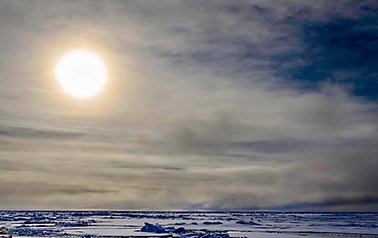
A little over a week has passed since the Research school on icebreaker Oden passed the North Pole and we are now relatively far south but on the other side of the pole which has some weird consequences. While the sun doesn't set, it does vary over the day. Since we are still on UTC time (sometimes called Greenwich Mean Time) this means that where we are now, the sun is the lowest in the middle of our day and vice versa.
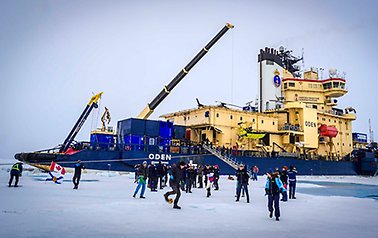
A week has passed on the Swedish/Canadian icebreaker expedition to the central Arctic Ocean and late Saturday afternoon we arrive at the North Pole where we stayed until the very early hours of Sunday. Everyone got together on the bridge and as we arrived on the North Pole we cheered eachother with a glass of (alcohol free) bubbles. After the crew had moored us to an ice floes, we were allowed off the ship for some free time and also the mandatory group photo.
The expedition Arctic Ocean 2025, with the research school on the Arctic climate system, is now well under way. We left Longyearbyen last Sunday August 10 under clear-blue skies and sunshine and this stayed with us through yesterday. Late last night we saw the first ice rather far north, and now were continuing north in ice and fog, as is usual along the ice edge this time of the year.
On August 18, Julie Lattaud and Flor Vermassen will set off on a research expedition to southeast Greenland aboard ATKA, a 16-meter sailing vessel equipped for scientific work. The boat is operated by the French organization Témoins Polaires and accommodates five people, including two researchers. “I’m trying to understand the role the ocean plays in glacier melting within the fjord,” says Flor Vermassen at the Department of Geological Sciences. Thanks to its small size and specialized equipment, ATKA can access narrow, shallow fjords where larger research vessels cannot reach. This allows scientists to study the effects of glacier melt on the ecosystem – up close and on site. Ocean currents carrying warmer water into the fjords accelerate glacier melting. By gaining deeper insight into this process, the researchers hope to contribute valuable knowledge about how climate change is impacting the Arctic, and how we might address these changes in the future. The expedition is also carried out with minimal environmental impact. “With ATKA, we can conduct research in a highly carbon-neutral and cost-effective way,” says Julie Lattaud at the Department of Environmental Science.
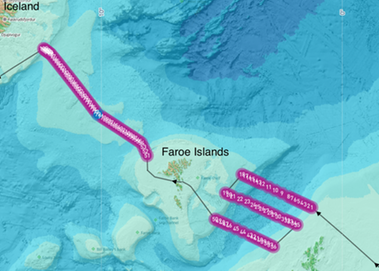
Léon Chafik, Stockholm University, and Fabien Roquet, Gothenburg University, will investigate deep water currents in the North Atlantic on 2–16 July 2025. During the expedition they will make measurements in two important sea passages: the Faroe-Shetland Channel and the ridge between the Faroe Islands and Iceland.
The European Commission has launched its EU Ocean Pact after a long period of preparatory discussions. The Ocean Pact was launched it in conjunction with the UN Ocean Conference currently taking place in Nice, France, and the communication states that an 'Ocean Act' will be proposed by 2027. Published 2025-06-11. The EU Ocean Pact is a strategy that sets out what the Commission wants to achieve on ocean issues. Formally, it is a communication, i.e. not a formal legislative proposal but a document setting out the Commission's intentions. The Pact has been developed over a long period of time with several opportunities for stakeholders to provide input, most recently by participating in Ocean Week in early March when many gathered in Brussels for a series of seminars and workshops where marine issues were discussed. The Stockholm University Baltic Sea Centre participated but has also submitted written comments. The Pact aims to support six priorities: protecting and restoring ocean health, boosting sustainable competitiveness of the blue economy, supporting coastal, island communities and outermost regions, advancing ocean research, knowledge, skills and innovation, enhancing maritime security and defence as a prerequisite, strengthening EU ocean diplomacy and international rules-based governance. The Ocean Pact communication also states that: "Based on a consultation of the relevant stakeholders, the Commission will propose by 2027 an 'Ocean Act' that will build on a revision of the MSP Directive. It will aim at strengthening and modernising maritime spatial planning as a strategic tool that will serve the priorities of the Ocean Pact and their implementation, notably through increased cross-sectoral coordination at national level and through a better organised sea basin approach." The fact that the Commission intends to propose a legislative revision came as a surprise to many stakeholders, as the Commission repeatedly emphasised during the preparations that it would only be a strategy and not a legislative proposal. It remains to be seen when and if the legislative proposal will come and what will eventually be decided. The Baltic Sea Centre will continue to follow the issues. Text: Gun Rudquist Links The European Ocean Pact Baltic Sea Centre's comments on the proposed European Oceans Pact
If EU fisheries ministers follow the latest advice from ICES regarding next year's Baltic Sea fishery, the result could be herring catches that breach EU rules and a failure to achieve one of the key objectives of the Common Fisheries Policy.
Out at sea, at the classic environmental monitoring measuring station B1 near Askö in the Trosa archipelago, the very first samples of a new long series are collected. These samples will reveal the activities of the sea’s smallest inhabitants. What lives in the water? We can see some of it with our own eyes, such as aquatic plants, macroalgae, fish and small animals. Even the phytoplankton and zooplankton in the Baltic Sea, which are microscopic, are fairly well understood thanks to scientists and their microscopes. However, the smaller the organisms, the less we tend to know about them. Every litre of seawater also contains billions of bacteria, but few people know much about them or what they do.