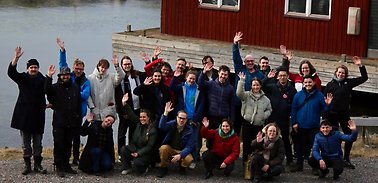
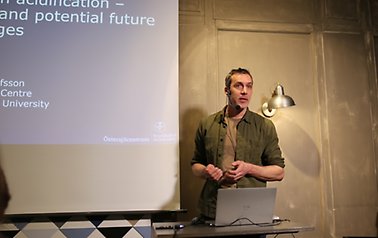
Solving complex questions about interactions between the sea and climate change, and how they relate to society, requires a broad set of skills. In a new research school, PhD students from diverse scientific disciplines at Stockholm University get a unique opportunity to learn how transdisciplinary approaches and research communication can lead to sustainable management of coastal environments. What unites students in from widely varied subjects like marine geology, business accounting, and ecotoxicology? They all provide important perspectives necessary to answer questions on societal challenges and solutions to climate change in coastal seas. During a kick-off meeting for the research school Perspectives on climate change in coastal seas in March, 14 new PhD students were introduced to this framework that will be their research focus for the coming years. "I feel proud to be part of this program, and though this transdisciplinary context is new to me, I think I have a lot to bring to the table," says Emma Flévaud, PhD student in environmental law. Adding new pieces to the puzzle The oceans face multiple climate-related pressures such as acidification, oxygen deficiency and rising temperatures. These, among others, cause feedbacks that release potent greenhouse gases into the atmosphere, reinforcing the climate effects. However, under healthy conditions with prospering ecosystems, the coastal zones have effective carbon storage capacities and can be important carbon sinks. "If we manage the coastal zones right, they could globally contribute to 20 percent of the greenhouse gas emission reductions we need to fulfill the Paris Agreement," says Christoph Humborg, Scientific Director at Stockholm University Baltic Sea Centre and one of the initiators of the research school. This intricate puzzle is partly understood and described in science, and questions remain about the links between climate change, biodiversity and the full potential of the coastal zones to serve as climate mitigators. In research initiatives like CoastClim experts in ecology, modeling, marine physics, and atmospheric sciences explore these links. For the next couple of years, the students from Stockholm University will be involved in research questions that add important information in this context.
On 6-9 June, EU citizens will elect their representatives to the European Parliament. And if you care about the sea and the climate, you should care about who you elect to the Parliament. The majority of environmental issues in our countries are governed by EU policies.
22 March 2024 marks the 50-year anniversary of the first Helsinki convention that led to the formation of the Helsinki Commission – HELCOM. “Without the successful cooperation in HELCOM, the Baltic Sea would likely be in a much worse shape today”, comments researcher Bo Gustafsson, whose modelling team has made important contributions to the development of Baltic Sea Action Plan. In the 1970s it became impossible for the coastal countries around the Baltic Sea to ignore that the sea was becoming unrecognizably degraded. The then seven bordering countries agreed to sign an agreement aiming to address the increasing environmental challenges arising from industrialisation and other human activities, which were having a severe impact on the marine environment. The convention became the starting point for the formation of the Baltic Marine Environment Protection Commission – also known as the “Helsinki Commission” or “HELCOM” – that was established the same year. In 2007 the HELCOM contracting parties adopted the Baltic Sea Action Plan (BSAP) – a strategic programme of measures and actions for achieving good environmental status of the sea, originally by 2021. By the time of the preparation of the BSAP, the Swedish project MARE led by Fredrik Wulff at Stockholm university had the tools required to support a sophisticated evaluation of the maximum inputs of nutrients that could be allowed to the Baltic Sea to achieve the eutrophication goals. The concept and quantification of the maximum allowable inputs (MAI) and the necessary reductions of inputs derived therefrom, was incorporated in the plan, and that success led to the institutionalisation of the independent scientific decision support as the Baltic Nest Institute (BNI). BNI still, after 17 years, serves HELCOM with independent scientific advices from its base at Stockholm University Baltic Sea Centre.
The Swedish coasts are currently net sources of greenhouse gases to the atmosphere, mainly in the form of methane. Reducing these methane emissions requires more measures to combat eutrophication. These are the findings of the Baltic Sea Centre's researchers in a new policy brief.
Last week, the European Parliament (EP) finally voted in favour of the Nature Restoration Law. What should have been a formality became a final battle.
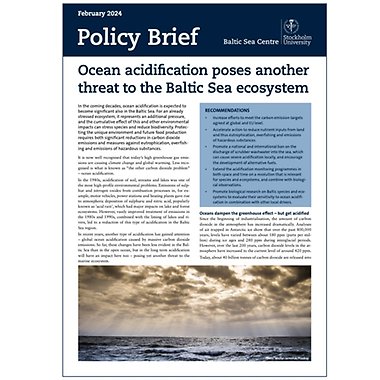
Large anthropogenic emissions of carbon dioxide don’t only cause global warming, but also acidification of the oceans. In the Baltic Sea pH is expected to decrease between 0.1 and 0.4 units during this century depending on future emissions. The effects of ocean acidification on organisms have already been visible and are expected to increase, but not for the reason previously thought. The oceans absorb about 25 percent of the global carbon dioxide emissions. One effect of this is that pH in the water is decreasing – the oceans are being acidified. “The global trend is currently a pH decrease of 0.02 units per decade”, explains Erik Gustafsson, oceanographer and researcher at Stockholm University Baltic Sea Centre. Future acidification is directly related to the development of carbon dioxide emissions. If the goals of Paris agreement (to limit global warming to well below 2 degrees) are met, the pH decrease will level out and pH begin to increase again during this century. A more moderate mitigation of emissions would lead to a continuous decrease and in the worst-case scenario, where emissions continue to increase significantly, pH would decrease by up to 0.4 units until the end of this century.
Ocean acidification is expected to become significant also in the Baltic Sea in the coming decades. It represents an additional pressure for the already stressed ecosystem and makes it even more important to act to reduce other pressures, such as eutrophication and hazardous substances.
How high a risk are we prepared to take with fish stocks, with fisheries and with the marine environment? That question is at the heart of the recent move by the European and the Council to amend the multiannual plans for commercial fisheries in the Baltic and other regions. It deserves to be discussed openly. So far it hasn’t. In effect, the Commission and the Council are now prepared to take much greater risks than they were a few years ago. This risk-prone behaviour is escalating now, despite the history of stock collapses in the Baltic within the past 10 years. The Council has in practise accepted a one in four risk that fish stocks fall below a limit value instead of accepting a risk of 1 to 20, meaning by coming below this limit, they could crash or be “harmed” in the next year. Moving with unusual speed and without the normal consultations and impact assessments, the Commission has in effect accepted this higher risk. It has proposed, together with the Council, that the Council should be allowed to take similar or even higher risks in the future. Fortunately, the proposal will also be discussed in the Parliament. That gives a bit of time for reflection and discussion on how good an idea this actually is. MAPs The multiannual plans (MAPs) were adopted by the EU as a central tool to achieve sustainable fisheries after the reform of the Common Fisheries policy in 2013. The Baltic MAP, adopted in 2016, was the first, and the model for the others. A key goal of the MAP, and of the CFP, is to restore and maintain levels of commercially fished stocks above levels that can produce “maximal sustainable yield”. But in case they do not succeed, there is a safety catch in the MAP: fishing quotas are to be set in a way that in any case does not give more than a 5% probability that the stocks fall below a crisis level called Blim (the biomass limit, below which reproduction may be impaired, meaning the stock could collapse or being permanently reduced in productivity). Falling below Blim means that the fishery irrevocably should be stopped. Of note, these limits are rather arbitrarily set, and there is a risk that the stocks in the Central Baltic as well as in the Gulf of Bothnia already are reduced in reproductive capacity due to fact that years of overfishing have passed unnoticed. The October surprise Due in part to overly optimistic decisions in the Council, the state of two of the four herring stocks in the Baltic is now so bad that even with no fishing in 2024 they were estimated to have too high a probability of falling below the crisis level in 2025. In accordance with rule 4(6) in the MAP regulation the Commission duly proposed closing the targeted fisheries for them. In doing so, it fudged the definition of “targeted” for one of them, leaving a gaping loophole allowing for an unknown but large amount of herring to be caught as “bycatch” in the sprat fishery. And, implicitly, allowing a much higher level of risk than the regulation permitted. The Council, ostensibly not understanding the MAP-regulation, decided in October to set fishing levels with a much higher level of risk. Then again, they also requested that the Commission start a process to remove the offending safe-guard, suggesting that they did in fact understand that they were breaking the rules. How big a risk is sustainable? According to calculations by ICES (International Council for Exploration of the Sea, the scientific body that does these estimates for the Baltic and Northeast Atlantic) the levels of fishing approved by the Council would give a 20% or larger probability of the stocks falling below the limit level. For the central Baltic herring, the probability is a whopping 29% (assuming the Russians will stick to their fair share of the herring catches, which they haven’t for the past years). That is, the Member States’ fisheries ministers Council are taking a one in four chance of the stock falling into the danger zone, more than five times the level currently allowed in the MAP-regulation. If the Council would make such decisions for a stock four years in a row, statistically, the stock would likely fall below the limit value. Put another way, if the Council would make such a decision for four stocks this year, at least one would be expected to get into the red zone next year. It should be noted that these probabilities are estimates, based on expected growth of the stocks. These growth projections might be loosely compared to the projections made by banks about the growth of the economy, the rate of inflation or the interest rate. That is, they are by nature uncertain. In Baltic fisheries, the uncertainties can be very great, due to misreporting tainting the data fed into the models, environmental changes impacting relations the models are based on, the weather or other uncertainties. So in reality, the probabilities could be lower – or higher. One might compare the odds accepted by the Council with those of a classic Russian roulette, where the odds are in fact better, only one out of six. Serious consequences or sky is the limit? But that raises another question: how serious are the consequences of being unlucky? In Russian roulette, the consequences are very serious for the individual player. But for fish stocks? The consequences for the fishers and the communities where people make a living by catching or processing fish is that people can lose their livelihoods. This is less serious than losing one’s life, but serious enough. The consequences for the marine environment can be more far-reaching and long-lasting. The fishing for the Norwegian spring spawning herring was stopped in the mid-1960s, and the ban lasted for 30 years. However, it saved the most important fish stock in Europe, and Norway can rightly pride themselves on taking the wise and correct decision at the right time. Herring are a key low-trophic level species, interacting with other species both as predator and prey and a motor moving energy flows in the Baltic. The consequences for coastal environments can be enormous, impacting coastal fish species, birds, amplifying the effects of eutrophication etc. A fisher with loans to pay may be willing to take a very large risk with the fish stocks or the environment to avoid having to close down operations. But how big a risk do we as a society want to take with fish stocks and the marine environment beyond next year? How much is sustainable? That is something we ought to discuss more openly before the European Parliament decides if it wants to remove a safeguard or not, and what it wants to put it its place. Would it be enough to amend the 5% rule and accept a 30% probability of a stock entering the danger zone, or, as is the case in the Commission and Council proposal, simply remove the safeguard and accept that the sky is the limit? Text: Charles Berkow
The Stockholm University Baltic Sea Centre has sent in a response to the EU-Commission’s consultation on its proposal to weaken the multiannual plan for major commercial Baltic fisheries. The Centre suggests that the proposal be withdrawn. In substance it would mean a higher level of risk for further decline or collapse for Baltic fisheries. The process leading up to the proposal was also deficient. For example, no analysis was made of the socio-economic consequences beyond the first year, of the higher risk level, not to mention the consequences for fish stocks or the environment. The Commission’s justification for the amendment is based on a misunderstanding of both the science and of the logic and structure of the plan. The decline of most fish stocks covered by the plan points instead to the need of a more conservation -oriented approach, instead of an even higher-risk approach. Read the full response here: Feedback to the EU Commission proposal to amend the Baltic MAP
The recent and unusually rapid moves by the European Commission and the Council to weaken the management plan for major Baltic fisheries raise the question of if they may have forgotten parts of their deal about how to achieve better law-making, writes Charles Berkow in an analysis.
The European Commission and the Council’s ministers are moving rapidly towards a revision of the multiannual plans for fisheries. Unfortunately, the haste is not matched by the quality of the proposal or the logic of its justification. On the contrary, the ministers seem to have fundamentally misunderstood both the plans they want to amend, the science that underpins annual decisions on fishing quotas, and how the plans and the science interact, writes Charles Berkow, fisheries policy expert at Baltic Sea Centre. If adopted, these changes will increase the risk that fish stocks will continue to collapse. The losers will be fishers, the associated industries, their communities and, most importantly, the marine environment. This article attempts to clarify the issues. The focus will be on the Baltic, where the first multiannual plan was adopted and where a controversy this autumn sparked the drive to weaken the plans . The controversy, call for change and Commission cave The central tool of the EU’s Common Fisheries Policy (CFP) after the reform in 2013 is multiannual plans (MAPs) for managing fisheries. In May, 2023 scientists at the International Council for Exploration of the Sea (ICES) pointed out that the risk for the stocks slipping below a limit level was too high, even if there were no fishing at all. Referring to the provision of the Baltic MAP under these circumstances (article 4.6, also called "the 5% rule"), the Commission proposed in August 2023 a closure of targeted fisheries on these two herring stocks (with a substantial by-catch quota for central Baltic herring in other fisheries). The proposal provoked a strong reaction from both major fishing interests and Member States. They objected to the proposed closure of targeted fisheries and wanted higher quotas for the herring (and sprat). In October, ministers rejected the Commission proposal and instead agreed on large quotas of both central Baltic herring and Gulf of Bothnia herring, while also agreeing on restrictions on trawling herring for limited periods as so-called remedial measures, which are suposed to ensure the rapid increase in the fish stocks. In a statement in connection with the Council decision, the European Commission expressed understanding for the Member States’ request for a targeted amendment to the MAP, but pointedly reminded the Council that “it is notably for the Commission to appreciate the timing and content of any such proposal”. Just a few weeks later, on December 6th, the Commission submitted a proposal for a removal of Article 4.6 in the MAP to the Council and the Parliament. There had been no public consultation and no impact assessment, as is normal procedure before the Commission presents a proposal; the Commission claimed that they weren’t needed. Nonetheless, the same day, the Commission in a case of mixed signals, initiated a public consultation on the proposal, open until the end of January 2024. The Working Party on Fisheries Policy (that is, civil servants from the governments in the Member States) examined the proposal already the next day. The Council Presidency presented a compromise (with little change in substance from the Commission proposal) that the Working Party examined and approved on the 18th of December. At least two Member States, however, entered “parliamentary scrutiny reservations” , giving their parliaments a chance to express an opinion. The presidency compromise was then sent to the Permanent Representatives Committee (COREPER) for formal approval, or further discussion, if needed. Two lines of argument In essence, the Commission has two lines of argument. The first is that there may be “inconsistencies” between article 4.6 in the MAP on the one hand and Article 2 and/or Article 5 on the other. The second is that applying the 5% rule could “have potentially severe socio-economic implications”. Article 4 is about setting fishing quotas for the coming year (a more detailed presentation may be found here ). Claiming inconsistency is like comparing apples and oranges The Commission claims that the safeguard in Article 4.6 is essentially redundant. It points out that the main rule for setting TACs is that quotas should be set between F-ranges estimated by ICES, and, crucially, that these values are capped such that the probability of the stock falling below Blim is no more than 5%. This follows from the definition of “range of FMSY values” in Article 2(2). (see Box below) The 5% rule in Article 4.6 is, however, not the same as the 5% rule in Article 2.2. The two 5% rules are based on different time frames and different levels of concreteness. The 5% rule in 4.6 is about the actual risk over the next year based on the most up-to-date information. The 5% rule in 2(2) is about hypothetical risks over the long term , based on simulations often covering 50 or more years. In other words, there are no inconsistencies between the 5% rules in Articles 4.6 and 2(2), except that 5% refers to different entities. Put more simply, it is like comparing apples and oranges: they are both round fruits, but they are different. Evidence that 5% rule for F-ranges in Article 2.2 does not apply to the next year can be seen in the latest ICES advice for the central Baltic herring and Gulf of Bothnia herring. There, ICES presents F-ranges that give a probability of SSB<Blim in 2025 of over 20%. Dropping the 5% safeguard in Article 4.6 in favour of the 5% definition in Article 2.2 means increasing the risk for a stock collapse. From the Baltic MAP: "Article 2.2 'range of FMSY' means a range of values provided in the best available scientific advice, in particular from ICES or a similar independent scientific body recognised at Union or international level, where all levels of fishing mortality within that range result in maximum sustainable yield (MSY) in the long term with a given fishing pattern and under current average environmental conditions without significantly affecting the reproduction process for the stock in question. It is derived to deliver no more than a 5 % reduction in long-term yield compared to the MSY. It is capped so that the probability of the stock falling below the limit spawning stock biomass reference point (Blim ) is no more than 5 %. Article 4.6 Fishing opportunities shall in any event be fixed in such a way as to ensure that there is less than a 5 % probability of the spawning stock biomass falling below Blim. Article 5 Safeguards 1. When scientific advice indicates that for a given year the spawning biomass of any of the stocks referred to in Article 1(1) is below the MSY Btrigger, all appropriate remedial measures shall be adopted to ensure rapid return of the stock concerned to levels above those capable of producing MSY. In particular, notwithstanding Article 4(3), fishing opportunities shall be set at levels consistent with a fishing mortality that is reduced below the upper range of FMSY, taking into account the decrease in biomass. 2. When scientific advice indicates that the spawning stock biomass of any of the stocks referred to in Article 1(1) is below the Blim, further remedial measures shall be taken to ensure rapid return of the stock concerned to levels above the level capable of producing MSY. In particular, those remedial measures may include, notwithstanding Article 4(3), suspending the targeted fishery for the stock and the adequate reduction of fishing opportunities. 3. Remedial measures referred to in this Article may include: (a) emergency measures in accordance with Articles 12 and 13 of Regulation (EU) No 1380/2013; (b) measures pursuant to Articles 7 and 8 of this Regulation….” Article 4.6 vs. 5 The Commission claims (in recitals 8-11) that there may be inconsistencies between Article 4.6 and Article 5. A detailed and somewhat technical comparison between Articles 4.6 and 5 (see box below) show that is not the case. Articles 4.6 and 5 compared: Article 4 in the MAP is about setting fishing quotas for the coming year. Article 5 is about extra protective measures to be taken in some specified circumstances. Starting points: Article 4.6 takes as its starting point the forecast situation next year: the estimated the probability of the spawning stock biomass (SSB) being below the biomass limit level (Blim) Article 5 takes as its starting point the estimated situation this year: 5.1 refers to a situation where the estimated SSB is below a trigger level, MSY Btrigger, while 5.2 refers to a situation where the estimated biomass is below the lower limit level Blim Targets: Article 4.6 has a very clear target: the probability of the spawning stock biomass (SSB) being below the biomass limit level (Blim) shall be less than 5%. Article 5 has the loftier but possibly vaguer target of “return of the stock to levels above those capable of producing MSY” (maximum sustainable yield). Some argue this should be BMSY (the spawning stock biomass that results from fishing at FMSY for a long time). Not all may agree, but it is unclear what the alternative would be. In any case, ICES does not normally provide information on estimated BMSY although it does provide information on MSY Btrigger. Measures: Article 4.6 has only one measure, the setting of fishing quotas (total allowable catches, or TACs). Article 5 refers to “all appropriate remedial measures”. There is a reference to (presumably non-exhaustive) lists of measures in Articles 7 and 8 in the MAP and in articles 12 and 13 of the basic regulation of the Common Fisheries Policy (1380/2013). Article 5.1 singles out one measure in particular: setting TACs below FMSY (a fishing pressure consistent with achieving Maximum Sustainable Yield). Article 5.2 singles out another measure in particular, suspending the targeted fishery and setting TACs at levels to provide only by-catch of the particular stock (for example cod) when targeting other species (for example plaice). Timing: Article 4.6 says nothing about the timing. The most reasonable interpretation is that it refers to the following year, as Article 4 is about setting fishing quotas and they are normally set for the following year. None of the articles 4.3-4.5 specify the time frame, but it is implicit that they refer to TACs for the following year. That is also how they have been applied in practise. If something else is meant in 4.6 that would reasonably be specifically stated there. Article 5 specifically states that the time frame for recovery of stock levels is “rapid”, which, however, is somewhat vague. A close reading of Articles 4.6 and 5 suggests that the differences between them are clear and completely in order. They have different starting points, different targets and different time frames. While there is some overlapping regarding the measures, there is no conflict or problematic “inconsistency” between the two. Severe socio-economic impacts As a closer examination of the alleged inconsistencies between Article 4.6 and other provisions of the MAP shows that there are in fact no such inconsistencies, that leaves the socio-economic impacts as a justification for the change of the MAP. When Member States in the Council refer to “socio-economic impacts” they normally refer to consequences for fishers and the processing industry in the coming year. These consequences are used as arguments for higher quotas than the European Commission has proposed and/or ICES advised are compatible with the MAP. However, the short-term consequences must be weighed against the consequences if the stock is perennially depleted or crashes. When stocks are held at anemic levels for year after year the catches are less than they would be if the stocks were more robust. A short-term reduction in catches can then be seen as an investment in larger stocks and catches in the medium term. As no impact analysis has been presented for the Council/Commission proposal it appears that it is only the impacts in the immediate term that are being considered. The impacts on the marine environment are seldom mentioned but can be assumed to be severe when top predators like the Baltic cod or low-trophic level keystone species like the Baltic herring are depressed. Before an amendment is approved it would be useful for the Council and Commission to present their assessments on the socio-economic and environmental impacts of the proposed changes. Next steps As a result of the consultation it has opened after the fact, the Commission may realize that its proposed change of the MAP was based on a misunderstanding of the MAP and the science and withdraw the proposal. If the Council and Commission maintain their current positions the proposal will go to a three-way “trialogue” negotiation with the European Parliament. It will then be up to the Parliament to defend the integrity of the MAP for which it fought for the status of co-legislator. Then again, perhaps someone will appeal the decisions made under the MAP to the Court of Justice so it can determine if they are consistent with the provisions in the basic regulation of the CFP. Text: Charles Berkow
Stopping eel fishing when it does the least good for eel stocks and paving the way for continued eel restocking signals that EU fisheries ministers are more interested in protecting fisheries than in protecting eels, say the Baltic Sea Centre's Henrik Svedäng and Charles Berkow.