


Legacy effects are expected to reduce phosphorus loads
The accumulation of nutrient legacies on land and in inland waters will lead to excessive nutrient loads to the Baltic Sea for still a long time to come, according to a new study. That's one side of the story. On the positive side, measures already taken to reduce the inputs of nutrients to the catchment will have an impact on future loads to the sea as legacies are depleted, thereby reducing the need for additional mitigation measures.
In a recently published comprehensive modelling study, researchers at the Stockholm University Baltic Sea Centre, have analysed more than a century of nutrient dynamics in the Baltic Sea catchment, covering 1.6 million km2 and 14 countries. The construction of a model enabled them to link the net anthropogenic inputs of nitrogen (NANI) and phosphorus (NAPI) to the Baltic Sea catchment to the waterborne loads to the sea from 1900 and up to today.
Researcher Bärbel Müller-Karulis.
“The import of nutrients to the area that drains into the Baltic Sea is closely connected to the loads of nutrients to the sea, where they cause eutrophication”, explains main author Bärbel Müller-Karulis. “A part of the nutrient import is transported rapidly to the sea, while some is stored and released later. Understanding these dynamics is important to predict future loads to the sea.”
Nutrient import peaked in 1980s
The import of nutrients to the Baltic Sea drainage basin increased rapidly after the 1950s, with the increased use of mineral fertilisers, to peak in the 1980s. Areas with a high share of agricultural land, such as the catchment of the Danish Straits, received the highest inputs relative to land area. In the Baltic Sea catchment as a whole, mineral fertilisers made up as much as 81 per cent of the total input of nitrogen and 96 per cent of the total input of phosphorus during the period 1900-2018. Other contributions to NANI and NAPI have been import of food and feed, and in case of NAPI also detergents.
Some of these nutrients brought into the catchment are transported to inland waters and further on to the Baltic Sea in form of human excreta in wastewater (also as point sources to the sea), rapid runoff from agricultural land, or slow leakage from accumulated nutrient legacies. For the whole period 1900-1918, however, only a small fraction of the nutrients brought into the catchment – about one-twentieth of the nitrogen and one-fifth of the phosphorus – has reached the Baltic Sea. This has still been enough to cause extensive eutrophication, which has degraded the environmental status of the sea.
Instead, the model shows that most nutrients are removed by nutrient sinks. These include the removal of nitrogen by denitrification (where biologically active forms are reduced to inert nitrogen gas) and the immobilisation of nitrogen and phosphorus in terrestrial and aquatic environments. On the time-scales covered in the study, only a minor fraction of the nutrients brought into the catchment create legacy pools that are mobilised and released into freshwater and marine ecosystems, affecting these over several decades. This diffuse riverine load has made up an increasingly important part of the total waterborne load to the sea, as wastewater treatment has improved in the drainage basin, Bärbel Müller Karulis says.
“As the anthropogenic inputs of nutrients to the catchment increased, the share converted to human excrements declined”, she says. “Increased urbanisation and connection to sewage systems with poor treatment made nutrient loads from sewage systems grow faster than population size after the second world war, but these loads have dropped with the modernisation of the sewage treatment plants. Now, the release of accumulated nutrients makes up a larger part of the loads.”
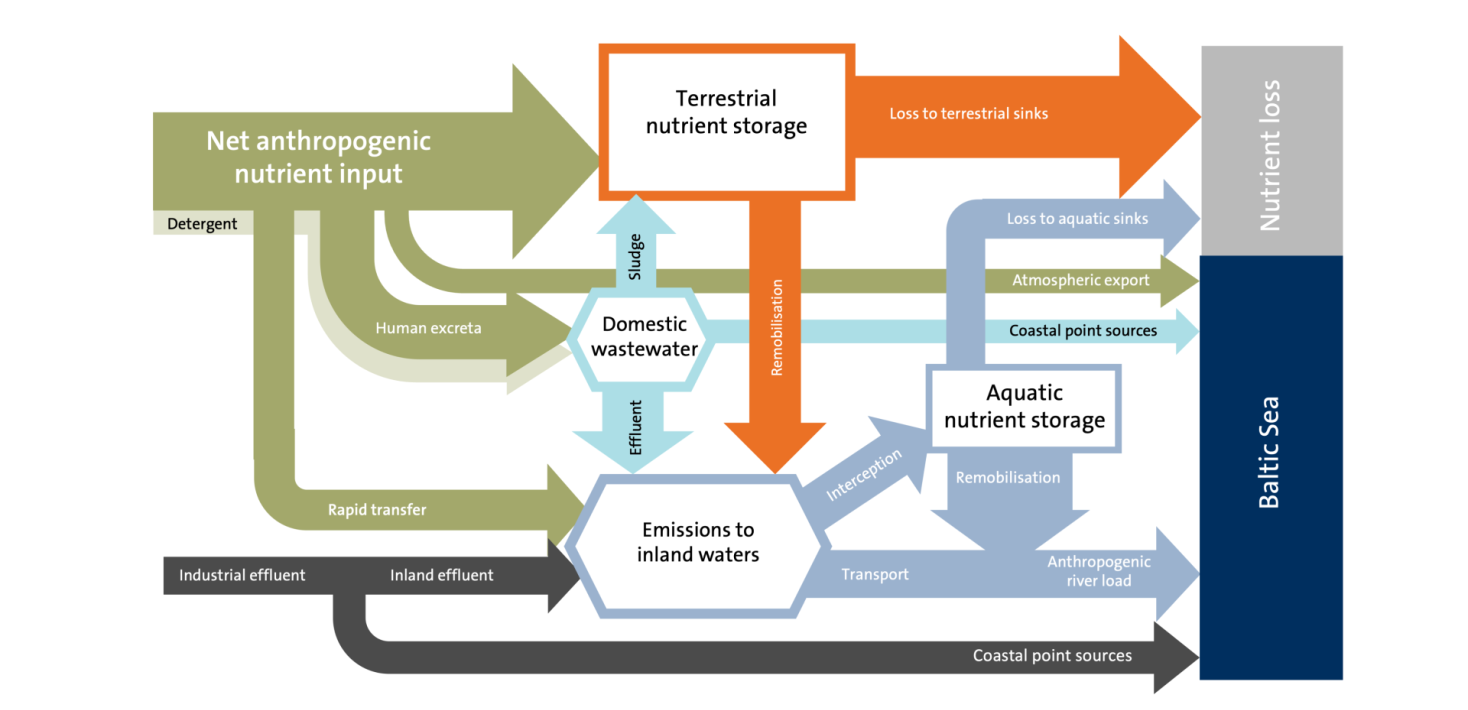
Part of the nutrient inputs to the Baltic Sea drainage basin reach the sea in form of wastewater, atmospheric deposition or rapid runoff from agricultural land. However, a larger part is stored in terrestrial and aquatic enviroment, from which some is released later on and some is lost. Modified illustration from the scientific article, Müller-Karulis et al 2024.
Delayed response
Since the peak in the 1980s, the net input of both nitrogen and phosphorus to the Baltic Sea catchment has decreased significantly, and has stabilized at 40 – 70 per cent of peak inputs for nitrogen, and 15 – 30 per cent for phosphorus. The study shows that in recent years the buildup of nitrogen storage has halted, and the phosphorus accumulation has turned to depletion. However, the response time of river loads to changes in the net inputs to the catchment is approximately 4 years for nitrogen and 6-18 years for phosphorus, in all systems except for Gulf of Riga and Gulf of Finland catchments, where response times are shorter.
The long response times of nutrient loads to changes in the catchment is often seen as an obstacle that masks the effect of management measures, but Bärbel Müller Karulis points out that there is a bright side. The storage depletion that has begun will have an impact on future loads. For phosphorus, the study foresees a continued decline, so that the gap to the maximum allowable loads agreed in the HELCOM Baltic Sea Action Plan is smaller than a glance at current loads would suggest.
"Taking into account nutrient storage, time lags and legacy effects could significantly reduce
the need for additional mitigation measures in the future," says Bärbel Müller Karulis.
Text: Lisa Bergqvist
About the study
- The study “Legacy nutrients in the Baltic Sea drainage basin: How past practices affect eutrophication management” was conducted by Bärbel Müller-Karulis, Michelle McCrackin, Benoit Dessirier, Bo Gustafsson and Christoph Humborg at Stockholm University Baltic Sea Centre and published in Journal of Environmental Management.
- The researchers constructed a nutrient fate model for the Baltic Sea that links anthropogenic nitrogen and phosphorus inputs to the catchment to the dynamics of waterborne loads to the Baltic Sea, covering the time-period from 1900 to present. The work builds on a previous model for phosphorus that was refined by splitting the drainage basin into several sub-catchments and by expanding the model approach to nitrogen.
- From 1900 and onwards, nutrient inputs to the drainage basin approximately tripled to a peak in the 1980s, after which they declined. In total, 19 per cent of the cumulative nitrogen inputs and 6 per cent of the phosphorus inputs have reached the sea. 66 per cent of the nitrogen and 81 per cent of phosphorus was removed by sinks. The remains make up a stored legacy which is continuously released to inland waters. This mobilisation from the storage pools, forming diffuse nutrient inputs, is currently the primary pathway by which anthropogenic nutrient loads reach the Baltic Sea. For phosphorus, these loads are expected to decrease, as the legacy pools are depleted.
Last updated: 2024-09-30
Source: Baltic Sea Centre