News

  • Five persons in a cave.

    Previously unknown extinct bovine species discovered in Siberia

    DNA analyses of ancient remains have revealed a previously unknown extinct bovine species that inhabited southern Siberia during and even before the last Ice Age. The extinct species was related to modern yaks, but followed a separate evolutionary path for hundreds of thousands of years. The findings are published in Current Biology .

  • GGRCC Launches New Online Seminar Series. Graphics: GGRCC

    GGRCC Launches a New Talk Series

    The newly founded Global Governance Research Centre Consortium (GGRCC) is now launching a new ”online speaker series” – GGRCC Talk Series. Four speakers will be sharing their insights this fall. The first seminar will take place on October 12, featuring Rosemary Foot, University of Oxford.

    Stockholm Center on Global Governance
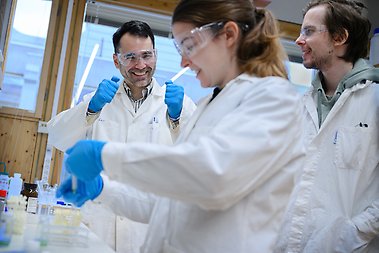
  • Researchers in a lab at the Department of Chemistry

    18 PhD positions available at the Faculty of Science

    As a PhD student at Stockholm University, you will have the opportunity to deepen your knowledge within a research field and contribute to new knowledge. The Faculty of Science is now offering 18 PhD positions across a range of scientific disciplines.

  • Beyond the Risks: The Role of Law and the Price of Unused Technology

    When new technologies are discussed, the debate often focuses on risks and regulation. But what do we miss when technology is not used? This was the question at the centre of the Faculty of Law’s honorary doctorate lecture with Professor Ugo Pagallo.

    Department of Law
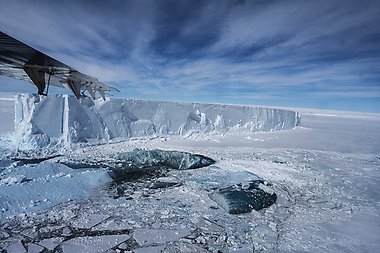
  • The edge of a large ice shelf in Antarctica. The photo is taken from a small airplane

    To predict Antarctica’s future, scientists need to see beneath the ice

    Professor Arjen P. Stroeven from Stockholm University and the Bolin Centre for Climate Research is one of 80 scientists behind a new international review highlighting major gaps in our knowledge of Antarctica’s coastal zone. The researchers warn that what we do not yet know about the landscape beneath and around the Antarctic ice could be limiting our ability to predict future sea-level rise.

    Bolin Centre for Climate Research
  • Studying four generations: New ERC project sheds light on social mobility

    Do people fall or rise in social status after migrating to another country? A new five year project led by sociologist Rosa Weber will explore the dynamics of long-term social mobility of immigrant families. The project is funded by the prestigious ERC starting grant.

    Department of Sociology
  • Nobel Calling October 5-12

    In connection with the announcement of the Nobel Prizes, Stockholm University organises activities in collaboration with the Nobel Prize Museum as part of Nobel Calling. In 2026, the programme will include a lecture from Chad Finley and Sven Lidström about the IceCube research facility at the South Pole and discussions.

    Department of Physics
  • First Women’s Network Conference, 15–16 September 2026.

    New conference brings together women in economics

    On 15–16 September, Stockholm hosted the First Women’s Network Conference. The conference is part of a new network for women in economics, initiated by Laura Montenbruck, a researcher at Stockholm University.

    Department of Economics
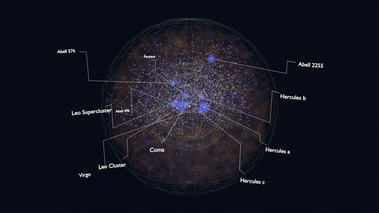
  • A cloud of white-blue dots shows supernovas in the universe, overlayed by a dark red layer showing cosmic dense regions of space. Large blue spheres indicate superclusters in the universe with higher than average supernova rates.

    Supernova hotspots could skew how we measure the expansion of the universe

    New findings from PhD student Antoine at Oskar Klein Centre, Fysikum/SU, puts calculations of the Hubble constant into question. Supernovas were assumed to either be evenly distributed, or scale with a structure's mass. But new simulations based on ZTF observations show them distributed in dense superclusters at rates far exceeding what mass alone can account for. This could affect how cosmologists calculate the Hubble constant in the future.

    Oskar Klein Centre
  • Two women in white lab coats.

    Second call for WISE Research Master's Thesis 2026-2027

    In the second call Stockholm University is offering up to 4 stipends of 75,000 SEK during 2026-2027 to master’s students interested in pursuing doctoral studies in materials science for sustainability. The stipends are part of the WISE Research Master's Thesis programme, an initiative by Wallenberg Initiative Materials Science for Sustainability (WISE).