


Beyond the Risks: The Role of Law and the Price of Unused Technology
When new technologies are discussed, the debate often focuses on risks and regulation. But what do we miss when technology is not used? This was the question at the centre of the Faculty of Law’s honorary doctorate lecture with Professor Ugo Pagallo.

Using examples including autonomous vehicles, Ugo Pagallo discussed how law can contribute to the responsible and appropriate use of new technologies, while also contributing to their underuse. Photo: Mostphotos
On 24 September, Ugo Pagallo, Professor of Legal Philosophy at the University of Turin, delivered this year’s honorary doctorate lecture at the Faculty of Law. Entitled The Opportunity Costs of Technological Underuse: A Legal Perspective, the lecture took place the day before Pagallo was conferred an honorary doctorate in law at Stockholm University’s 2026 conferment ceremony.
The price of forgoing new technology
In his lecture, Pagallo turned a common perspective on new technology on its head. While considerable attention is typically devoted to the risks associated with artificial intelligence and automation, the price of not using available technologies often receives far less attention.
This relates to what are commonly described as opportunity costs: the value of opportunities that are lost when one option is not chosen. When new technologies are not adopted, society may miss out on more efficient transport, new ways of solving problems, and opportunities to expand people’s scope for action. Opportunity costs can also take more concrete forms, for example as economic costs associated with inefficient transport systems and traffic congestion.
At the same time, Pagallo emphasised that underuse is not necessarily a negative outcome. There are situations in which choosing not to use a particular technology is justified, for example when its use entails serious risks or conflicts with other values. The challenge, therefore, is to distinguish between situations in which there are good reasons not to use a technology and those in which technology remains unused because of obstacles that could be removed.
Part of the problem, Pagallo argued, is that the absence of an event is harder to observe than the event itself. While an accident caused by automation can quickly become visible and attract considerable attention, it is much harder to identify the losses or risks that might have been avoided if the technology had been used instead.
When law becomes part of the problem
A central part of the lecture concerned the dual role of law. Legal systems and regulatory frameworks can create the conditions for new technologies to be developed and used, but they can also contribute to technological underuse.
Legal systems can be both a solution to and the cause of the underuse problem. It's the law’s paradox.
Pagallo identified several factors that can stand in the way of technological adoption. These include overlapping or poorly coordinated regulatory frameworks, principles that are poorly suited to technological developments, complex bureaucracy, and frequent changes to legislation. Uncertainty about how rules should be interpreted can also make it more difficult for organisations and businesses to develop and use new technologies.
A further contributing factor is that new technologies often lie at the intersection of several areas of law. Actors developing and deploying autonomous vehicles, for example, must navigate rules relating to transport and road safety, cybersecurity, data protection, and artificial intelligence. When multiple regulatory frameworks apply simultaneously, difficult questions can arise as to how they interact.
Pagallo’s point was that regulatory complexity and a lack of coordination can have consequences beyond the administrative burden they create. If it becomes difficult to determine which rules apply, or if regulatory frameworks change frequently, this may delay the development and adoption of technologies that could otherwise generate benefits.
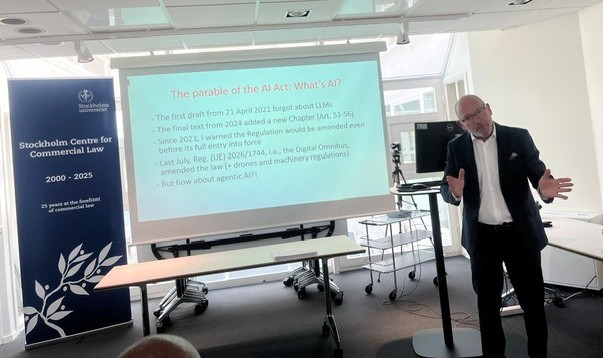
Ugo Pagallo during his lecture at the Stockholm Centre for Commercial Law at the Faculty of Law. The presentation included, among other topics, the EU AI Act. Photo: Liane Colonna
Regulating technology in a changing landscape
The challenges become particularly apparent when technological development moves faster than the legal frameworks designed to govern it. Using artificial intelligence as an example, Pagallo discussed how new technological applications may emerge while legislation is still being implemented or already requires adaptation.
This does not mean that technological development should be left unregulated. Rather, the challenge lies in designing legal frameworks that can both address risks and create the conditions for responsible use. According to Pagallo, legislators need to understand the technologies they seek to regulate and recognise that technological development can proceed rapidly and in ways that are difficult to anticipate.
He also highlighted the need for more coherent and easily applicable regulatory frameworks, as well as simpler and better-coordinated structures for implementing regulation. When technological development involves multiple authorities and areas of responsibility, clear coordination becomes essential. Pagallo compared this with other jurisdictions where responsibility among relevant institutions is more consolidated, whereas the EU system, in his view, is characterised by greater institutional complexity.
He also raised the question of how the effects of legislation are evaluated. If the purpose is to encourage desirable behaviour, it is not always sufficient to assess whether an actor complies with or violates a rule. It is also necessary to understand how rules operate in practice and what outcomes they produce.
The challenge for law: Seeing the full picture
Pagallo returned to the idea that technological underuse is not solely a matter of technological possibilities, but also of the social, cultural, and institutional conditions that determine which opportunities are ultimately realised. Which technological solutions are adopted – and which never reach their full potential – is influenced by a range of factors, from public trust in new technologies to the way institutions and regulatory frameworks are designed.
According to Pagallo, these questions need to receive greater attention in discussions about new technologies, particularly at a time when technological development is advancing rapidly and the consequences of forgoing certain opportunities can be significant. A key challenge is therefore to distinguish between situations in which there are good reasons to refrain from using a particular technology and those in which opportunities are lost because of obstacles that could be removed.
Pagallo’s argument is not that the risks associated with new technologies should be underestimated, but that they need to be weighed against the costs that may arise when technological opportunities are not realised. For the law, this means taking a broader view when assessing the effects of regulation: not only considering which risks it prevents, but also which opportunities it enables or constrains.
About Professor Pagallo
Ugo Pagallo is Professor of Legal Philosophy at the University of Turin and previously worked as a lawyer. He has published fifteen monographs and around one hundred scholarly articles and book chapters.
He has participated in a wide range of international research and policy initiatives, including high-level expert groups within the European Commission and the World Health Organization (WHO). Through his research, Pagallo has contributed to international discussions on the legal and ethical dimensions of artificial intelligence and other emerging technologies.
Pagallo’s appointment as an honorary doctor of law at Stockholm University in 2026 recognises his significance to the Faculty of Law and his distinguished contributions to the University’s research and education.
Text: Natalie Oliwsson
Last updated: 2026-10-02
Source: Department of Law