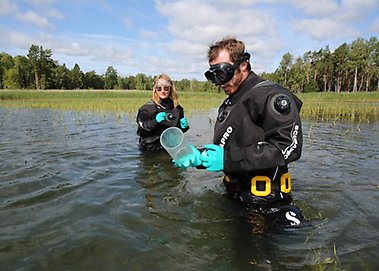
A large expedition has arrived at Askö. For 1,5 years, the Traversing European Coastlines Expedition travels along Europe's coasts, stopping at selected sites to sample air, land and sea water. It's early morning and the sea and land teams from the gigantic Traversing European Coastlines project (TREC) are waking up in their cabins on board Electra af Askö, Stockholm University's research vessel based at the Askö Laboratory in the Trosa archipelago. The expedition started at the end of March in Brittany, and has since travelled along the coasts of France, Belgium, the Netherlands, Germany, Denmark, Poland, the Baltic States and Finland. Now it has come to Sweden and Askö, and a long day of sampling along transects from the sea and into the coastal forest awaits. Collaboration with research stations The expedition is a gigantic pan-European project, led by the European Molecular Biology Laboratory, headquartered in Heidelberg, Germany, in collaboration with a large number of marine research stations across Europe. It just arrived from Askö's sister station at the mouth of the Gulf of Finland – Tvärminne Zoological Station, via Åbo Akademi University. After the stop at Askö, it will continue to Kristineberg Center on the Swedish west coast. From there the journey continues to Norway, Great Britain and Ireland and down along the Bay of Biscay and the Atlantic coast to Cádiz in southern Spain. Next year, the expedition will continue to the Mediterranean.
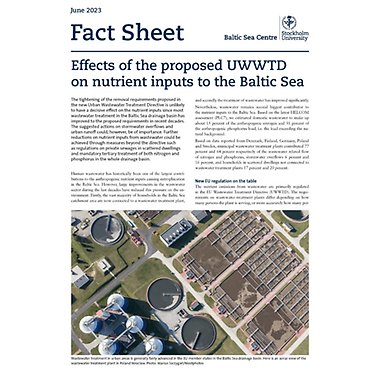
The requirements on wastewater treatment proposed in new EU Urban Wastewater Treatment Directive draft is unlikely to have a decisive effect on the nutrient inputs to the Baltic Sea. This is concluded in a new fact sheet, describing the requirements in the proposed directive in relation to the current situation regarding wastewater treatment in the Baltic Sea catchment.
Autonomous and accessible underwater robots can be groundbreaking in marine monitoring and research. They are also desired components in ocean based industries and the armed forces. In June, the Askö Laboratory hosted a test week for a new generation of underwater robots from the innovation centre SMaRC. LoLo and SAM have the leading roles when SMaRC ( Swedish Maritime Robotics Centre ). runs robotic demonstrations in the archipelago. While these two robotic prototypes circulate in the bay, discussions on land focus on how to make tomorrow's underwater robots as agile as possible and how to develop long-endurance models that can reach inaccessible areas. Both areas have great potential to replace measurements and monitoring that today require ships and divers, according to Ivan Stenius, project manager at SMaRC. "If you can carry out measurements with autonomous vehicles, you can avoid climate footprints but still achieve greater geographical coverage, all year round." he says.
The oxygen situation in the Baltic Sea is worse than ever before, as are the cyanobacteria blooms. However, the reductions of nutrient loads to the sea have had significant effect – conditions would have been much worse without them. This was one of the key messages in the presentation by Stockholm University researcher Bo Gustafsson at the recent GO2NE webinar. The Global Ocean Oxygen Network (GO2NE) is an Unesco initiative committed to providing a global and multidisciplinary view of deoxygenation, with a focus on understanding its multiple aspects and impacts. Part of the network’s communication efforts in the monthly Webinar Series Ocean Deoxygenation.
At the end of April 2023, the European Commission presented a proposal for an updated regulation on detergents and surfactants. It was hoped that the European Commission would update the regulation so that it also covered phosphorous compounds in hand dishwashing detergents and industrial cleaners which is lacking today. But unfortunately, this was not included in the proposal. In 2012, the Detergents Regulation was amended with the aim of reducing the damage caused by phosphates from detergents to the environment. Phosphorous is one of the main limiting factors for biomass production in nature and phosphorous leakage, along with nitrogen, is a major contributor to eutrophication in the aquatic ecosystem. Eutrophication increases the growth rate and biomass of algae, in the form of slime, mats and blooms. In the Baltic Sea, eutrophication has affected the whole ecosystem. The rules set in 2012 did not however specifically provide a limitation on the content of phosphate or phosphorous in industrial detergents or hand dishwashing detergents. This despite the fact that the International Association for Soaps, Detergents and Maintenance Products (AISP) in 2020 concluded that hand dishwashing detergents accounted for 41% of the total household dishwashing detergents market. And industrial and institutional detergents accounted for approximately 20% of the total market for detergents. Additionally - in 2021 the European Commission and all Member States around the Baltic Sea endorsed the HELCOM Baltic Sea Action Plan. This sets clear targets for reducing the phosphorous content in laundry detergents for consumers by 2024 and to “undertake efforts to reduce and where possible eliminate phosphorous in detergents for industrial and institutional use”. We are afraid that none of these targets will be possible to reach without addressing them in the proposed update of the regulation. Obviously, the amounts of phosphorous in hand dishwashing detergents and industrial cleaners are likely to be small in relation to the phosphorous content of toilet waste. Therefore, voices are raised in favour of not including these products in the proposal. But a counter-argument is that phosphorous is a finite resource and the more we can reduce the use the better. Another argument in favour of not imposing requirements on phosphorous is that treatment plants are good at retrieving phosphorous, so rules are not needed. But this does not apply to all treatment plants in the Baltic Sea countries, and certainly not to all treatment plants in Europe. Also, the less phosphorous we add to the system, the less we need to treat in the treatment plants. In addition, at least in Sweden, hand dishwashing detergents are often used in summer cottages with private sewers. Hence - upstream work is preferable. A third argument against tightening legislation on phosphorous is that there are not enough alternatives on the market. But that was exactly what was said when the rules were decided in 2012, and it didn't take long before there were alternatives on the market. The environmental criteria in the EU's ecolabelling scheme, the EU Flower, also already sets criteria concerning phosphate and phosphorous content for hand dishwashing detergents and industrial dishwashing and laundry detergents. Alternatives are in other words already available. Overview of present legislation on detergent products, the EU Ecolabel flower criteria and the presented EU proposal. The European Commission's proposal is now being processed by the authorities and will be sent out for consultation. The Swedish Chemicals Agency has been tasked by the government to conduct an impact assessment of the proposal, which will be presented on 22 June. There is also a consultation from the European Commission that is open until 20 July 2023 where anyone can give their opinion. We here at SU Baltic Sea Centre continue to keep an eye on the proposal. Text: Gun Rudquist
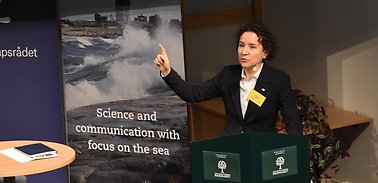
Citizens and academia want knowledge to reach society to a larger extent, but time, resources and professional academic rewarding systems are getting in the way. How to promote collaboration between scientists and decision-makers was a hot topic when Stockholm University Baltic Sea Centre co-organised a conference on open science. The development of the Paris Agreement's target of limiting global warming to 1.5°C shows both the opportunities and risks of co-production of knowledge in societal issues. – We often think that this target came from science, but it was actually adopted in 2015 by decision-makers in Paris. They then asked the research community for evidence of the target, and the research community responded that it didn't exist," said Jessica Jewell, Associate professor of Physical Resource Theory at Chalmers University of Technology, at the conference Open Science - From Policy to Practice . Thanks to generous funding and political support for more scientific knowledge, much research could be conducted, which is partly a success story of policy relevant and useful science. But it also illustrates the risk of research being influenced by policy issues. – Scientists already suspected that scenarios for a two degree target were unrealistic, and yet, tons of new knowledge came out about the 1.5 degree target, she said. In contrast, the " throw it over the fence " model was presented, where science is excellent and independent but instead risks avoiding the societal issue and becoming irrelevant. When the same scientists were asked to answer whether it is possible to achieve the target, the response was " limiting warming to 1.5°C is possible within the laws of chemistry and physics ", which was difficult for politicians to translate into a societal context. According to Jessica Jewell, when aiming to combine research and policy, we need to be reminded that the term 'feasible' means different things to researchers than to politicians. – Something that is feasible for a politician is something that society can actually do, while something that is feasible for the researcher is something that solves their mathematical models," she said.
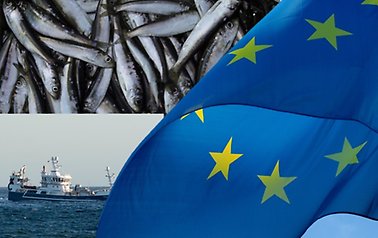
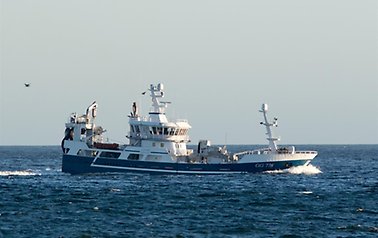
Zero catch on both of the cod stocks and on the western Baltic herring, but for the central and Bothnian herring, the International Council for the Exploration of the Sea (ICES) advises that trawling should be allowed to continue next year. "The recommended quotas in this crisis situation risk destroying the Baltic Sea ecosystem even more", comments scientist Henrik Svedäng.
Major herring fisheries in the Baltic should be closed next year. That is the content of the scientific advice. But you won’t find that message in the headline advice that most readers focus on. It is buried deep in the text. This may be a result of leaving it to biologists to interpret a political decision, writes Charles Berkow in an analysis of the latest ICES advice on Baltic Sea fisheries. The scientists at ICES appear to have faced a very difficult choice this year. Too many signs were pointing towards an ecological catastrophe in the Baltic Sea, and an imminent disaster for the fishing sector and the communities who benefit from fishing. There are also expectations from the sector, its political friends, governments, and maybe sections of the European Commission, to continue to be able to carry on business more or less as usual. Given the situation on the one hand, the expectations on the other, and the uncertainties riddling both the environmental, political and legal contexts, it would not be surprising if the scientists opted for erring on the side of caution. But what caution? Background: The need for regulation It is generally accepted that fishing needs to be regulated somehow. Otherwise fishing stocks would be depleted, as they have been time after time over the centuries, not the least in Northwestern Europe and the Baltic . In principle, there are two ways to do this. Those who fish can get together and regulate themselves. Or the government has to do it. With technological advances allowing fishers to travel farther and farther to find stocks to replace the more depleted local stocks, and allowing fishers to catch more fish in larger vessels with the aid of more advanced instruments it is less and less practical for the fishers to regulate themselves. In the Baltic Sea, for examples, there are fishers from nine different countries. And even within the countries fishers who have larger boats and can fish over greater distances have different interests, at least in the short term, from small-scale fishers more dependent on local resources (and often using less destructive methods). So regulation is up to the governments. But in the Baltic, fish stocks can straddle the different national zones or may migrate from one zone to another. Eight of the nine coastal states have banded together for common management of several of the key stocks – such as herring, sprat, cod, and salmon – through the Common Fisheries Policy (CFP) of the European Union. And the EU, in turn, has an agreement on cooperation with Russia on management of these species. (But that is another story; suffice it to say here that Russia and the EU have not managed to agree on catch limits, that they are not allowed to fish in each other’s zones and that 95 percent of the Baltic waters are in the EU zone . Even if fishing rights are privatised, as some advocate in a purportedly market-oriented Third Way, government intervention is needed to regulate entry (in effect establishing protected oligopolies), to ensure that rules are followed, and to assess how much can be fished and set rules for allowable catches. The scientists' dilemma This was the challenge faced by the scientists at the International Council for Exploration of the Sea (ICES). They are designated by the EU (and Russia) to give advice as to how much fish can be caught sustainably the coming year. This advice is used by governments in the EU to negotiate an annual political deal on how much fishing to allow, so-called Total Allowable Catches (TACs) or quotas. This is such a unique situation it merits a moment of reflection. I know of no other business so directly dependent on annual political decisions made on the basis of advice from a particular group of scientists. The aim, again, is to avoid depletion of the resource – and, as a result, the long-term destruction of the business. Except it isn’t working. When the scientists sat down to crunch the numbers and make their estimates – an extremely difficult task in the best of circumstances, (think of the challenges economists have in trying to make predictions about inflation, the rate of interest and unemployment next year) – the signs were disturbing. ICES' assessments The scientists at ICES are not free to make assessments of what could be sustainable fishing as they see fit. They are constrained by an agreement with the EU Commission and a multiannual plan for management of cod, herring and sprat in the Baltic (MAP). They are obliged to supply a range of catches around a target called maximum sustained yield. These ranges give options for the politicians in making their decisions about quotas. But the MAP also requires that “fishing opportunities shall in any event be fixed in such a way as to ensure that there is less than a 5 % probability of the spawning stock biomass falling below B lim” (Article 4.6) . “Fishing opportunities” is a technical term for what is more commonly called total allowable catches (TACs) or quotas. “Spawning stock biomass” (SSB) is technical jargon for the amount of fish, in tonnes, of a size suitable for commercial fisheries and sexually mature. “Blim” (which can be read as biomass limit) is a limit below which the stocks should not be allowed to sink, in order to avoid a collapse of the stock and long-term or even permanent damage. Technically, it is defined by ICES alternately as a “limit reference point for spawning stock biomass” or “as the stock size below which there is a high risk of reduced recruitment” . It is understandable that the EU does not want fish population to fall below the crisis level Blim. They want to avoid a collapse of the stocks. But none of this is as simple as it may appear . It is difficult enough to estimate how much fish there is in the sea now. It is of course even more difficult to estimate how much there may be next year if a given amount is caught. (This is done with simplified – though complex – models based on assumptions of parameters such as the rate of reproduction, the rate of growth and the rate of fish dying from natural causes, each of which is tricky enough, given that they can be affected by factors such as the impact of the temperature on the food of the fish at different stages of the life cycle. And based on data from different sources, including commercial catches – which in some cases are suspected to be incorrectly reported.) In addition, the target values, MSY as the jargon goes, are even stickier to estimate, as they are the products of all factors mentioned above – and may be assumed to change all the time. Against this background, the level of precision in ICES headline advice, with recommendations specified down to the nearest ton, conveys a false impression of a level of certainty that simply does not exist. Thus, it is not easy to determine what limits on fisheries are needed to prevent a risk for collapse – Blim. Not to mention the less than 5% probability of the stock falling below Blim next year given as mandated in the MAP. ICES’ choice Still, let us assume that the scientists did their best. And this year, when they gathered the data (such as it is), tweaked the models and crunched the numbers, the result was not positive. For two of the key stocks, the Gulf of Bothnia herring and the central Baltic herring , ICES wrote that even a closure of the fishery would not meet the minimum condition of the EU plan. That is, even a zero catch in 2024 will not bring the stock above Blim with a 95 percent probability in 2025. For two other stocks, the western Baltic herring and the eastern Baltic cod , ICES has for several years recommended a zero catch for the coming year. For the eastern Baltic cod the situation is so uncertain (and poor) that ICES was not able to calculate the ranges required in the MAP. But they felt they could calculate these ranges for the central Baltic and Gulf of Bothnia herring. The scientists then faced the question of what fishing levels to recommend for these two herring stocks. On the one hand, the MAP requests ranges of sustainable fishing (expected to give “maximum sustainable yield”). On the other hand, the MAP requires that fishing is set at levels to avoid the stock falling below the crisis level at the end of the next year. Normally, if an EU regulation is unclear those implementing it should ask the European Commission, in its role as Guardian of the Treaty, for an interpretation. If no such clarification is forthcoming, it is up to the scientists at ICES to interpret the rules. Not being lawyers, it is natural that they would opt for a cautious approach. But cautious in which direction? If they would take a precautionary approach regarding the environment and the future development of the stock, ICES would recommend a zero catch. If they would take a precautionary approach in terms of avoiding complaints from the fishing sector and the politicians who want to allow the sector to fish more or less as usual for at least one more year they would opt for some continued fishing quotas for 2024.
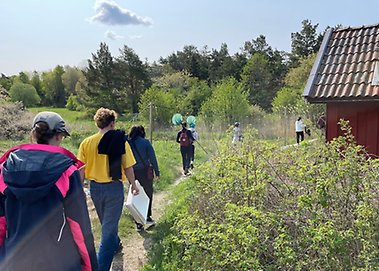
A textbook is one thing – reality another. In the master's course ‘Environmental field studies’ students learn how to assess the marine environment in practice, using both simple and advanced methods. – Waders, wellies or barefoot – the choice is yours! The master's students in Environmental Science have brought their brail nets, buckets and identification literature to one of the rocky shores, rich in bladderwrack, close to the Askö Laboratory. The task is to find gravid amphipods whose eggs and embryos can be used as an indicator of the environmental state of the sea. Some of the students slip into waders, others roll up their trousers and enter the water barefoot. They hand over equipment to each other, then fall silent, as they crouch over the water and net through the seaweed. – Take the chance to look at the beautiful river nerites too, says Ann-Kristin Wiklund, researcher and director of studies at the Department of Environmental Science (ACES) at Stockholm University. – We have used those small gastropods in previous studies to investigate the damage caused by toxic anti-fouling paints, she says. Different stressors cause different types of damage Earlier in the morning, the students gathered in the field station's lecture hall and learned about the advantages and difficulties of field studies, and about one of the sub-programmes in the environmental monitoring of the Baltic Sea, on the amphipods Monoporeia affinis and Pontoporeia femorata , which has been running since 1994.
The Baltic Sea is affected by eutrophication and climate change and both the spring phytoplankton bloom and the summer cyanobacteria bloom start earlier today than in the 1980s. Diatoms have decreased while nitrogen-fixing cyanobacteria have increased. How does all this affect food chains in the Baltic Sea?
Alexander Stockhaus has a master's degree in marine biology from Stockholm University and now works as an environmental consultant specialising in pollution in aquatic environments at the engineering consultancy Niras. He found the field studies to be one of the most fun and important parts of his education.
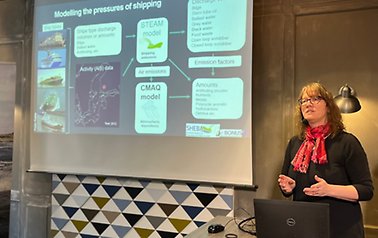
Shipping causes a number of pressures on the marine environment, including the discharge of tank cleaning residues into the water. Action is needed to reduce this problem, stated the Baltic Breakfast speakers who presented a policy brief on the subject.