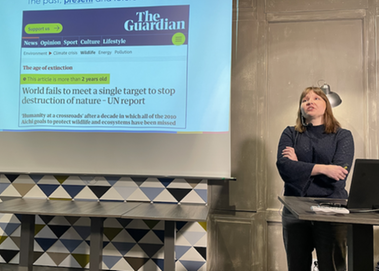
Well implemented marine protected areas, as well as goals and targets for preservation of genetic diversity. That's what the scientists Susa Niirinen and Linda Laikre, who participated in the most recent Baltic Breakfast, hope will come out of the ongoing biodiversity conference in Montreal.
The Baltic Sea Centre comments on the EU Commission Call for Evidence for the initiative for the energy transition of the EU’s fisheries and aquaculture sector: A major hurdle for an energy transition for fisheries is the fuel subsidy, in the form of exemption from tax or other full carbon pricing. Another hurdle is the depleted fish stocks. Robust fish stocks make for more efficient fuel use and aid the energy transition. In the wake of Russia's invasion of Ukraine, with the rising fuel costs that followed, the EU is seeking to speed up the transition towards the Green Deal. An initiative has been launched to identify the barriers that could slow down the shift away from fossil fuels in the fisheries and aquaculture sector. The Baltic Sea Centre writes, in a reply to the EU Call for evidence, that fuel tax exemptions are a major obstacle to the transition, as they reduce incentives to invest in more efficient engines or use less fuel-intensive practices. Instead, fuel subsidies worsen overcapacity inEuropean fisheries, resulting in depleted stocks and degraded marine environments. As renewable fuels also have an environmental impact, energy efficiency is a key part of the transition. Energy consumption needs to be reduced. Ecosystem-based management for the of fisheries Several of the important fish stocks in the Baltic Sea are distressed or depleted. More time and effort is required to fish if stocks are depleted. With larger fish stocks in the sea, less energy is required to catch a given amount of fish. Therefore, an efficient energy transition requires that the EU achieves the objective of progressively restoring and maintaining populations of fish stocks to levels required to maintain biodiversity (including genetic diversity within the target stock), habitat integrity and foodwebs. Reducing fishing pressure to levels consistent with the environmental objectives of the Common Fisheries Policy would further increase energy efficiency. Summary Fuel subsidies in the form of tax exemptions or reductions are a barrier to implementation of better energy technologies and practices. Important synergies between removal of fuel subsidies, the energy transition and a healthier marine environment should be exploited. More robust fish stocks make for more efficient use of energy in fishing and thereby contribute to the energy transition. Read the Stockholm University Baltic Sea Centre's reply to the European Commission’s Call for Evidence on the energy transition of EU fisheries and aquaculture sector
The Baltic Sea Fellows initiative, a network of young Baltic Sea researchers from several disciplines, was launched to strengthen the environmental Baltic Sea research at Stockholm University. The results of this year's awarded research grants from the Swedish Research Council and Formas show that it is going well. The group of researchers has raised over 25 million Swedish crowns this year.
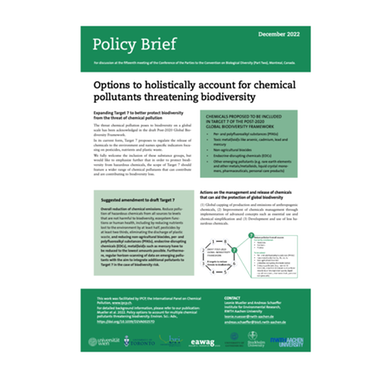
The Post-2020 Global Biodiversity Framework needs to consider additional groups of chemicals, according to a large international group of researchers. For the UN Biodiversity Conference, COP15, they have developed a perspective article and a policy brief with concrete proposals for better inclusion of hazardous chemicals in the forthcoming targets.
The Department of Environmental Science at Stockholm University has marked their 30th anniversary by paying tribute to the marine biologist Rachel Carson. Watch the seminar with invited keynote speakers, now on the department's webpage. On September 27th 1962, Rachel Carson's Silent Spring was published, to address the dangerous effects of pesticides such as DDT. The book became one of the most influential publications of the modern environmental movement and it ignited a growing environmental movement. It's impact reverberates to this day. What lessons can be drawn from Silent Spring that could help us achieve a more sustainable future? The seminar is now available to view at the Department of Environmental Science' website: https://www.aces.su.se/events/celebrating-60-years-of-silent-spring-the-loud-uproar-that-still-resonates/
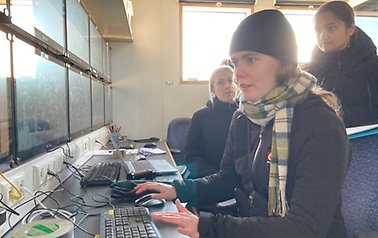
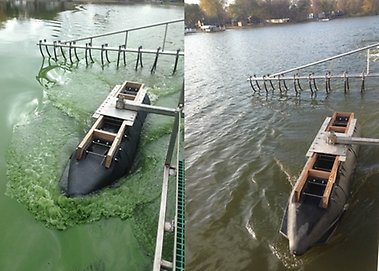
The newly built drifter balances at the end of the four-metre-long boat hook. In a few seconds it will be launched and tested for the first time. At best, it will provide measurement data and can soon be picked up again. At worst, it disappears, forever. It's November when Master students from the course in Physical Oceanography set sail on the research vessel Electra, together with researchers and PhD students from the Department of Meteorology at Stockholm University (MISU). Oceanographer and course leader Inga Koszalka and technician Joachim Dillner at MISU have designed and built drifters that, if they work, will give researchers a better idea of how ocean currents move in the Baltic Sea. That knowledge is needed, among other things, to see how ocean currents affect the oxygen content of the water and to be able to make forecasts for algal blooms during the summer. The drifters are one of several instruments that the Master students will learn to use during the sea excursion. They will also collect data from an instrument on the hull of Electra, called an ADCP (Accoustic Doppler Current Profiler), which measures ocean currents by bouncing sound waves off plankton and other suspended particles in the water.
Aluminium treatment can be an efficient way to remove excess phosphorus from lakes and coastal waters. But if the external loading of phosphorus isn’t reduced, the effects of the treatment won’t last long, and monitoring and modelling are keys to optimising the results, concluded the researchers participating in last Baltic Breakfast.
The Baltic Sea Fund’s award is open for nominations, to honor and reward people or organizations that contribute to improving the state of the Baltic Sea. The deadline to submit your proposals is 24 february 2023. Anyone can nominate for the Baltic Sea Fund’s award. The nomination is made in Swedish or English and it must clearly state what the candidate has achieved and what significance it has had for the environment in the Baltic Sea. The Baltic Sea Prize is given to a person or organization that contributes to improving the condition of the Baltic Sea through practical or technical solutions to environmental problems, who are active in, for example, science and research or in any environmental movement, administrators or decision-makers in business or public administration . The Lasse Wiklöf prize is given to a Nordic parliamentarian who has worked to improve the situation and who in his work has shown solid knowledge, great commitment and strong action. The Youth Award is given to a person, group or organization that has contributed in an exemplary way and with great commitment to drawing attention to the state of the Baltic Sea. The Åland Award is given to an Åland actor who worked for the Baltic Sea. Read more and nominate your hero here
The European eel has been critically endangered for decades. The 3-month closure period applied in the EU over the past few years has been deemed insufficient. European Commission has now proposed a doubling of the annual eel fishery closure from three to six months in 2023. The Commission’s proposal is more steering and far-reaching than its proposals the past few years. It gives Member States less room for interpretation or flexibility as to their choice of the closure period. The closure is to cover fishing at all life stages. It is also to cover both marine waters in the EU and adjacent brackish waters. The closure is to last for six consecutive months, and may extend until 2024. The intention is to increase protection of the eel, both at the earliest stages of life in European waters and during spawning migration of silver eels. The background is the dire situation of the threatened European eel and the clarified advice for a ban on fishing from scientists at at the International council for exploration of the sea (ICES) last year. This advice was reinforced this year. Timing of the closure The timing of the closure is to be determined by the Member States, but conditions for the closure are also stiffened compared to last year. The closure is to cover the relevant weeks and months of the main migration of eels at the glass eel and silver eel life stages, respectively. It is to cover both the peak migration period and at least two months before and after. A justification is that the peak migration period may vary from year to year. Member States sharing straits and other transboundary areas are encouraged agree on the appropriate time for the closure, in the appropriate consultation for a. For the Baltic, that means in particular Sweden and Denmark. It is not clear if the “appropriate consultation forum” for the Baltic would be bilateral discussions between Sweden and Denmark, or within Baltfish, where governments for all EU Member States with Baltic Sea coasts are represented. Eels from the whole Baltic region must pass through Swedish and/or Danish waters on their way to spawning migration through the Atlantic. The Commission has also clarified, and strengthened, requirements on Member States for justification for the choice the closure period. Member States are to determine the weeks and months of the eel migration based on the best scientific information covering the last 10 years, including the peak migration period for every relevant geographical area. The context The eel has long been in critical condition. ICES estimates that numbers of new glass eels coming to areas around the North Sea declined dramatically in the early 1980’s. In past years they have been less than one percent of the average during the period 1960-1979. Member States have not supplied data required under EU rules. Since 2001 ICES has recommended that eel catches be “reduced to the lowest possible level”. In 2021 this was clarified to a recommendation that “there should be zero catches in all habitats in 2022”, including catches of glass eels for restocking and aquaculture. ICES reinforced its message in the advice released in November, 2022 . There, they write that "all non-fisheries related anthropogenic mortalities should be zero". The Commission’s proposal is the latest instalment in EU measures to protect the eel. An Eel Regulation was adapted in 2007, requiring among other things that Member States adopt national eel management plans. As noted above, the regulation has not achieved its main objective. In 2017 the Commission proposed a ban on eel fishing in the Baltic Sea, citing data that showed that 57% of the silver eels that reached the open sea in the Baltic were caught by commercial and recreational fishers. Instead, Member States’ agriculture and fisheries ministers decided in the Council that Member States all over the EU would close eel fisheries for a three-month period , to be determined by each Member State. Last year, the Commission proposal did not reflect the latest ICES advice. The Commission now notes both ICES’ advice from 2021 and ICES’ findings from May, 2022 that no overall progress has been made in the achieving the main objective of the Eel Regulation from 2007. In its Communication on the state of play of the Common Fisheries Policy in June 2022, the Commission wrote that it is exploring how to follow up on Member States’ progress in implementing their Eel Management Plans and measures under the Eel Regulation. In an information note to the Council meeting in September 2022 the Commission emphasised that the current 3-month fishing closure is insufficient and that efforts should focus on reducing eel mortality and increasing escapement for spawning migration. The Commission also argued that in order for the eel to recover, it is necessary to look at issues such as river continuity and nature restoration. The Commission referred to also to other EU actions , such Biodiversity Strategy and the need for implementation of the Water Framework Directive and the Marine Strategy Framework Directive. A key and controversial element of the Swedish eel management plan has been restocking with glass eels imported from other countries . One issue that has been hotly debated is eel mortality in hydropower turbines. Some have argued that hydropower is a bigger problem than fisheries. Even if many of the eels killed in hydropower turbines have been restocked, dams can also block migration upstream and reduce potential eel habitat. The Swedish government has initiated an international evaluation of the national eel management. This evaluation is to be published by the end of 2024. The more detailed Commission proposal is consistent with frustration over the way that some Member States have chosen to time the periods of fisheries closure. For example, the Swedish choice of closure period has been based at least in part on avoiding negative impacts for eel fishers. The Commission proposal will now be discussed by the Member States, and probably decided at the Council meeting in December. Member States have to start working right away. They are to inform the Commission of the choice of the closure period by the end of January 2023, and at the same time submit supporting documentation justifying the chosen period. Text: Charles Berkow
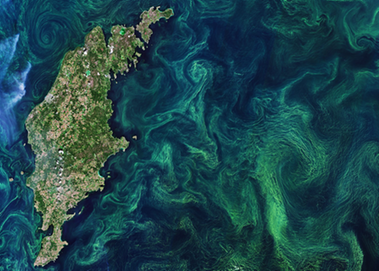
The Baltic Sea suffers from serious oxygen deficiency. Even large inflows of oxygen-rich seawater have in recent decades only provided short-term relief from oxygen deficiency in the deep water. In the latest issue of Ambio, a new method for quantifying the total oxygen debt from Öresund to Åland is presented. By using existing data dating back to the 1960s, the researchers show that we have gone from a supply of about 10 million tons of oxygen in the deep water to a net oxygen supply close to zero, with an oxygen debt of up to 4 million tons caused by accumulated hydrogen sulfide and ammonium. In the last 20 years, the oxygen debt has also spread to near-halocline waters west of Gotland. The extent of so-called dead bottoms in the Baltic Sea is one of the largest in the world, with an area almost twice that of Denmark. Virtually all water below the halocline, i.e. deeper than 60–80 meters, is now deficient in oxygen and hard or impossible for animals to live in. – The main cause of the lack of oxygen is eutrophication, says Carl Rolff, researcher at the Baltic Sea Centre and lead author of the article. The supply of nutrients from agriculture and sewage increased sharply until the 1980s. Since then, powerful measures from countries around the Baltic Sea have reduced the supply of the nutrients phosphorus and nitrogen by approximately half and a third, respectively. This has, however, not yet produced visible results in the form of reduced oxygen deficiency. A two-edged sword
The Stockholm University Baltic Sea Centre welcomes that the European Commission (EC) published a Staff Working Document last Wednesday, to promote policy debates and development in Member States for building capacity for a better use of scientific knowledge in policymaking. The document lays out the rationale for building capacity for science for policy, identifies key challenges, lists good practice cases, and identifies a set of EU support instruments, resources and policy frameworks to help Member States. The EC argues that policymakers face more and more complex policy problems, such as climate change, the energy crisis, the loss of biodiversity and the green transition. At the same time society has become more polarised and fact resistant. The role of science in order to support policymakers in better understanding policy problems and solutions, while at the same time presenting facts and arguments into political debates, has hence increased. The main challenges for this interaction to succeed is according to EC: the need for better connections and relationships between actors and organisations in both research and in public administrations; the need to improve professional competences of both scientists and policymakers to inform policy with science; and the need for good governance in informing policy with science through transparent, participatory, and anticipatory processes. EC see these challenges as a collective task that could serve policymakers at the EU, Member States, and regional level equally well. Some of the recommendations from EC to Member States to solve the task have direct implication to academia: creating more knowledge exchange opportunities such as innovation camps and pairing schemes to facilitate networking between scientists and policymakers, also enabling policymakers to visit scientific organisations and have interviews with many scientists providing support to existing professional networks across Member States in the area of science for policy developing fellowship schemes and placement opportunities of scientists in public administrations to promote inter-sectoral mobility as well as analytical capacity in public service Text: Ellen Bruno Further reading Personal relationships key to successful science - policy interactions The Commission publishes a new Document to promote discussion on a better use of scientific knowledge in policymaking
Researchers at Stockholm University Department of Environmental Science and Baltic Sea Centre welcome the proposal for an updated Urban Waste Water Treatment Directive from the European Commission. We especially welcome the fact that the updated Directive addresses treatment of micropollutants and emphasises the role of waste water treatment to reach the goals of the Water Framework Directive and its daughter legislations. We also welcome that the draft puts responsibility and cost for treatment of micropollutants on producers and importers of pharmaceutical and personal care products – in line with the polluter pay principle. We would however like to see that the extended producer responsibility includes more sectors contributing to micropollutants that end up in urban wastewater - textiles, household products etc. This would create incentives to phase out harmful substances already at the producer level. In this regard, we would like to stress that upstream work, never allowing harmful micro pollutants to enter the society, must be the preferred solution for stopping them from reaching our lakes and seas. Although the draft Directive requires monitoring of certain pollutants including microplastics, we lack the requirement for non-target screening with the aim of improving our understanding of waste water treatment plants as vectors of micropollutants used in households and identify potential new marine pollutants. As for eutrophication, a major problem in the Baltic Sea and many adjacent waters, we support the expansion of the Directive to agglomerations between 1 000 population equivalent (pe) and 2000 pe, with more stringent limit values to treat nitrogen and phosphorus. For more information, see our policy brief on what researchers at Stockholm University would like to see from an updated Urban Waste Water Treatment Directive: Call for better management of micropollutants in wastewater