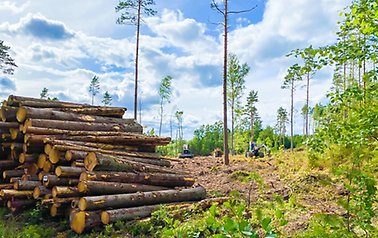
Sweden should increase nitrogen fertilisation of its forests — even in the southern parts of the country — according to the government’s forest policy inquiry. However, increased fertilisations is a also expected to lead to higher inputs of nitrogen to the Baltic Sea – inputs that Sweden has committed to reducing under the HELCOM Baltic Sea Action Plan, the EU Marine Strategy Framework Directive, and the Water Framework Directive. “If leaching from forests is allowed to increase, nitrogen loads from other sectors must be reduced even more,” says researcher Bärbel Müller-Karulis.
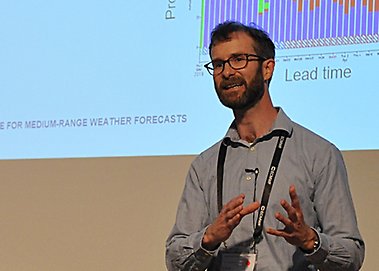
Linus Magnusson from ECMWF, the European Centre for Medium-Range Weather Forecasts, is appointed Adjunct Professor at MISU on 10 percent, from 1 September. He will e.g. supervise Master degree projects, do Arctic research related to forecast evaluation and model/observation improvements, support planning and forecasting during Arctic campaigns, and some preparation of course material.
How big a risk is it reasonable to take – with our fish stocks, our marine environment, our food security? How seriously do fisheries ministers take their targets? How seriously do the ministers take their own rules? Those are three questions that are on the table when the EU’s fisheries ministers meet on October 27-28 to make a deal on fisheries in the Baltic Sea in 2026. But experience suggests that these are not questions the ministers will comment in the official statements after the meeting. Neither, normally, in the media reports. The ministers generally pat themselves on the back for finding a carefully calibrated balance between incomes and the environment, after tough negotiations. And that their decisions are in line with scientific recommendations – which is based on a misunderstanding. For stocks like herring and sprat in the Baltic the scientists at the International Council for Exploration of the Sea (ICES) do not make recommendations. The media usually focus on how much the total allowable catches (TACs) go up or down compared to the year before. Maybe, also, if they are higher than the European Commission had proposed, and if so, by how much. They seldom compare next year’s TACs with the actual catches a few years back. This myopia misses the longer-term declining trends. No one usually comments on what the TAC decisions may mean for the marine environment or coastal ecosystems in a broader sense. But in a longer perspective it is clear that the risks for fish stocks are for real. The herring in the North Sea crashed in the 1970’s. It recovered, but that was after a five-year fisheries closure that was painful for fishers and dependent coastal communities. The cod in the Kattegat collapsed in the first decade of the new millennium (or, depending on how you look at it, in 2020). It still hasn’t recovered. The herring in the western Baltic collapsed in the second decade of the new millennium. It hasn’t recovered either. The cod in the western Baltic collapsed in the third decade of the new millennium. The sum of the annual careful political balances between the environment and the economy has been to the detriment of both in a longer perspective. Take, for example, the German fishers who used to target cod. Their tragic fate was depicted in a German TV documentary from 2023. It would be well if future ministers would take warning. Unfortunately, decision-makers have proven willing to take risks with fish stocks, the environment and the future of fisheries. If the ministers don’t approve the Commission’s relatively precautionary proposal it is like a driver opting to not brake when there is a yellow light ahead. In the hope that they will make it past the intersection before it turns red. Or at least that there is not a truck coming in from the left. When ministers claim to be following scientific recommendations that is, as mentioned, a misunderstanding . Or when they say that their decisions are “in line with the scientific advice” that gets at best into semantics. What the scientists actually present is, in essence, forecasts over catch levels that, under certain assumptions, can be sustainable. And that creates a problem: ministers dish out fishing opportunities based on a yield forecast; no serious company would decide dividends on the basis of forecast profits. But that is in effect what fisheries ministers do. That is an argument for caution: to not try to maximise the catch within the forecast. But most ministers seem not to have gotten that far yet. To compound the risks, the forecasts can be more or less uncertain . In Stockholm the Chair of ICES Advisory Committee recently compared their catch forecasts with speed limits: they work well LÄNKenough under normal conditions – but conditions are not normal in the Baltic. A driver who stubbornly drives at the speed limit is behaving recklessly when the road is icy and the weather is foggy. At the same occasion, the EU’s Fisheries Commissioner in effect warned ministers from only reading the speed limit in the headlines, instead of heeding the warnings in the fine print. Around 10 years ago , the EU’s fisheries ministers and the European Parliament agreed on a level of risk they felt acceptable. Catch limits should be set so that the estimated probability for certain stocks (such as herring) in the Baltic falling into a “danger zone” the following year should be less than five per cent. That may have felt not only reasonable but also politically safe back then – the stocks were not close to such levels. And the politicians also adopted an objective of restoring and maintaining stocks to healthy levels. If a stock fell into the risk zone that would trigger special measures so that the stock would rapidly recover. Possibly, the politicians overestimated the precision of the scientific assessments and forecasts. In any event, since then several stocks have declined. Politicians have relied on uncertain forecasts, ignored clear caveats and bet on luck with incoming year-classes. So this year the scientists say that the herring catches in the Gulf of Bothnia need to be slashed by over 60 per cent to meet the adopted risk level. They also raise warning flags for herring in the central Baltic and for sprat. For the cod and herring in the western Baltic it is even worse. There should be no fishing on these stocks, according to the scientific reports. The European Commission has taken the warnings seriously. A herring catch of under 26 000 tonnes in the Gulf of Bothnia is what is compliant with the regulation, and that is what the Commission is proposing . The Commission has proposed the same TACs as for 2025 for herring in the central Baltic and for sprat. For herring in the western Baltic and cod the Commission is proposing major reductions from already low levels, and basically that catches should only come from by-catches when targeting other species.
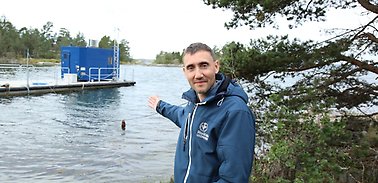
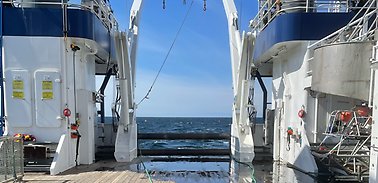
A unique floating laboratory is giving researchers an unprecedented window into the hidden exchanges between air, sea, and coast and their role in the climate system. One of its most important features is the ability to make continuous, long-term measurements in different coastal environments. This makes it a valuable new addition to Stockholm University's marine research infrastructure.
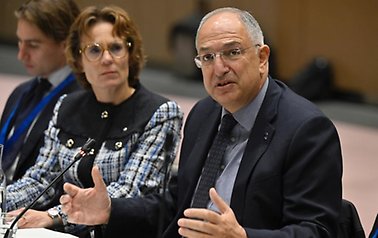
The European Commission organised the third edition of the Our Baltic Conference in Stockholm at the end of September. The commissioners and ministers for environment, fisheries and agriculture from around the Baltic Sea reaffirmed their commitment to the improvement of the marine environment. A first test will come when ministers decide on fishing quotas later in October. When the EU Commission presented its Ocean Pact in June 2025, it also announced that another high-level meeting on the Baltic Sea would be arranged, the third edition of the Our Baltic conference since 2020. The Our Baltic conference took place on September 30 this year in Stockholm. In addition to Environment Commissioner Jessika Roswall and Fisheries and Maritime Affairs Commissioner Costas Kadis, the participants included ministers (or their representatives) for the environment, agriculture and fisheries from the EU's Baltic Sea coastal states, as well as some representatives from the European Parliament, HELCOM and ICES. A total of around 60 people attended. According to the European Commission's introduction and subsequent press release, the purpose of the event was to address the pressing environmental and socio-economic challenges affecting the Baltic Sea. Key outcomes of the conference included a commitment to revise the Marine Strategy Framework Directive to enhance its effectiveness and the implementation of the Nature Restoration Regulation to regenerate marine habitats and species. Additionally, the conference highlighted the role of the Water Resilience Strategy and the European Ocean Pact in promoting sustainable blue economies in the region. However, these proposals were already included when the Ocean Pact was presented in June. In his opening speech, Kadis emphasised that the situation in the Baltic Sea is urgent – eutrophication and other pollution, declining fish stocks, destroyed habitats, etc. Kadis said: What we are witnessing is not a crisis caused by a single factor, nor one that can be solved by a single measure. The decline of our unique ecosystem is the result of multiple, interconnected pressures – climate change, eutrophication, overfishing hidden by misreporting, habitat destruction and pollution. Each of these factors exacerbates the others, creating a cycle of degradation that threatens marine life, coastal communities, and entire industries. To break this cycle, we need more than isolated interventions – we need a comprehensive approach with coordinated action across sectors and across borders. He emphasised that environmental pressures on the Baltic Sea interact and that measures must therefore also be coordinated. Kadis pointed out that fish stocks are in crisis. He addressed complaints that some total allowable fishing catches the Commission had proposed for 2026 were below the catches in the “headline advice” from ICES, pointing out that the Commission had also been taking into account the whole advice, not just the headlines. The need to consider the headline advice in context was underscored by ICES in a newspaper interview in connection with the conference, where Kadis said that the headline advice “is like a speed limit, which can work well under normal circumstances. But the Baltic is not in a normal condition.”
Summer's much-maligned cyanobacterial blooms may not be all bad after all. New research shows that these summer blooms can be crucial for juvenile herring – without the blooms, they would have less opportunity to grow.
Creating controlled mini-ecosystems, called mesocosms, is one way for researchers to study factors that influence processes in the sea. This summer, a large experiment of this kind was conducted at the Askö Laboratory, to investigate how emissions of greenhouse gases from shallow coastal bays are affected by global warming and by animal communities in the water and sediment. Understanding the connection between coasts and climate is a key question for researchers in CoastClim . This summer, Sara Westerström and Moritz Nusser from the Research School Perspectives on Climate Change in Coastal Seas took a new approach to investigating how small animals in the water and in the seafloor can affect greenhouse gas emissions, both now and in a warmer future.
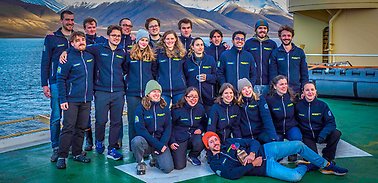
The research school onboard the research ice breaker Oden has come to an end. In the evening the day before yesterday we did our last research station and deployed a mooring in the marginal ice zone, where the pack ice meets in the open ocean; a permanent buoy under the the surface that is tethered to the ocean floor and will stay there for the next years.
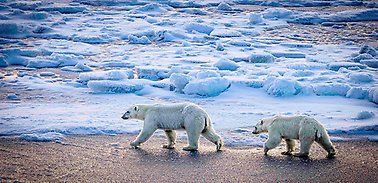
During this week it has become clear that we moved into the autumn freeze up. There is almost no open water around us at all anymore. Where open water was present previously, between the more solid ice floes, the ocean is now covered with a layer of new ice.
Small pelagic fish are central to the Baltic Sea food web. They feed on plankton and serve as prey for larger fish, seabirds and mammals. Because of this, their feeding habits influence the entire ecosystem. A new study led by researchers at the Department of Ecology, Environment and Plant Sciences (DEEP), published in ICES Journal of Marine Science, shows that the main pelagic fish species in the central Baltic, herring, sprat and stickleback, overlap surprisingly little in their use of resources. Less overlap than expected Group Winder at DEEP, together with colleagues at the Swedish University of Agriculture examined the diets of the dominant species by combining stomach content analyses with data on prey availability. Using DNA metabarcoding, they could assess the full spectrum of their resource use. Modest diet overlap was also supported by stable isotope data. The results suggest that these fishes are not locked in strong competition under current conditions. Seasonal dynamics in prey availability play a key role, as the fish adjust their diets throughout the year.
Department of Ecology, Environment and Plant Sciences
The recent SWERVE funded FAROX cruise, led by Léon Chafik on RV Skagerak, set out to explore how dense overflow waters move between the Nordic Seas and the North Atlantic. By collecting unprecedented measurements of temperature, salinity, currents, and turbulence, the team mapped deep currents and investigated their role in shaping the climate system.
Four weeks have now passed and there is less than two weeks left of our Arctic adventure. One can sense that people on board have started to realize this and react differently. Some refuse to think about it while others think about it all the time. This is human nature and the mood onboard is very good but it will be a special moment when we get back.