A new study from Stockholm University maps how the countries that have ratified the UN Convention against Torture have written it into their own criminal law, and finds wide variation in who can be held liable.
The Stockholm Center on Global Governance (SCGG) will offer a PhD-level course in the spring of 2027, which will run between February and June: “Key Concepts in Global Governance (7,5 ECTS)”
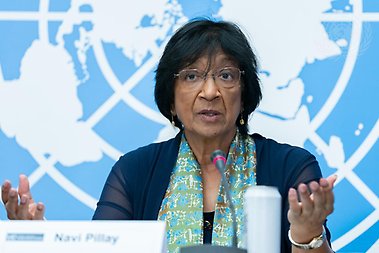
“This prize does not mean that international justice has arrived — it means the world still believes that those who have devoted their lives to pursuing it deserve to be recognized.” That was Mark Klamberg, professor of public international law at Stockholm University and Stockholm Center on Global Governance, speaking to Swedish public service broadcaster Sveriges Radio about today’s Nobel Peace Prize to South African judge Navanethem "Navi" Pillay.
“Politicians aren’t in a position to read and appreciate primary literature – they often need somebody to explain the science and its significance,” said Erik Angner, a professor of practical philosophy, during a panel discussion at Stockholm University on how researchers can share their knowledge with politicians.
Theresa Squatrito, Associate Professor in International Relations at the London School of Economics and Political Science (LSE), is spending the next month at Stockholm University as a guest of the Department of Political Science and the Stockholm Center on Global Governance (SCGG).
The newly founded Global Governance Research Centre Consortium (GGRCC) is now launching a new ”online speaker series” – GGRCC Talk Series. Four speakers will be sharing their insights this fall. The first seminar will take place on October 12, featuring Rosemary Foot, University of Oxford.
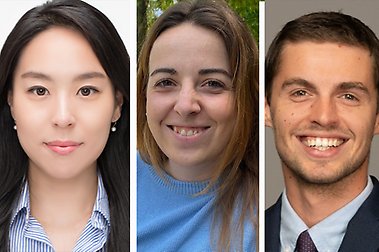
“While leaders in the A.I. industry warn that the machines could one day become independent of us, we are already willingly making ourselves dependent on them. The more of our decision-making we hand over to opaque systems, the harder it becomes to tell who is actually in charge,” Sonia Bastigkeit Ericstam, a visiting researcher at Harvard Law School and doctoral student affiliated with the Stockholm Center on Global Governance, wrote in the Swedish daily Svenska Dagbladet on Sept. 21. In her essay, she addresses A.I. regulation and the limits of human decision-making.
A new collaboration between four CIVIS universities will bring researchers and civil society groups together to experiment with creative approaches to democratic participation and public engagement.
With no new government in place, Sweden could lose influence in negotiations over the European Union's next long-term budget, just as the talks enter a decisive phase. "It is not an ideal situation," Jonas Tallberg, a professor of political science at Stockholm University, told Altinget, an independent news site, on Tuesday.
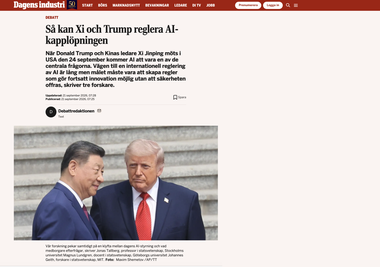
When President Trump and President Xi Jinping of China meet in the United States on Sept. 24, artificial intelligence will be high on the agenda. International rules for A.I. are still a long way off, but the goal must be rules that allow continued innovation without compromising safety, three political scientists argue in an op-ed published today in the Swedish business daily Dagens Industri.
Since the beginning of the fall, the Stockholm Center on Global Governance (SCGG) and the Department of Political Science have been hosting Andrea Knapp, University of Potsdam (Germany), and Eunsil Choi, University of British Columbia (Canada). SCGG has also been hosting Paul Vernus, Centre d'Etudes et de Recherches sur le Développement International (CERDI) in Clermont-Ferrand, France.
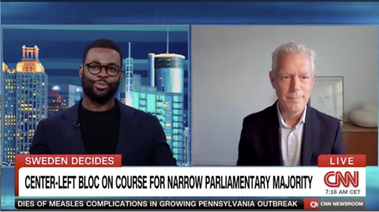
"Just a few weeks ago, we still had the center-left in the clear lead. Now we have results showing that indeed, there is a slight majority for the center-left opposition, but it's still too close to call," Jonas Tallberg, co-director of the Stockholm Center on Global Governance, told CNN on Monday morning, the day after Sweden's parliamentary election.