


When ‘Sweden Decided,’ Who Is Actually Deciding?
A state’s intentions can ultimately be traced to the small circle of people who make its foreign policy. That is the argument of a new article in the journal International Theory by Marcel Jahn, a postdoctoral fellow in philosophy at Stockholm University affiliated with the Stockholm Center on Global Governance, and Moritz S. Graefrath, an assistant professor of international security at the University of Oklahoma.
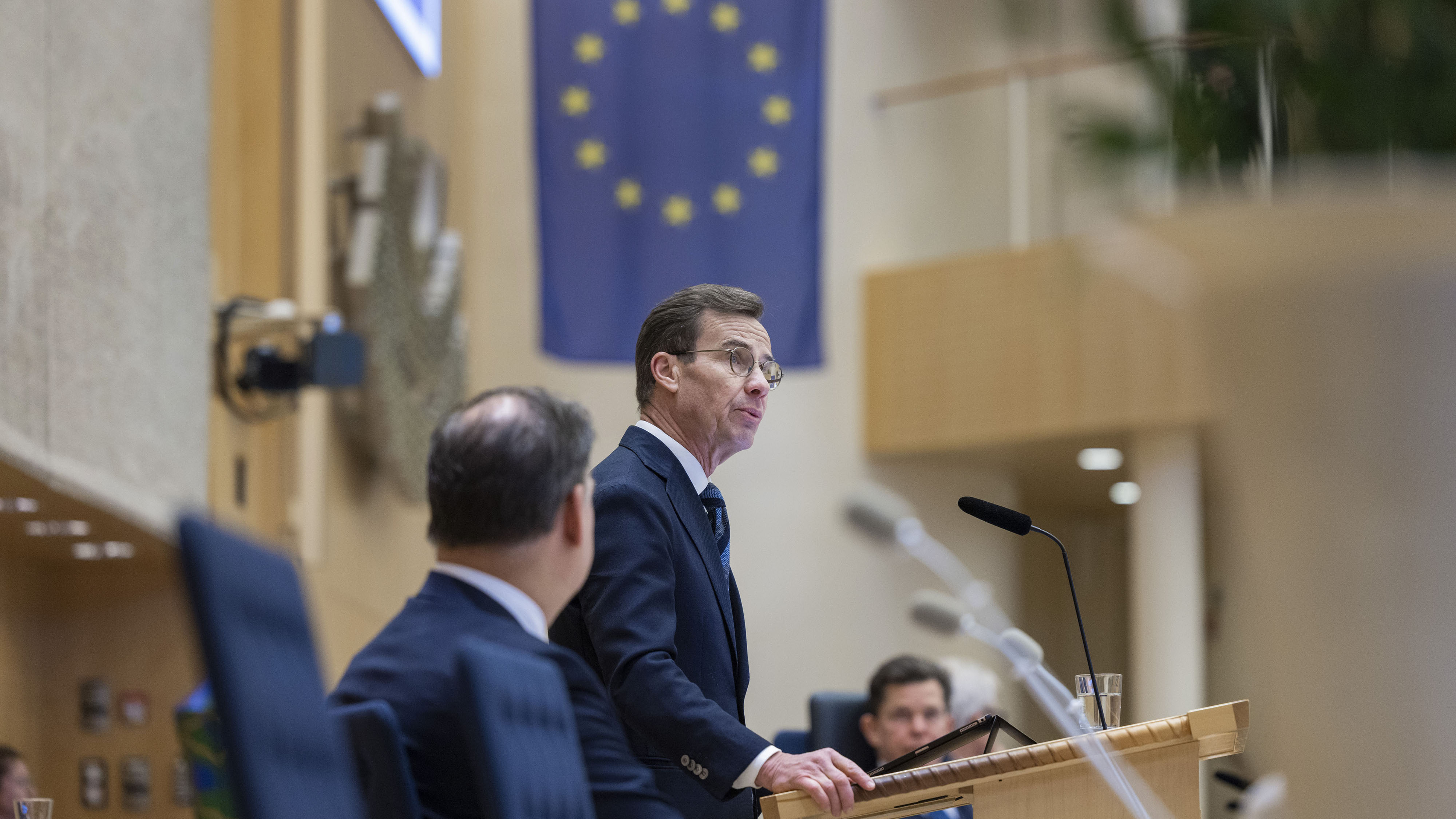
Prime Minister Ulf Kristersson, the leader of the center-right Moderate Party, speaking during a debate among party leaders on European Union policy in the Swedish Parliament on Nov. 12, 2025. Photo: Melker Dahlstrand/Swedish Parliament
Read the full article (open access)
We asked Dr. Jahn what that means for how we read the news, why alliances fall apart and who should be held responsible when states do wrong. The interview has been edited and condensed.
In a nutshell, what is the study about?
In international politics, we routinely speak of states and groups of states as having intentions. In this article, my co-author and I ask what such talk really means. Drawing on the work of the philosopher Michael Bratman, we argue for a reductionist view: collective intentions can ultimately be traced back to the intentions of the individuals involved and how these fit together.
We hear “Russia wants” or “Sweden decided” on the news every day. Is that literally true, or just a figure of speech?
It’s more than a figure of speech, but less mysterious than it sounds. When we say that “Sweden decided” something, we may be describing a genuine collective intention. But this doesn’t mean that the state has a mind of its own. Rather, such intentions emerge when political decision-makers deliberate, develop shared plans and coordinate their actions to carry them out.
What are your most important conclusions?
Above all, our article suggests that researchers should take a closer look inside the room where political leaders deliberate and make foreign policy decisions. Our account attributes collective intentions to states only when foreign policy officials coordinate their plans and work together to implement them. That raises the question of whether states genuinely have collective intentions when such coordination is absent.
Take the second Trump administration. Many observers have described its foreign policy as driven largely by the president’s personal instincts, with little genuine deliberation. If this picture is accurate, future scholars might conclude that at least some of the administration’s policies did not reflect genuine collective intentions of the United States. What at the time may have appeared to be the intentions of a state may instead have been the plans of a single individual.

Marcel Jahn, postdoctoral fellow at the Stockholm Center on Global Governance. Photo: Michael Rimkus
Are alliances and coalitions stronger or more fragile than we think?
They may be more fragile than we assume. Some theories suggest that once states commit to acting together, their shared commitment creates obligations that help hold the coalition together. On our account, however, cooperation ultimately depends on the continued willingness of its members to pursue a common goal. When their interests diverge, even well-established coalitions can fall apart. Take the Concert of Europe, which emerged after the Napoleonic Wars. Although it endured for decades, we suggest that its stability depended on the great powers continuing to see cooperation as in their interests, rather than on any binding collective commitment.
When a state does something wrong, who should be held responsible: the country or the individuals?
Our account points primarily to individuals, especially the political leaders who make and approve decisions. But it also suggests that officials who knowingly plan and carry out a wrongful policy together may be more blameworthy than if they had acted independently. That’s because their shared commitment makes each of them responsible not only for their own contribution, but also for the wrongdoing they deliberately pursue together.
What research project is this article linked to?
The article is part of a multi-year project in which Dr. Graefrath and I explore the role of concepts in international politics. Our previous work has addressed questions such as what it means for states to cooperate, how to understand the idea of global commons, and how researchers should define the concepts they use to study international politics.
Is there anything you’d like to add?
We think our article demonstrates how ideas from philosophy can shed new light on very concrete questions in world politics, such as how decisions get made, why coalitions break down, and who bears responsibility when things go wrong.
Collective intentionality in international relations: a reductionist view
FURTHER DETAILS
Concert of Europe, in the post-Napoleonic era, the vague consensus among the European monarchies favouring preservation of the territorial and political status quo. The term assumed the responsibility and right of the great powers to intervene and impose their collective will on states threatened by internal rebellion. (Source: Britannica.com)
Last updated: 2026-11-09
Source: Department of Political Science