News

  • Observations of planetary cradles reveal rocky planets can form in extreme environments

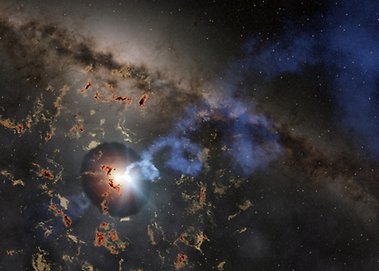
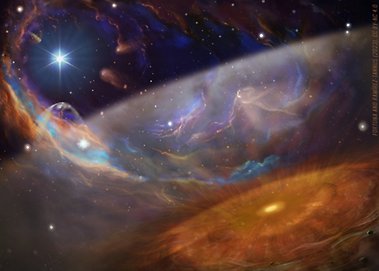
    Planets like our Earth, including planets with water, could form even in the harshest known star-forming environments, drenched by hard UV light from massive stars. That is a main result of analyses of new observations of such an environment with the James Webb Space Telescope (JWST). The observations are the first of their kind – before the JWST, this kind of detailed observation had not been possible. This is good news for Earth-like planets, and for life in the universe: there is a great variety of environments in which such planets can form. The results have now been published in the Astrophysical Journal Letters. Water and carbon-bearing molecules have been discovered in a disk of gas and dust surrounding a young solar-type star, which is located in one of the most extreme environments in our Galaxy. Such disks are where planets form around nascent stars. A team of astronomers led by María C. Ramírez-Tannus at the Max Planck Institute for Astronomy in Heidelberg, Germany and Arjan Bik from Stockholm University, made use of the James Webb Space Telescope to peer into the inner region of the disk, which is where planets similar to our Earth are expected to form: so-called terrestrial planets, with a thin atmosphere covering a planet made of rock. The disk, which the astronomers call XUE-1, is exposed to intense ultraviolet radiation of nearby hot, massive stars. Yet even in this harsh environment, the observations detected both water and simple organic molecules. Ramírez-Tannus says: “This result is unexpected and exciting! It shows that there are favourable conditions to form Earth-like planets and the ingredients for life even in the harshest environments in our Galaxy."
    Department of Astronomy
  • Researcher Highlight: Jorrit Leenarts

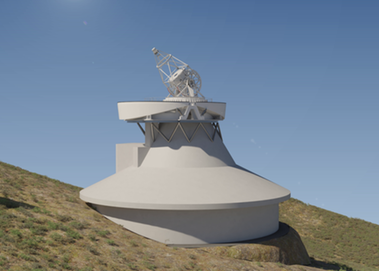
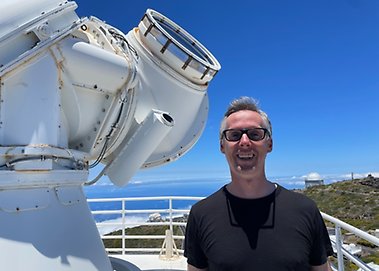
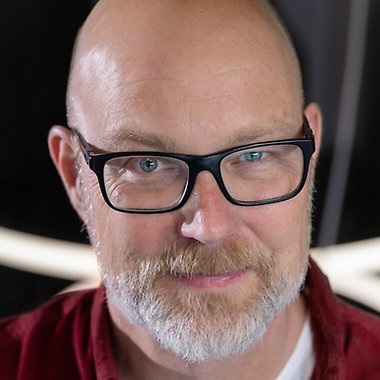
    Today we introduce Jorrit Leenaarts, the director of the Institute for Solar Physics. What is your field of interest? I study the atmosphere of the Sun using a combination of observations and numerical models. Could you please describe your current project in simple terms? I am the director of the Institute for Solar Physics, which operates the Swedish Solar Telescope.  My main activity right now is upgrading the scientific instruments at the telescope so they can view a larger part of the Sun and with less noise. What are the expectations and/or challenges for the future? The main challenge we have is to measure the magnetic field in the atmosphere of the Sun. For that we need very precise measurements of the polarisation of the light emitted by the Sun. Achieving the required precision is challenging as all the components in the telescope and the instruments introduce false polarisation. We need to measure and correct for that so that we can see the actual polarisation of the sunlight. What part of your research do you find the most exciting? Formulating questions that no-one has asked before and then finding the answer to that question. Do you have any advice for prospect astronomers that are interested in your field of expertise? Astronomy is applied physics. Focus on studying physics and math. If you’re good at that then learning how to apply your knowledge to the solar atmosphere is easy.

    Department of Astronomy
  • Researcher Highlight - Jesper Sollerman

    Today we introduce Jesper Sollerman, Professor in the supernova group that studies the explosions of massive stars. Could you please describe your current project in simple terms?  I lead the supernova group in the Zwicky Transient Facility project, with several dedicated supernova telescopes on Palomar in California. The past 6 years we have been monitoring the sky every night for exploding stars.

    Department of Astronomy
  • Fast flickering black hole caught in breakout

    In the latest issue of the journal Nature, astronomers from Stockholm University participate in a study of an optical transient displaying fast flickering of light. A small black hole in a distant galaxy could lie behind the phenomenon. Supernovae – exploding stars - are well known transients that suddenly appear on the night sky and then shine on for a few weeks.  Current supernova survey telescopes find thousands of these each year, but also start to find different and faster optical transients. The Zwicky Transient Facility at Palomar in California discovered the object named AT2022tsd in September last year (2022), and it was soon clear that it was not an ordinary supernova.

  • James Webb telescope detects water vapor, sulphur dioxide and sand clouds around a nearby exoplanet

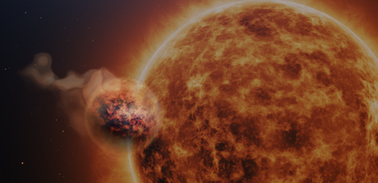
    A team of European astronomers recently utilized observations made with the James Webb Space Telescope to study the atmosphere of the nearby exoplanet WASP-107b. By peering deep into WASP-107b's fluffy atmosphere, they discovered not only water vapor and sulfur dioxide but even clouds of silicates (i.e., sand). The results of the study were published today in the prestigious journal Nature. Astronomers worldwide are currently leveraging the James Webb Space Telescope (JWST) and the capabilities of the Mid-Infrared Instrument (MIRI) to conduct groundbreaking observations of exoplanets—planets orbiting stars other than our Sun. One of these captivating worlds is WASP-107b, a unique gas giant planet orbiting a star slightly cooler and less massive than our own Sun. Although the planet's mass is comparable to Neptune, its size is much larger, almost approaching that of Jupiter. This characteristic renders the atmosphere of WASP-107b rather 'fluffy' compared to the gas giants in our solar system, enabling astronomers to explore its atmosphere approximately 50 times deeper than a Jupiter-like planet.

  • Researcher highlight - Evan O'Connor

    It’s time to introduce some of the members at our department! First out is Evan O’Connor, Associate Professor in the computational astrophysics and supernovae groups. What is your field of interest?

    Department of Astronomy
  • Campus Albano inaugurated

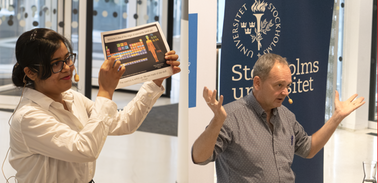
    The new Albano campus was inaugurated between the 20th and 23rd of September, and the Department of Astronomy participated in the festivities! Albano is Stockholm University's new campus area and also the home of our department. During the "Albano Talks," a series of short presentations about current research, two of our colleagues took part. Thursday, Smaranika Banerjee talked about her research on the "Origin of heavy elements," and Garrelt Mellema discussed "The first stars and galaxies” during the Friday. Both presentations were well-received by the audience!

    Department of Astronomy
  • Karin Lind has been awarded Strömer-Ferrnerska belöningen 2023 by the Royal Academy of Sciences.

    Karin Lind, Associate Professor at the Department of Astronomy, has been awarded Strömer-Ferrnerska belöningen 2023 by the Royal Academy of Sciences. Strömer-Ferrnerska belöningen is awarded to Swedish citizens who have conducted outstanding scientific work in the fields of mathematics, astronomy, or space science. The motivation for the prize reads: "For world-leading research in stellar spectroscopy to investigate the history of the Milky Way.” Karin's research focuses on observing and analyzing starlight. By analyzing stellar spectra, we can learn about stars and star populations, as well as planets, galaxies, and how stars contribute to the cosmic enrichment of chemical elements from the Big Bang until the present day. Royal Academy of Sciences publication

    Department of Astronomy
  • The department celebrates 50 years as part of Stockholm University

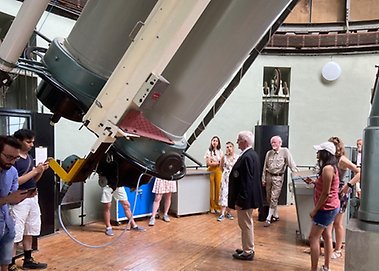
    On 1 July 1973, Stockholm's observatory was transferred from the Royal Academy of Sciences to Stockholm University and the Department of astronomy at Stockholm University was born. The names "Stockholms observatory" and "The Department of Astronomy" have since been synonymous. Even before the transfer, however, the observatory cooperated with the university by teaching astronomy there. Left at KVA after the transfer was the Institute for Solar Physics (ISF), which under KVA's auspices ran a solar observatory (first on Capri, and from about 1980 on La Palma) although they in Sweden shared premises with the Department of Astronomy. Stockholm Observatory's roots go back to the middle of the 18th century when the old observatory on  Observatoriekullen (Observatory Hill) was inaugurated. Since central Stockholm started to become light polluted, the operations were in 1931 moved to a new observatory in Saltsjöbaden, where Stockholm observatory was located until the move to AlbaNova University Center in 2001. In 2013, ISF also became part of Stockholm University, and the solar telescope on La Palma became a national research infrastructure with support from the Swedish Research Council.

    Department of Astronomy
  • Jaime de la Cruz Rodriguez awarded Letterstedtska priset

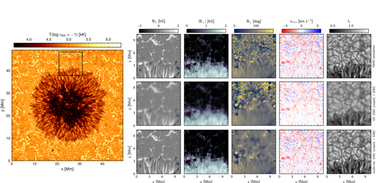
    Jaime de la Cruz Rodriguez has been awarded Letterstedtska priset för särskilt maktpåliggande by the Royal Academy of Science. Jaime’s research is in solar physics, where he specializes in the solar atmosphere. His work involves so called “inversion methods”, which are codes that allow researchers to construct a 3D model of the solar atmosphere from observations. Creating 3D models of the solar atmosphere is extremely valuable for solar researchers as this usually gives more information about what is happening in the atmosphere than just ordinary observations. In addition to creating a powerful inversion code, he managed to include the possibility for the code to use data from different telescopes. Combining datasets is something that has been a challenge in the past, which is why Jaime’s code STiC (Stockholm inversion code) is very successful.

    Department of Astronomy
  • Radio signal reveals supernova origin

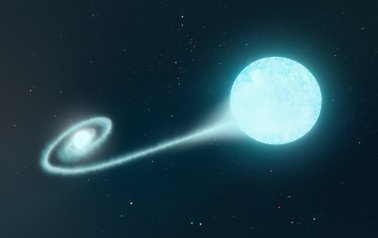
    In the latest issue of the journal Nature, astronomers from Stockholm University reveal the origin of a thermonuclear supernova explosion. Strong emission lines of helium and the first detection of such a supernova in radio waves show that the exploding white dwarf star had a helium-rich companion.