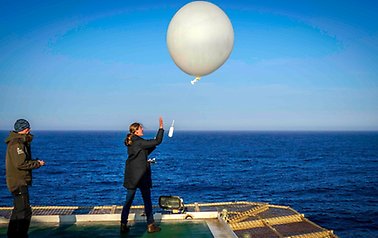
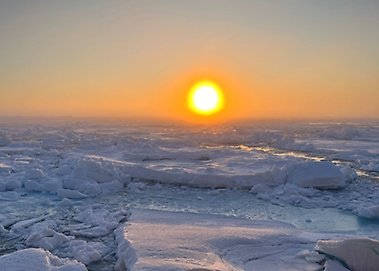
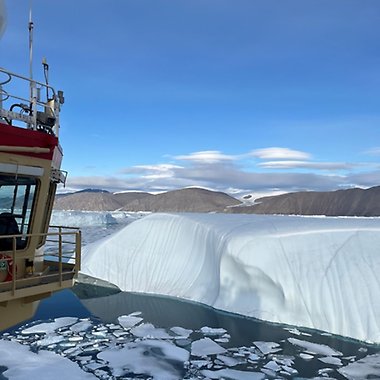
The expedition Arctic Ocean 2025, with the research school on the Arctic climate system, is now well under way. We left Longyearbyen last Sunday August 10 under clear-blue skies and sunshine and this stayed with us through yesterday. Late last night we saw the first ice rather far north, and now were continuing north in ice and fog, as is usual along the ice edge this time of the year.
Anomalies in temperature and salinity that originate in the midlatitude North Atlantic can affect the Atlantic Meridional Overturning Circulation (AMOC) in the Nordic Seas up to a decade later. The study published in Nature’s journal Communications Earth & Environment shows that the anomalies that travel northward with the Atlantic Water are an important part of the system, and actively modulate both the inflow of warm water into the Nordic Seas and the overflow of dense water back into the deep Atlantic.
On August 18, Julie Lattaud and Flor Vermassen will set off on a research expedition to southeast Greenland aboard ATKA, a 16-meter sailing vessel equipped for scientific work. The boat is operated by the French organization Témoins Polaires and accommodates five people, including two researchers. “I’m trying to understand the role the ocean plays in glacier melting within the fjord,” says Flor Vermassen at the Department of Geological Sciences. Thanks to its small size and specialized equipment, ATKA can access narrow, shallow fjords where larger research vessels cannot reach. This allows scientists to study the effects of glacier melt on the ecosystem – up close and on site. Ocean currents carrying warmer water into the fjords accelerate glacier melting. By gaining deeper insight into this process, the researchers hope to contribute valuable knowledge about how climate change is impacting the Arctic, and how we might address these changes in the future. The expedition is also carried out with minimal environmental impact. “With ATKA, we can conduct research in a highly carbon-neutral and cost-effective way,” says Julie Lattaud at the Department of Environmental Science.
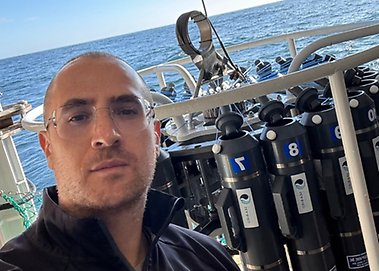
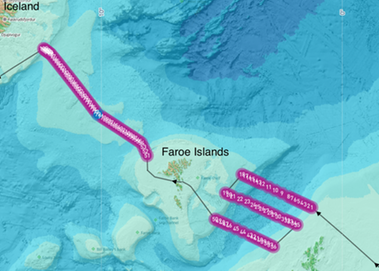
Léon Chafik, Stockholm University, and Fabien Roquet, Gothenburg University, will investigate deep water currents in the North Atlantic on 2–16 July 2025. During the expedition they will make measurements in two important sea passages: the Faroe-Shetland Channel and the ridge between the Faroe Islands and Iceland.
Global warming stems from the difference between incoming solar and outgoing reflected and infrared radiation, causing energy buildup and climate impacts like rising temperatures and sea levels. In 2023, this imbalance reached a new record high, twice that of the IPCC best estimate. Improved understanding and monitoring are urgently needed.
Congratulations to Frida Bender, appointed Professor of Climate modeling, and Thorsten Mauritsen, appointed Professor of Climate science, at the Department of Meteorology (MISU) at Stockholm University, and to Magnus Hieronymus at SMHI, appointed Associate Professor of Atmospheric Sciences and Oceanography. Frida Bender, Professor of Climate modeling
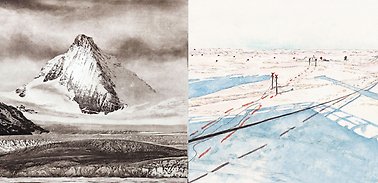
Ida Rödén and Ian Brooks 2024.11.30 - 2024.12.22 Slipvillan, Långholmen, Thursday-Sunday 12:00-17:00 Opening reception on Saturday November 30 , 14.00-18.00. Opening speech at 14.15, artist talk at 15.00 Sunday December 8 , presentation of the exhibition at 16.00. At 17.00-18.30: Martin Jakobsson, Professor of Marine Geology and Geophysics at Stockholm University, will present his research on the Arctic and ocean floor mapping.
Three professors at the Department of Meteorology, Stockholm University (MISU) have received funding from the Swedish Research Council for Meteorology and Atmospheric research. Rodrigo Cabellero: "Storm track intensity and midlatitude cloud feedback" Jörg Gumbel: "Long-term changes at the edge of space - Odin and a quarter of a century of shiny clouds" Caroline Leck: "Unravelling the role of marine biopolymers in cloud formation in the high Arctic"
We want to welcome Casey Wall who will join us as Assistant professor on November 1st. Casey has recently received an ERC starting grant to study aerosols, tropical convective clouds, and climate.
A week ago Oden departed from the Victoria Fjord in Northern Greenland, aiming to go east around the northern tip of Greenland and arrive in Longyearbyen on Svalbard. September 19, 2024, Johan Nilsson Some one-hundred-fifty years after Nansen’s Arctic Ocean expedition with Fram, no ship has yet navigated through this passage into the Arctic Ocean via the Lincoln Sea. Oceanographically, it is an unexplored area where the Transpolar Drift deposits waters and sea ice from a large swath of the Arctic Ocean onto the continental shelf.
Professor emeritus Hilding Sundqvist has passed away in Rättvik at the age of 90. Hilding worked at MISU for most of his career. At first as a research assistant and a PhD student, later as an associate professor and full professor. Hilding’s research area was dynamic meteorology with emphasis on cloud physics and numerical modeling.
August 28, 2024, Johan Nilsson. We have now completed our exploration of the Victoria Fjord. Oden only managed to get 30 km into the 70 km long fjord. At that point the concentration of enormous icebergs became so dense that further progress was impossible. 2024-08-28; 82°N, 48°W