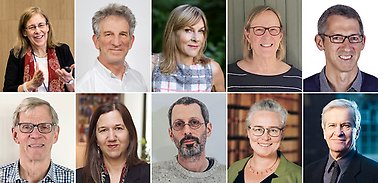
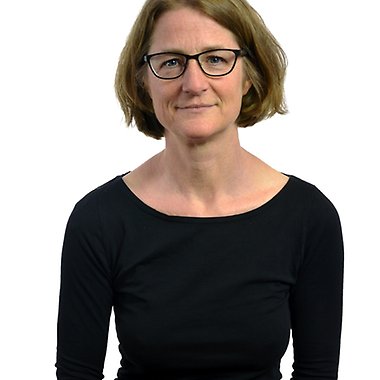
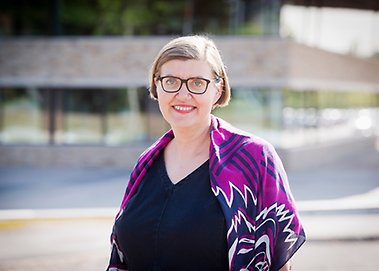
Stockholm University has chosen this year’s honorary doctors, all of whom have contributed in distinctive ways to the University’s activities in research and education. The ten new honorary doctors are: Jim Albrecht, Ian Brooks, Richard Dyer, Jan Ellenberg, Janet Gornick, Birke Häcker, Susanne Ljung, Peter Sarnak, Janet M. Thornton and Susan Vroman. They will be conferred their honorary doctorates on 29 September 2023.
Researchers have detected the environmental pollutant PCB in sediment samples taken at a depth of 8,000 meters in the Pacific Ocean. While organic carbon is degraded, persistent PCB accumulates in the deep sea.
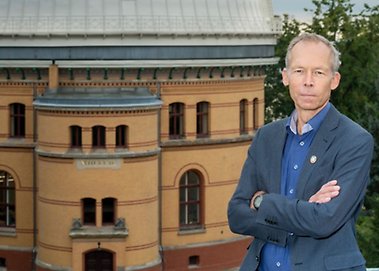
Johan Rockström, professor in environmental science at Stockholm University and director of the Potsdam Institute for Climate Impact, is included in TIME magazine's annual list of the hundred most influential people in the world.
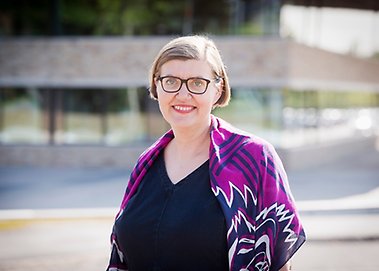
Katarina Winter will be leading the project "Promises and consequences in security technology". - The aim is to understand the establishment of so-called security technologies in society, more precisely by focusing on "security apps". A long-term aim is to create better conditions for discussing what crime prevention and safety-creating solutions have been, are, and can become in an increasingly digitized world. The project will last until the end of the year 2025. Within its framework they will both map which initiatives exist and carry out a number of studies to research in more detail how this type of security technology is aimed at individuals, initiated by developers and received and practiced by those who are supposed to use it. - It feels important to be able to focus both on developers and users of these security technologies in order to better understand how expectations, prerequisites and actual practice of security technology can be understood, both in relation to the emerging "security market" that surrounds them and to society at large. Read more about the project on the department's website .
Scientists have managed to map far more DNA than anyone has ever done for an extinct Ice Age animal species. A new study identifies mutations that were unique to the woolly mammoth - which probably underlie the mammoth's hair growth, fat storage and small ears.
President’s blog 29 March, 2023 When it comes to universities and colleges, one of the top issues in Swedish media today is – as no one could have failed to notice – our international collaborations. Media points out that there are inappropriate collaborations, sometimes problematic from a security policy point of view. There are also claims that universities are naive and do not understand in what way a foreign power can exploit these collaborations to harm Sweden. We find ourselves in the most serious security policy situation in many decades, and it is both natural and reasonable that these issues are high on the agenda for everyone involved. It is of course of utmost importance that our universities do not contribute to jeopardizing Sweden’s security. At the same time, there is a clear conflict of goals here. While security policy considerations easily lead to a desire to limit contacts as much as possible, as a precaution, academia is essentially global, and international exchange has been our modus operandi ever since the first universities were founded in the Middle Ages. How then can one navigate this difficult and dangerous terrain? A possible key wording is the one usually employed for open research data: “As open as possible, as closed as necessary”. Openness is the baseline – but it may be necessary to limit it in various ways for good reasons. STINT (The Swedish Foundation for International Cooperation in Research and Higher Education) published an important report on the issue a while ago, “ Recommendations to higher education institutions on how to work with responsible internationalisation ”. The Association of Swedish Higher Education Institutions (SUHF) also appointed a geopolitical council a couple of years ago, “ SUHF global relations advisory group ” (in Swedish), which advises universities on concrete issues regarding different countries. SUHF has also recently developed a number of indicators for responsible internationalization, “ Checklist – Global Responsible Engagement ”. The six indicators are “Democratic principles and restricted academic freedom”, “Partner reputation and university values”, “Conflicts regarding use of data, IPR and patent rights”, “Misuse of research and negative unintended applications”, “Ethical dumping and security around personnel and biological data” and “Personal safety”. This checklist is intended as a support for universities in their important work of assessing what security aspects might have to be considered in each individual collaboration. Higher education institutions, both in Sweden and internationally, are where we find the chief expertise on different regions and on the risk factors that may exist there. Now it is important that we use and share this knowledge, so that it will benefit all universities and researchers in Sweden. Astrid Söderbergh Widding President Read more from the President’s blog
A new chemical process should make it possible to create new environmentally sustainable materials that can be repaired, "charged" with new functions and also be completely degradable.
Many new doctoral students and postdocs as well as three strategic teacher recruitments at Stockholm University. It is the first step in WISE, the multi-billion kronor investment in sustainable materials.
A repetitive and fairly boring book, written on scrap bits of poor quality parchment. Still, the ‘Ormulum’ has fascinated linguists for hundreds of years. After 30 years of work at the English Department at Stockholm University, a new critical edition of the book is now being released, the first one since 1878.
Three researchers at Stockholm University are awarded Advanced Grants by the EU Research Council ERC. In total, it is about SEK 78 million for research in sustainability, political science and economics. The EU Research Council ERC has decided on the prestigious Advanced Grants in the 2022 call. The grant goes to senior researchers for research of the highest quality. A total of 218 researchers in Europe receive grants, of which 13 are in Sweden. Three of the Swedish grants go to researchers at Stockholm University. Other Swedish universities receiving ERC grants are Karolinska Institutet, Lund University, Uppsala University and Gothenburg University. Maja Schlüter: Building models of, with and for sustainability transformations
President’s blog 16 March, 2023 During a meeting in Karlstad today, the general assembly of SUHF (The Association of Swedish Higher Education Institutions) has decided on a joint position against hate speech and threats, which all presidents have signed. Our starting point is our core mission as universities and colleges, which is to transmit knowledge, to create new knowledge and to question existing knowledge, a mission which we must fulfil not only within the higher education institutions themselves but by operating in the middle of society. Today, we are deeply concerned about the expressions of hatred and threats directed at researchers and teachers that have been increasingly witnessed in recent years, and which have been described in Swedish press recently by a number of climate scientists. With our stance we want to show that this is a development that we strongly repudiate and that we perceive as a direct threat to both academic freedom and personal freedom of expression. Our position is as follows (translated from Swedish): “We, the presidents of Sweden’s higher education institutions, work actively to ensure that research results are used to develop our society and our understanding of it, and we encourage our employees to participate in public debate. We condemn all types of threats against employees at our higher education institutions when they carry out the institution’s mission. All threats that come to our attention will be reported to the police. We will introduce broader supporting measures in terms of preventive work as well as support after employees have been exposed to threats and harassment. In this way, we ensure that our staff will get the support they need.” Astrid Söderbergh Widding President Read more from the President’s blog