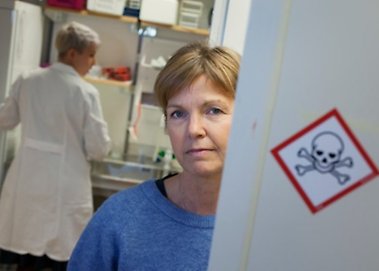
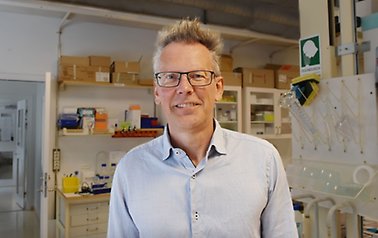
Emil Marklund at the Department of Biochemistry and Biophysics at Stockholm University has been named one of the future research leaders by the Swedish Foundation for Strategic Research. The award includes a research grant of SEK 15 million and leadership training.
Three researchers at Stockholm University are awarded Advanced Grants by the European Research Council ERC. In total, it is about SEK 86 million for research in evolutionary biology, biochemistry and molecular bioscience.
So what is the point of studying English? Professor Joakim Wrethed and university lecturer Andrew Cooper answered that question and more at Järvaveckan in the middle of June, where Stockholm University was one of the exhibitors.
On the evening of 1 July, the university will be replacing its firewall system. As a result, you should not expect access to either the wired or wireless network that evening.
250 researchers from across Europe have signed an open letter urging the European Commission and EU Member States to introduce a Mixture Assessment Factor (MAF) in the ongoing revision of the REACH Regulation. The letter, originally published earlier this year by a group of leading scientists, calls for improved protection of human health and the environment from the real-world risks posed by combined chemical exposures. The letter highlights that current EU chemicals regulation largely evaluates substances in isolation, despite decades of scientific evidence showing that mixtures of chemicals, even at individually safe levels, can have harmful cumulative effects. The proposed MAF would address this gap by introducing a precautionary, science-based factor into chemical risk assessments under REACH. The strong response from the research community underscores the urgency and scientific consensus around this issue. Among the signatories are experts in environmental science, toxicology, chemistry, and public health, representing institutions from across Europe.
The article "The spectrum of excisive functors" by professor Gregory Arone has appeared in Inventiones Mathematicae, which is published by Springer Science and is regarded as one of the most prestigious mathematics journals in the world. The article investigates the category of excisive functors. Excisive functors are analogous to polynomial functions. They were introduced by Tom Goodwillie around 1990, and have been the subject of much study ever since. We analyse excisive functors using methods of tensor-triangular geometry. The philosophy here is that categories are generalised rings, and one can import ideas from algebraic geometry to the study of categories. One of the pioneers in the area is Paul Balmer, and the space of prime ideals of a category is known as the Balmer spectrum. The main result of our article describes the Balmer spectrum of the category of excisive functors. In the process, we find a rather far-reaching analogy between excisive functors and equivariant stable homotopy theory. Read the article.
A new study from Stockholm University’s Department of Public Health Sciences highlights large regional differences in the prevalence of early and premature menopause in low- and middle-income regions. It also highlights that prevalence in these regions is higher than what has been reported in the literature for high-income countries.
As the climate warms, many species are shifting northward into areas that were previously too cold for them. A new study on the wall brown butterfly, published in the scientific journal PNAS, shows that rapid evolution can aid this process – but only up to a point. Cold winters stop further expansion beyond certain climatic limits. “Our results show that even though the butterflies adapt their life cycle as they move northwards, there are limits that evolution cannot easily overcome,” says Mats Ittonen, one of the lead authors of the study done by researchers at the Department of Zoology, Stockholm University. The wall brown ( Lasiommata megera ), a common European grassland butterfly, has become more common at higher latitudes in Scandinavia, despite declining steeply in Western Europe. During its northward expansion, rapid evolution has helped the butterfly adapt its life cycle to new conditions – evolution helps the species cope with factors that do not change with climate warming, such as daylength. But despite these changes, cold winters still prevent the wall brown from spreading further north. Two years of field experiments The researchers did field experiments in which they moved butterflies within and north of the species’ current range in Sweden. Individuals collected in the south (Skåne county) and north (Södermanland, and Uppland counties) were placed in field cages at sites in Skåne, Södermanland, and southern Dalarna – the latter being an area where the species has not yet spread. By comparing how caterpillars of different origins grow and develop under shared environmental conditions, the researchers could investigate how the wall brown has evolved during its northward expansion over the past 20–30 years. The caterpillars were also left in the field over winter to see whether better winter survival has evolved in northern populations – and whether they could persist further north than the species is currently found. “We wanted to know whether traits like faster growth, properly timed winter dormancy, and improved winter survival have evolved in northern butterflies – traits that could help them establish even further north,” says Karl Gotthard, professor at the Department of Zoology, Stockholm University. Few caterpillars survived in the north The study found that butterflies from northern populations grew faster than those from the south, likely as an adaptation to the shorter summers of higher latitudes. They also managed to enter dormancy at the correct time of year. But despite these evolutionary changes, very few caterpillars survived the winter in Dalarna, north of the species’ current range. “These kinds of limits are important to recognize if we want to predict how far north other species – including pests and disease vectors – will be able to move in a future climate,” says Karl Gotthard. Winter cold remains a barrier The findings show that evolution can proceed quickly enough to influence the distribution of insects under climate change, yet that does not necessarily mean that the specific traits that are most critical for survival evolve. For the wall brown butterfly, further northward expansion will still require milder winters, not just longer and warmer summers. This may be true for many species. “The wall brown is far from alone—many other insect species have also expanded northward over the past few decades, both in Sweden and elsewhere. Understanding both which traits evolve and which ones actually set the limits for where species can live is essential for predicting the future of ecosystems and biodiversity in a warming world,” says Mats Ittonen. The publication in PNAS: ”Winters restrict a climate change-driven butterfly range expansion despite rapid evolution of seasonal timing traits” DOI:10.1073/pnas.2418392122 Publiched: 2025-06-24
A new doctoral thesis by IIES graduate student Patrizia Massner looks into some of today’s most pressing social and economic challenges (from aging populations to inequalities in work and family life), and discusses the relevant policies aiming to address these challenges. Drawing on Sweden’s unusually rich administrative data, Patrizia’s research provides new evidence based insights in these topics. Subsidized elder care cuts hospitalizations and boosts family incomes
Lower blood sugar and increased fat burning – without negatively affecting appetite or muscle mass. These are some of the most promising effects of a new potential drug treatment for people with type 2 diabetes and obesity, according to a new study published in the journal Cell by researchers from Stockholm University and Karolinska Institutet. The new drug, which is taken in tablet form, has a completely different mechanism of action than the well-known GLP-1-based drugs, such as Ozempic, which is administered via injections. GLP-1 drugs affect hunger via signals between the gut and the brain, but often have side effects such as loss of appetite, reduced muscle mass, and gastrointestinal problems. The new substance instead activates metabolism in skeletal muscle. In animal studies, the treatment has shown good effects on both blood sugar control and body composition, but without the side effects associated with today’s GLP-1-based drugs. An initial phase I clinical trial involving 48 healthy subjects and 25 people with type 2 diabetes shows that humans also tolerate the treatment well.