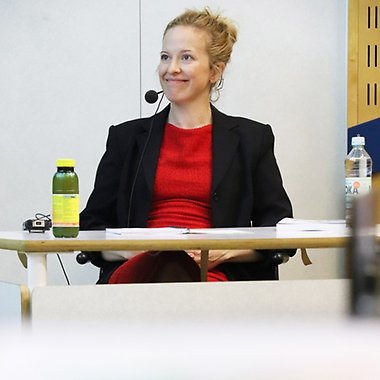
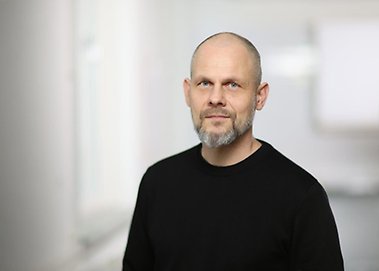
On 12 June 2025 at Stockholm University, Ossian Prane defended his doctoral thesis about how climate policy and international trade shape the green transition in the manufacturing sector.
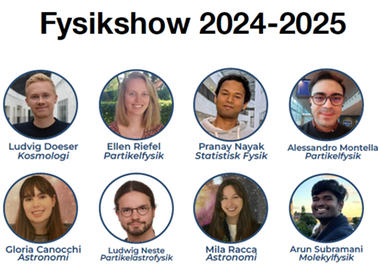
Are you curious about current physics? Then you and your class are warmly welcome to FysikShow organized by Fysikum at Stockholm University. FysikShow presents statistics for the number of classes they have arranged shows for during 2024 - 2025.
Income inequalities have a negative impact on everyone’s health, but they have a greater impact on the mortality risk of male descendants of immigrants compared to the majority population without a migration background in Sweden. These findings are presented in a new study by researchers at the Department of Public Health Sciences at Stockholm University.
From May 19-22, 2025 Nobel Symposium 198 “Chemistry for Sustainability: Fundamental Advances” was hosted by SUCCeSS Chemistry for sustainability is a strongly growing research field focusing on the transformative, dynamic and adaptive power of green chemistry and sustainable chemistry to progress towards the SDGs. The field drives future progress through developments within catalysis, resource efficient processes, alternate drivers for chemical transformations, use of green solvents, biobased chemicals and materials, toxicity /hazard screening, environmental foot print evaluation, system thinking, and data driven design at molecular scale. Leading researchers and emerging scholars from across the globe were invited to Stockholm to discuss the significant breakthroughs which have played a significant role advancing sustainability in the field of chemistry. Program: Chemistry for sustainability, fundamental advances (522 Kb) Satellite Events There were also several satellite events in connection to the Nobel symposium, to reach out to a diverse audiences including schools, academia, industries, policy makers and the general public. Green Chemistry for Sustainable Materials (May 19) Program: Reimagining Chemistry Building a Circular World (227 Kb) (May 22) The Future of Chemical Safety (May 23) Biomass for sustainability (May 23) Launch of The Stockholm Declaration on Chemistry for the Future (May 23) SUCCeSS Mingle @Accelerator (May 23) Stockholm Declaration on Chemistry for the Future
Stockholm University Center for Circular and Sustainable Systems − SuCCESS
How do industry-wide wage negotiations interact with firm-level wage setting? Why do firms rent workers from staffing agencies instead of hire them directly? How can raising a minimum wage actually lower wages in some cases? And what explains the unusual financial behavior of wealthy entrepreneurs? These are a few of the puzzles tackled in a newly published doctoral thesis by IIES graduate student Agneta Berge, who brings fresh theoretical tools to bear on how wages are set, how workers are hired, and how identity shapes economic behavior. The double-edged sword of collective bargaining In many countries, unions and firms bargain wages through a combination of industry-wide and firm-level negotiations. Agneta proposes a new framework for studying this two-tier wage bargaining system and finds that it can behave in surprising ways.
Researchers have identified a shipwreck off Porkkala in the Gulf of Finland as the warship Falken. The ship was built for King Gustav II Adolf and was later used under Queen Kristina. It played a central role in the Swedish navy – both in combat and for transporting high-ranking people.
Kerstin Hesselgren's guest professorship for 2027 is awarded to Jennifer Clapp from Waterloo University in Canada. She will be active at Stockholm University in 2027.
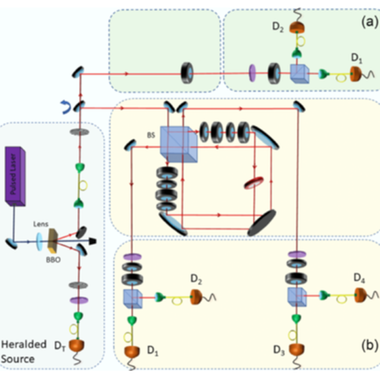
Researchers at the Department of Physics, Stockholm University and colleagues from other universities have developed and implemented a test that can reveal just that. Using entangled photons and a form of so-called non-locality inequalities (CHSH and CGLMP), they have shown that some experimental outcomes can only be explained by higher dimensional quantum systems. The higher the dimension of a quantum system, the more information it can carry - and the more powerful some quantum technologies can become. The result is an important step towards safe and reliable quantum technologies. It means we can build quantum devices where you don't have to rely blindly on the manufacturer or the technology, but where physics itself guarantees that quantum information is actually used.
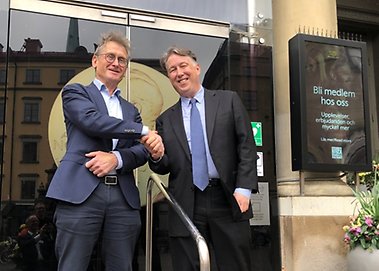
In a new paper published today in Environmental Science & Technology Letters, 22 scientists—including Professor Ian Cousins and Associate Professor Marlene Ågerstrand from the Department of Environmental Science—defend the current definition of PFASs established by the Organisation for Economic Co-operation and Development (OECD).
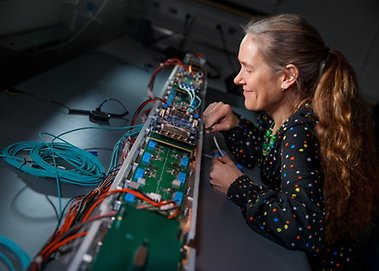
The discovery of the Higgs particle at the LHC particle accelerator in CERN in Switzerland sent waves of joy throughout the research community. Yet the evidence raised several new questions about the components of the universe. Sara Strandberg is preparing an upgrade of the accelerator to obtain more answers.
How do media narratives about brain research shape our understanding of the human psyche? This is the focus of an article by Robert Ohlsson, researcher at Stockholm University – and the first to be published in SU Dynamica, the university’s open access platform.
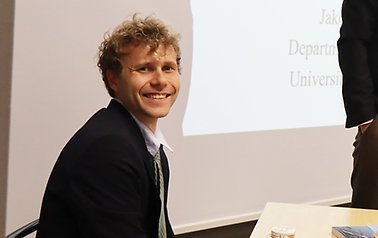
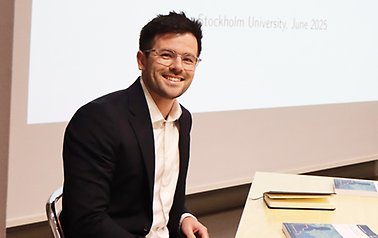
On 10 June 2025 at Stockholm University, Jakob Beuschlein successfully defended his doctoral thesis about personal debt relief and firms in the labor market.