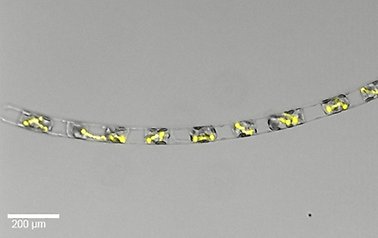
The microscopic alliance between algae and bacteria offers rare, step-by-step snapshots of how bacteria lose genes and adapt to increasing host dependence. This is shown by a new study led by researchers from Stockholm University, in collaboration with the Swedish University of Agricultural Sciences and Linnaeus University, published in Current Biology.
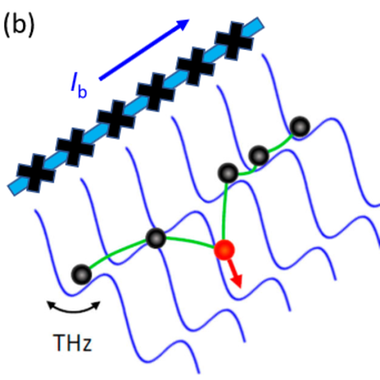
By using the domino effect of cascade multiplication, superconducting detectors can register even the faintest traces of radiation. While traditional photomultipliers work well for visible light, they fail at lower frequencies such as terahertz and microwaves. Superconductors overcome this limitation, opening new possibilities for quantum technology and for exploring the hidden signals of the universe. Professor Vladimir Krasnov and PhD Roger Cattaneo from Fysikum have worked together with Artemii E. Efimov, Kirill I. Shiianov and Oliver Kieler. The article was published recently in Nature Communications.
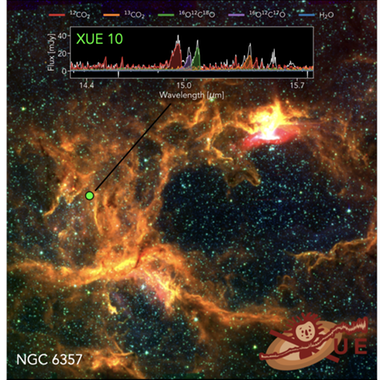
A study led by Jenny Frediani at Stockholm University has revealed a planet-forming disk with a strikingly unusual chemical composition: an unexpectedly high abundance of carbon dioxide (CO₂) in regions where Earth-like planets may one day form. The discovery, made using the James Webb Space Telescope (JWST), challenges long-standing assumptions about the chemistry of planetary birthplaces. The study is published in Astronomy & Astrophysics.
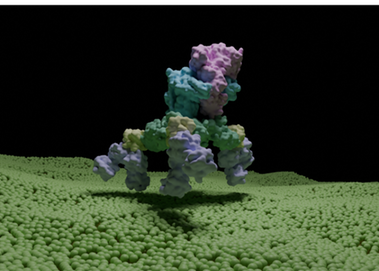
Researchers at Stockholm University have succeeded in creating a molecular blueprint of how one of the world's most dangerous toxins, botulinum toxin, is structured, stabilised, delivered and released. The research, published in the scientific journal Science Advances, paves the way for more effective drugs.
A new paper on the science-policy interface by climate experts Svante Bodin and Örjan Gustafsson at the Bolin Centre for Climate Research, Stockholm University, calls for urgent reform to the relationship between the Intergovernmental Panel on Climate Change (IPCC) and the United Nations Framework Convention on Climate Change (UNFCCC).
A new discovery about how sea spray forms on coastlines may change our understanding of the oceans’ impact on climate. In coastal areas, aerosol concentrations have been greatly underestimated — but globally, they may have been overestimated. The findings, from a study that included a researcher at Stockholm University, could also affect air quality in coastal cities. And it all began during a car journey on a windless day in the Azores. The small island of Graciosa in the Azores is home to one of the US Department of Energy's many atmospheric measurement stations. The continuous measurements taken at these stations form a large part of the basis for what we know today about climate change. They capture not only the effects of greenhouse gases but also the role of cloud-forming aerosols from land and sea. Matthew Salter, a researcher at Stockholm University, had been studying aerosols and their effects for a long time when he visited the Azores in the summer of 2022 to see how a research campaign led by his PhD students, together with American collaborators, was progressing. On a beautiful, almost windless summer's day, he and some colleagues drove across Graciosa to reach the observatory at its northernmost point. Although it was almost windless on the island, high waves were crashing against the coast and the air was filled with sea spray. “We drove through a dense mist of spray that was so thick we had to use the windscreen wipers. Yet it was such a calm day, with almost no wind,” explains Matthew Salter.
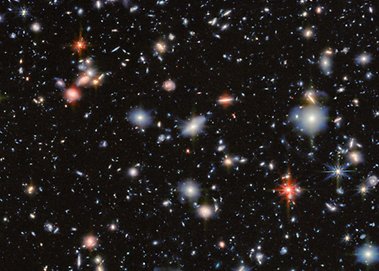
Images taken with the MIRI infrared camera on the James Webb Space Telescope (JWST) have made it possible to observe the first galaxies in long-wavelength infrared light for the first time. Alongside a recent study published in Astronomy and Astrophysics, these images provide new insights into how the first galaxies formed over 13 billion years ago.
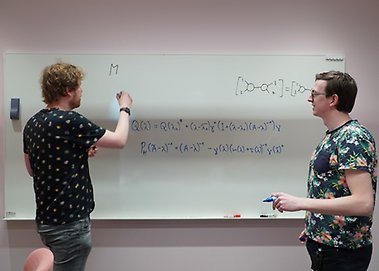
- It’s a justified question, but we hear it a lot, says Jakob Reiffenstein about frequently being asked ”how is your research applicable?”. – Basic research is important, even if you can’t point to a particular real-world application, his colleague Thomas Wennink adds.
Laura Montenbruck, Assistant Professor in Economics at Stockholm University, has been awarded the prestigious IIPF Young Economists Award. She is recognized for her study on how citizens’ willingness to pay taxes can be strengthened when they more clearly see the connection between tax revenues and public services.
The article “Rational homotopy theory of automorphism of manifolds”, authored by Alexander Berglund and Ib Madsen, has been awarded a Frontiers of Science Award. The award was presented at the International Congress of Basic Science in Beijing in July, a congress that brings together participants from all over the world. The Frontiers of Science Award was established in 2023 and is awarded to scientific works in mathematics, theoretical physics, and theoretical computer science that represent significant advances in their respective fields. Alexander Berglund is a professor of mathematics at Stockholm University. Ib Madsen is a professor emeritus of mathematics at the University of Copenhagen and a foreign member of the Royal Swedish Academy of Sciences. The article was published in Acta Mathematica 2020 and received a prize in the field of Algebraic and Geometric Topology. List of Frontiers of Science Awards in mathematics 2025.
“Extremely cold! But also very green and beautiful. There's a lot of forest everywhere”, Manuel Castellano responded when asked about his first impression of Sweden. The Spanish exchange student was one of around 400 international students welcomed during Stockholm University’s Arrival Service Weekend 23-24 August. With a temperature of around fifteen degrees Celsius, the sun peaking through the clouds every now and then and a gentle wind rustling the trees, most Swedes would probably describe the weekend weather as fairly normal for late August.
CATS Network Paper No. 26 by Paul T. Levin and Minna Ålander "This paper is part of a CATS Network Papers series exploring the role of Turkey in a future European security order, particularly in light of the EU’s ongoing challenges, first and foremost the war in Ukraine. As part of this series, CATS has commissioned nine country reports on several EU member states, as well as on Ukraine and Turkey, with the aim of identifying both the opportunities and the challenges for enhanced cooperation between Turkey and the EU within an evolving security order." Read the full paper here