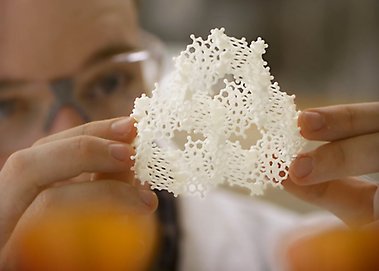
This year's Nobel Prize in Chemistry is about metal-organic frameworks, a molecular architecture that can be used in many different areas. Research on these frameworks in the field of sustainable chemistry has been ongoing at Stockholm University for many years.
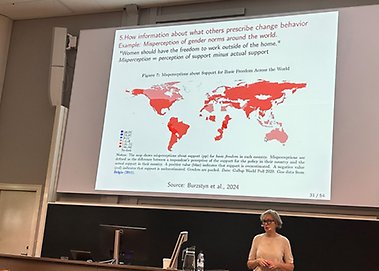
Marianne Bertrand, Professor of Economics at the University of Chicago Booth School of Business, held a lecture at Stockholm University last week, in front of an audience of around 200 people including researchers and students, among others.
Imagine a foggy evening in the docklands of Victorian London, illuminated by the then-modern gas lighting. Apart from the shady pubs and brothels, most of the town’s opium dens could be found here. Naturally, this and other aspects of the Victorian era decadence caught the attention of Charles Dickens.
Summer's much-maligned cyanobacterial blooms may not be all bad after all. New research shows that these summer blooms can be crucial for juvenile herring – without the blooms, they would have less opportunity to grow.
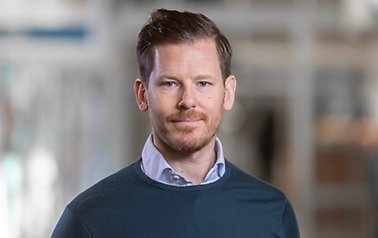
How can the Nordic countries meet the challenge of future elder care as populations age and the workforce shrinks? That is the central question in a new research project, with David Seim, Professor of Economics at Stockholm University, leading the Swedish part of the study.
With support from organizations such as Formas and Vinnova, Stockholm University alumna Helena Isolde Sundsgård is building a global platform to strengthen genetic variation among both wild and domestic animals. The venture is backed by scientific expertise from Professor Linda Laikre at Stockholm University. The goal: to safeguard the genetic future of animals and build a world-leading tech company with genuine societal impact.
The challenges of our time are unprecedented, but what about the solutions? What if solutions are already there – within our reach – if we could just see them?
Jonas Vlachos, Professor of Economics at Stockholm University, is one of ten researchers newly appointed to the Swedish National Agency for Education’s scientific council.
Ulrike Schimpf, researcher and Head of technical operations at the Department of Chemistry, studies cervical mucus in order to better understand infertility issues and improve women’s health. With the help of research infrastructure located at the Arrhenius laboratory, she is hoping to develop new ways of treating infertility.
Five of the seven planetary boundaries that have been exceeded can primarily be linked to today's food systems. By switching production and eating a "planetary health diet", we can halve food's climate emissions, save millions of lives and strengthen the economy. This is shown by the EAT Lancet Commission 2025, the largest research report of its kind ever published. On October 3, the new EAT-Lancet commission´s report Healthy, Sustainable, and Just Food Systems will be published in the leading medical journal The Lancet. The Commission's report has been produced by an international team of researchers in areas such as nutrition, climate, health, economics and agriculture. Several researchers from the Stockholm Resilience Centre (SRC) at Stockholm University have contributed to the commission and played a central role in the work. Updated based on the latest research
Why are female-managed farms less productive than male-managed ones in Uganda? Can a mobile credit-and-savings account transform small businesses in Tanzania? How do young people decide which careers to pursue? And what explains persistent homophobia in parts of Sub-Saharan Africa? These are some of the big questions tackled by IIES graduate student, Iacopo Bianchi, in his doctoral thesis "Productivity, Career Choice, and Colonial Legacies: Essays in Development Economics". Across four papers, Iacopo combines experiments, surveys and historical analysis to uncover hidden forces that shape development outcomes today. Gendered frictions in Ugandan agriculture