


“A versatile technology that contributes to solutions to today's greatest challenges”
This year's Nobel Prize in Chemistry is about metal-organic frameworks, a molecular architecture that can be used in many different areas. Research on these frameworks in the field of sustainable chemistry has been ongoing at Stockholm University for many years.
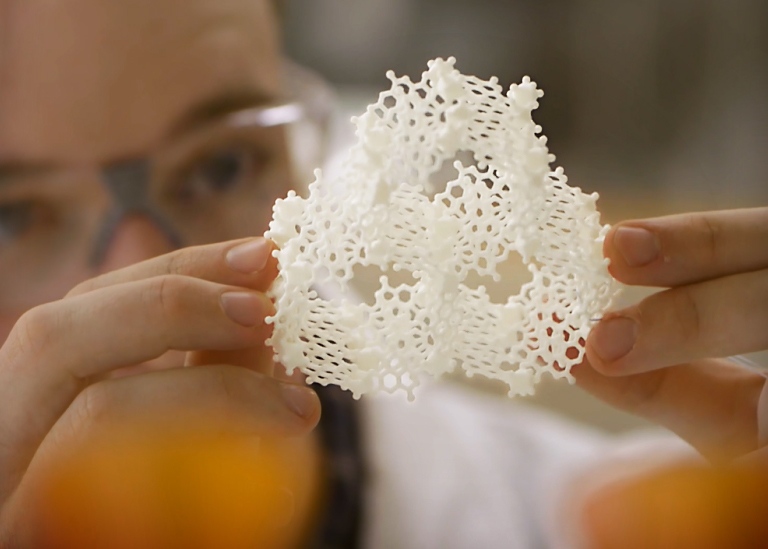
Model of a metal-organic framework that, like a sponge, can capture drug residues from water. Photo: Stockholm University
“It is an incredibly well-deserved prize that recognizes a new, versatile, and predictable way of building porous materials,” says Tom Willhammar, associate professor of inorganic chemistry at Stockholm University.
Together with his colleague Ken Inge and both of their research groups, he is investigating how new metal-organic frameworks (MOFs) can form new structures that contribute to potential solutions to some of today's greatest challenges.
What is this technology useful for?
“We can tailor a porous material with atomic precision. This enables control over its properties in a wide range of applications, such as the capture, storage, and degradation of chemical substances, for example, gases or water pollutants. In addition, the precise arrangement creates an opportunity to study its atomic structure using diffraction and electron microscopy, helping us understand how its properties arise.”
How does it fit into your field?
“In our research, we create new metal-organic frameworks (MOFs) by combining naturally occurring organic molecules with metal ions. This allows us to create materials that can capture drug residues. We utilize both the specific dimensions of the pores and their chemical properties to selectively capture molecules.”
Watch a film about the research
Read more
About the Nobel Prize in chemistry 2025
Articles about current research within the field
New way to purify water from pharmaceutical pollutants
Structure of the natural red pigment carmine revealed
Are you interested in studying material chemistry
Last updated: 2025-10-08
Source: Communications Office