Bergius Botanic Garden – a botanical oasis in the city
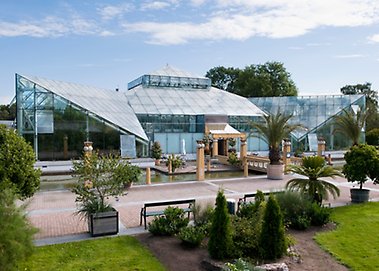
Bergius Botanic Garden, Stockholm’s only botanical garden, is located at Brunnsviken, just a few kilometres from Stockholm’s city centre. “In one day, you can go from the tropics to the mountains,” says Lars Gunnar Reinhammar, curator at Bergius Botanic Garden. Visiting the Bergius Botanic Garden is like stepping into another world. From the pine tree on the Italian terrace, which has stood for centuries, to the charming pavilion with its unique tree formations. At the intersection of history, science, and nature, there is something for everyone here. A botanical garden is a living museum In the Bergius Botanic Garden, living plants from all over the world coexist with a common purpose: to spread knowledge and contribute to scientific studies, education, and conservation. Unlike ordinary parks, where plants are mainly planted for their aesthetic value, a botanical garden has a scientific basis. The plant collections must be managed for the long term, carefully documented, and accessible for research, teaching, and the general public. “A botanical garden is more than just a beautiful park, it must meet specific criteria,” says Gunvor Larsson, director of the Bergius Botanic Garden. The plants are arranged thematically, for example, according to family or geographical origin, and each species is labelled with its scientific name, often also its Swedish name, as well as information about its natural origin. Many of the plants are of wild origin, with collection data - information about where and when they were collected, which is valuable to researchers and students. The garden participates in a global network of botanical gardens – BGCI, Botanical Gardens Conservation International – which exchanges knowledge and plant material through, for example, seed exchanges. The organization also manages a database where many botanical gardens register their plant material, which makes it easier for researchers to access plants. Like many other botanical gardens, Bergius Botanic Garden also has sections displaying ornamental and useful plants, such as dahlias, fruits, and berries. “Researchers use Bergius Botanic Garden to access plant material, conduct cultivation experiments, and collect insects,” says Lars Gunnar Reinhammar. The garden also conducts teaching at different levels. Pupils from primary and secondary school classes via Naturens hus to university students come here, and Bergius Botanic Garden is also a resource for various horticultural courses. For the general public, the garden offers guided tours, theme days, and exhibitions, and the staff answer questions about plants on a daily basis. “A botanical garden is never static! We are constantly being used and developed,” says Gunvor Larsson. From a kitchen garden to a botanical knowledge bank The history of the Bergius Botanic Garden dates back to the 18th century, when the two brothers Bengt and Peter Jonas Bergius founded a garden on Karlbergsvägen in what is now Vasastaden. There, on the Bergielund estate, they created an extensive garden filled with fruit trees, berry bushes, and medicinal plants – no fewer than 700 apple trees and 1,000 gooseberry bushes were cultivated. “You could say that Bergielund was like a private scientific institution, with a well-stocked library and a large herbarium. Peter Jonas Bergius, who was a doctor and disciple of Carl von Linné, wanted to combine practice and science,” says Gunvor Larsson. The Bergius brothers donated their entire estate to the Royal Swedish Academy of Sciences, which formed the Bergius Foundation in 1791. Since 2025, Stockholm University runs the garden. As Stockholm grew the Bergius Foundation moved to its current location at Brunnsviken in Frescati in the late 1880s. The director at the time, Professor Veit Wittrock, had a strong influence on the new area and created the botanical garden as we know it today. “Much of the garden is based on Wittrock’s great commitment and ideas. He had walkways and caves blasted out, ponds built, buildings erected, and impressive rockeries created to represent a number of mountain ranges. North American, Scandinavian, and Asian,” says Gunvor Larsson. Today, the university manages this cultural heritage, which has continued to develop throughout the 20th and 21st centuries. Important additions have been the orangery (1926), the department building (1936), the modern Edvard Anderson Conservatory, which was completed in 1995, and the wetland in 2009. The historical collections include the Bergius brothers’ book collection, which today is integrated into the University library’s rarity collection.